
Introduction
In aerospace, medical device manufacturing, and precision machining environments, heavy-duty drill machines directly determine part quality, production throughput, and compliance with tight tolerances. A poorly chosen drill press can introduce chatter, compromise hole cylindricity, and accelerate carbide tool wear—issues that cascade into rework, scrap, and line stoppages costing $10,000 to $500,000 per hour in heavy fabrication and aerospace facilities.
The heavy-duty drill machine market has evolved significantly in 2026. Advances in spindle precision, variable speed control, and CNC integration have transformed machine selection from a commodity purchase into a critical operational decision.
According to the Association For Manufacturing Technology, U.S. manufacturing technology orders hit a record $814.3 million in December 2025, with aerospace orders surging 45.1% year-over-year. Demand for precision drilling equipment is accelerating alongside that growth.
This guide profiles five of the best heavy-duty drill machines of 2026—evaluated across technical capability, application fit, build quality, and support—so you can match the right machine to your workpiece geometry, production volume, and accuracy requirements.
TLDR
- Heavy-duty drill machines include radial arm drills, floor drill presses, magnetic drills, and CNC drilling/tapping centers
- Key selection criteria: spindle power (HP/kW), speed range (RPM), drilling capacity, work table size, and tolerance capability
- CNC drilling/tapping centers excel in high-mix, low-volume precision work; radial arm drills handle large structural workpieces
- KENT and Clausing are established industrial brands with U.S. dealer support — T.R. Wigglesworth Machinery Co. carries both
- Magnetic drills from brands like Fein are the practical choice for field work where fixed machines can't reach
What Qualifies as a Heavy-Duty Drill Machine?
In industrial contexts, "heavy-duty drill machine" describes equipment designed for continuous-duty cycles, capable of drilling large-diameter holes—typically 1 inch (25.4mm) and above—in ferrous metals, composites, and hardened materials. These machines are built differently than cordless drills or benchtop drill presses used in light trade or DIY applications.
There is no formal ANSI or ISO numeric threshold for "heavy-duty" drilling performance. ANSI B11.8-2021 covers safety and safeguarding only — not duty classification. Instead, the industry relies on de facto standards:
- Minimum 1-inch drilling capacity in mild steel
- MT4 or larger spindle tapers
- Multi-horsepower motors
- Cast-iron construction with large column diameters to dampen vibration
Main Machine Types Covered in This Guide
- Radial arm drill presses: For large or irregular workpieces that cannot be repositioned under a fixed column
- Floor-standing industrial drill presses: For production drilling with vertical spindle travel
- CNC drilling and tapping centers: For precision, repeatability, and automated tool changes
- Magnetic drilling machines: For structural steel and on-site work where fixed machines are impractical

The right machine type depends on workpiece size, material, production volume, and positional accuracy requirements. Below, we profile five top-performing machines of 2026, selected for their industrial track record, specifications, and fit across aerospace, medical device manufacturing, mold machining, and heavy fabrication.
Best Heavy Duty Drill Machines of 2026
These machines were evaluated for spindle power, drilling capacity, construction rigidity, speed range versatility, and suitability for industries including aerospace, medical device manufacturing, mold machining, and heavy fabrication.
KENT Industrial Radial Drilling Machine
KENT International USA manufactures precision machine tools with a global installed base in heavy manufacturing and precision machining environments. KENT radial drilling machines are available in the U.S. through authorized dealers including T.R. Wigglesworth Machinery Co.
Radial arm geometry allows the spindle head to traverse along an adjustable arm — making these machines ideal when workpieces are too large or irregularly shaped to reposition under a fixed-column drill. KENT machines feature high-class cast iron processed under severe heat treatment, hardened and ground steel gears, and double-walled columns for maximum rigidity.
The KENT TRD-Series scales linearly in power and reach, from the 48-inch arm TRD-1230H to the massive 102-inch arm TRD-C2500.
| Specification | Value |
|---|---|
| Max Drilling Capacity in Steel | 1.65" to 3.15" (42mm to 80mm) depending on model |
| Spindle Speed Range | 44-1500 RPM (12 steps) on TRD-1230H; 16-1250 RPM (16 steps) on TRD-C2500 |
| Motor Power | 3 HP (TRD-1230H) to 10 HP (TRD-C2500) |
The TRD-C2500 uses an MT6 spindle taper and delivers 10 HP through 16 speed steps — suited for the heaviest fabrication tasks where 3.15-inch holes must be driven into thick steel plate.
DAH LIH CNC Drilling and Tapping Center
DAH LIH Machinery Industrial Co., Ltd., founded in 1960 and based in Taiwan, is a precision machine tool builder with a strong reputation in CNC drilling, tapping, and milling applications. DAH LIH machines are available through authorized U.S. dealers including T.R. Wigglesworth Machinery Co., serving manufacturers in aerospace, medical, and mold machining sectors.
Why choose a CNC drilling and tapping center over a manual drill press? Repeatability. In high-mix, low-volume production where the same hole pattern must be drilled across multiple parts with tight positional tolerances, a CNC center eliminates operator variance.
DAH LIH's DCM series uses Meehanite cast iron construction and roller linear guideways for heavy cutting stability, with 0.001mm input increment positioning accuracy.
The DCM series integrates 15,000 RPM built-in spindles and up to 60-tool automatic tool changers (ATC), enabling rapid transitions between drilling, tapping, reaming, and spot-facing operations without manual intervention.
| Specification | Value |
|---|---|
| Spindle Speed Range | 60-6,000 RPM standard; optional 10,000 or 15,000 RPM (DCM-2213) |
| Positioning Accuracy | 0.001mm input increment |
| Control System | FANUC 0i or 31i (depending on model) |

The 15,000 RPM spindle option makes the DCM series well-matched to aerospace drilling in aluminum and titanium alloys, where high surface feet per minute (SFM) is critical to avoid work hardening.
Fein KBM Series Magnetic Drilling Machine
Fein, a German manufacturer known for professional-grade magnetic drilling machines, invented the electromagnetic drill and manufactures its power tools in Germany. The KBM series is widely used in structural steel fabrication, shipbuilding, and heavy industrial maintenance.
Magnetic drills deliver high torque for annular cutter drilling in thick steel plate without requiring a fixed machine setup. They use an electromagnetic base to adhere to ferrous workpieces, enabling on-site drilling of large structural members that cannot be moved to a drill press.
The KBM series scales from the compact KBM 32 Q (9,000 N holding force) to the industrial KBM 80 U (18,000 N holding force). Safety features include magnetic holding force displays, personal safety switches, torque slipping clutches, and lashing straps to prevent falls if magnetic contact is lost.
| Specification | Value |
|---|---|
| Max Drilling Diameter (Annular Cutter) | 32mm (KBM 32 Q) to 80mm (KBM 80 U) |
| Magnetic Holding Force | 9,000 N (KBM 32 Q) to 18,000 N (KBM 80 U) |
| Motor Power | 700W input / 450W output (KBM 32 Q) to 2,000W input / 900W output (KBM 80 U) |
The KBM 80 U's torque slipping clutch prevents motor stalling or magnet dislodgement when driving 80mm cutters through structural steel — an essential feature for operator safety and tool protection.
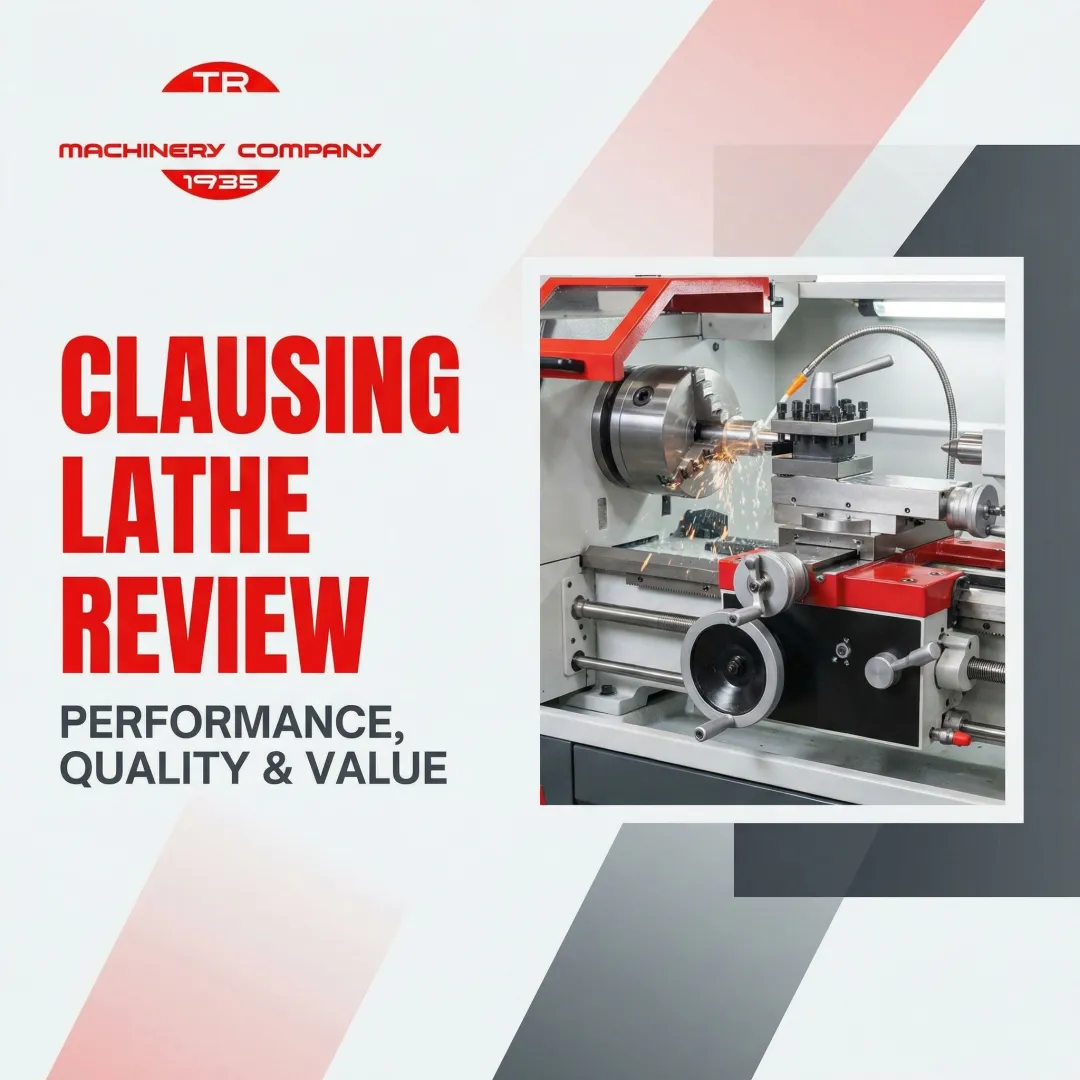
Clausing Industrial Radial Drill Press
Clausing is a long-established American industrial machine tool brand, widely specified in precision manufacturing, toolroom, and job shop environments for its heavy-duty construction and operator-friendly design. U.S. industrial facilities have long specified Clausing radial drills as a benchmark, and T.R. Wigglesworth Machinery Co. has represented the brand for over 40 years.
Clausing differentiates on domestic manufacturing history, an extensive U.S. service network, and design features built for longevity: hardened and ground steel gears, double-walled columns, large bearing surfaces for smooth arm rotation, and power spindle feeds with efficient coolant systems. Clausing radial drills support drilling, reaming, boring, and tapping operations, with models designated "RS" including automatic tapping with spindle reversal at limit stops.
The Clausing lineup ranges from the compact CL1100 (43.3-inch arm reach) to the heavy CLC2500 (98.4-inch arm reach).
| Specification | Value |
|---|---|
| Arm Reach / Swing | 43.3" (CL1100) to 98.4" (CLC2500) |
| Spindle Taper | 4MT (CL1100) to 6MT (CLC2500) |
| Max Drilling Capacity | 1.65" in steel (CL1100) to 3.15" in steel (CLC2500) |

Every Clausing machine is backed by an independently operated Clausing Service Center maintaining over 80,000 parts, with 95% of orders shipped within 24 hours and qualified technicians available for phone and on-site support.
Baileigh Industrial Floor Drill Press
Baileigh Industrial is a U.S.-based supplier of heavy-duty machine tools popular with fabricators, toolrooms, and production shops. Their floor-standing drill presses are known for robust cast-iron construction and variable-speed capability suited to a range of production drilling applications.
The DP-2012F-HD-V2 uses a 2 HP motor and geared head drive to maintain torque across 12 speed steps, achieving 1.25-inch drilling capacity in mild steel. The variable-speed DP-15VSF model offers electronic speed control from 400-5,000 RPM, ideal for shops that drill a wide range of materials.
Baileigh drill presses feature large cast-iron work tables (up to 18.5 inches) with tilting capability, making them versatile for angled drilling operations.
| Specification | Value |
|---|---|
| Spindle Travel | 4.75" (DP-2012F-HD-V2) to 6.0" (DP-15VSF) |
| Speed Range | 220-3200 RPM (12-speed step) or 400-5000 RPM (variable electronic) |
| Table Size | 14.0" x 18.0" (DP-15VSF) to 16.54" x 18.50" (DP-2012F-HD-V2) |
The Baileigh floor drill press is the practical choice for production shops that need fixed-column, heavy-duty drilling with broad speed range flexibility at a price point below radial arm drills or CNC centers.
Key Features to Evaluate When Choosing a Heavy-Duty Drill Machine
Drilling Capacity and Spindle Power
Drilling capacity—typically expressed as maximum diameter in mild steel—tells you the machine's ceiling for production use. Motor horsepower determines sustained torque under load.
A standard engineering rule of thumb: approximately 1 horsepower removes 1 cubic inch of mild steel per minute. Undersized machines create heat, chatter, and accelerated wear when pushed near their rated limits. Oversizing for your average workload is best practice in industrial settings.
Before selecting a machine, calculate your maximum required material removal rate (MRR) based on hole diameter and feed rate to ensure the spindle motor will not stall under load.
Spindle Speed Range and Variable Speed Control
Different materials demand different surface feet per minute (SFM):
- Aluminum: 230-980 SFM (high speeds required; prone to built-up edge)
- Titanium (Ti-6Al-4V): 150-260 SFM (low thermal conductivity traps heat; requires high torque and low speed)
- Hardened steel (55-60 HRC): 65-230 SFM (extreme cutting resistance; requires highly rigid setups)

A machine with a broad RPM range and smooth variable speed control reduces the need for secondary setups. CNC drilling centers offer the widest flexibility through programmed speed changes per operation.
Column/Arm Rigidity and Machine Weight
A heavier, more rigid machine structure dampens vibration during high-torque drilling, directly affecting hole quality and tool life. This is especially critical in aerospace and medical device applications where dimensional tolerances are tight.
Evaluate rigidity from published specs:
- Cast iron vs. fabricated steel construction (cast iron preferred)
- Column diameter (larger = stiffer)
- Base footprint (wider = more stable)
Insufficient rigidity causes the frame to deform slightly under cutting forces, directly affecting dimensional and shape accuracy. Vibration ruins surface finish and drastically shortens carbide tool life.
After-Sale Support Factors
For industrial machines, downtime costs far exceed purchase price differences. Industrial machine downtime costs range from $10,000 to $500,000 per hour in heavy fabrication and aerospace environments.
Evaluate before purchase:
- Parts availability and lead times
- Service network coverage (local vs. regional vs. national)
- Installation support and rigging services
- Operator training programs
- Technical support (phone and on-site)
Full-service providers offering delivery, installation, and operator training—such as T.R. Wigglesworth Machinery Co.—reduce total cost of ownership compared to purchasing from distributors with limited support capability.
How We Chose the Best Heavy Duty Drill Machines of 2026
These machines were assessed based on published technical specifications, brand track record in verified industrial applications (aerospace, heavy fabrication, precision machining), U.S. market availability, and breadth of after-sale support.
Common mistakes buyers make:
- Selecting based on price alone without calculating total cost of ownership
- Ignoring spindle taper compatibility with existing tooling
- Underestimating the importance of local service coverage
- Failing to calculate required material removal rate (MRR) before sizing motor HP
Avoiding these mistakes narrows the field considerably. That's why this list covers different machine types — radial drill, CNC center, magnetic drill, and floor drill press — because "heavy-duty" describes a performance tier, not a single category.
The right choice depends on your specific situation:
- Workpiece geometry: size, weight, and fixturing constraints
- Production volume: one-off jobs vs. high-cycle repeat operations
- Positional accuracy requirements: tolerance stack-up in multi-hole patterns
- Deployment: fixed-station shop floor vs. field-based or structural work
Conclusion
Selecting the right heavy-duty drill machine in 2026 means matching machine type and capacity to your specific application demands. A radial arm drill, a CNC drilling center, and a magnetic drill each excel in different scenarios—no single model is the universal best choice.
Buyers who prioritize sustained throughput and tight tolerances should resist choosing purely on price. Evaluate total capability against your production profile instead:
- Drilling capacity and spindle power
- Speed range and machine rigidity
- Support infrastructure over a 10–15 year service life
Service availability, parts lead times, installation expertise, and operator training all shape long-term ROI — often more than the machine's spec sheet does.
For buyers in the U.S. seeking industrial drill machines from trusted brands including KENT and Clausing, T.R. Wigglesworth Machinery Co. has been a full-service machine tool provider since 1935—offering new and used equipment, delivery, installation, and training to help operations get productive fast.
Frequently Asked Questions
Which brand drill machine is best?
For precision CNC drilling, DAH LIH and KENT are well-regarded in manufacturing; for magnetic drilling on structural steel, Fein is the industry benchmark. For general production floor use, Clausing and Baileigh are proven options with strong U.S. support networks. The right brand ultimately depends on your application and required capacity.
What drill is best for professional use?
For professional industrial use, the machine type matters as much as the brand. A radial arm drill is best for large or irregular workpieces, a CNC drilling and tapping center is ideal for high-repeatability production, and a magnetic drill is the professional choice for on-site structural steel work.
What is the difference between a drill press and a radial arm drill?
A floor drill press has a fixed column with vertical spindle travel and requires the workpiece to be repositioned under the spindle. A radial arm drill allows the spindle head to traverse along an arm and the arm to rotate around a column—making it far more practical for large, heavy, or awkwardly shaped workpieces that cannot be easily moved.
What's the most powerful cordless drill?
Milwaukee (M18 Fuel), Flex (24V), and DeWalt (20V XR) lead in torque for trade use. For sustained industrial drilling into steel or large-diameter holes, a corded drill press will always outperform any cordless option on both power and duty cycle.
How much horsepower does a heavy-duty industrial drill machine need?
Radial arm drills for production steel work typically run 2–5+ HP; heavy-duty floor drill presses commonly range 1.5–3 HP; magnetic drills for structural steel run 1,200–2,000 watts. Required power scales with hole diameter and material hardness—the 1 HP per cubic inch per minute rule of thumb is a reliable starting point for motor sizing.
What should I look for when buying an industrial drill machine?
Start by matching drilling capacity and spindle power to your heaviest anticipated job. Then verify spindle taper compatibility with existing tooling and confirm the speed range covers your material types. Factor in the supplier's ability to provide installation, training, and parts support—not just the purchase price.