
Introduction
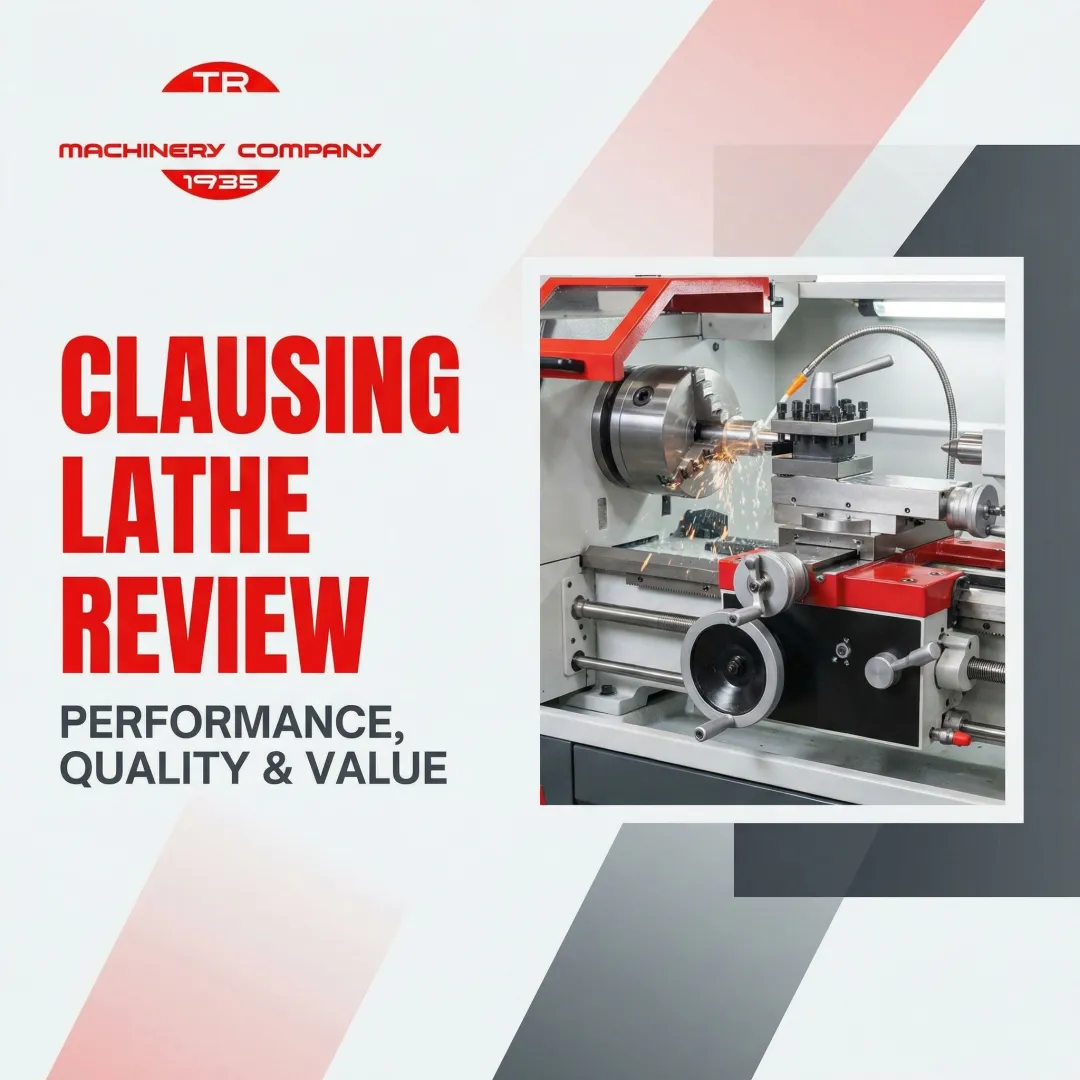
The Clausing 6900 Series is a precision-built, 14-inch swing lathe introduced around 1968 — and it shows its toolroom DNA in every detail. Its squarer, modernized profile marked a clear departure from Clausing's earlier designs.
That evolution brought genuine upgrades: a forged chrome-steel spindle, Timken taper-roller bearings, and a hydraulic speed-selection system that set it apart from comparable machines of the era. It became a go-to for toolroom work, precision manufacturing, and light industrial production.
This guide covers full technical specifications, headstock and variable-speed drive systems, screwcutting gearbox and feed controls, collet and tooling options, and what to inspect when evaluating a used machine.
TLDR:
- Swing capacity: 14 inches over bed (largest model in the 6900 lineup)
- Spindle bore: 1-3/8 inches on a forged chrome-steel spindle
- Variable-speed range: 52–2000 rpm direct drive; 26–280 rpm in backgear
- Defining feature: Hydraulic speed-selection dial on headstock for fast, seamless speed changes
What Is the Clausing 6900 Series Lathe?
The Clausing 6900 Series represents the late-model evolution of Clausing's precision engine lathe lineup, succeeding the earlier 6300 (200 Series) machines. Introduced around 1968, the 6900 Series brought a distinctly squarer, more modern aesthetic and significant engineering improvements over its rounded-casting predecessors.
Applications
Designed for precision manufacturing, toolroom operations, and light industrial production, the 6900 Series found a home across a range of demanding environments. Common applications include:
- Aerospace component machining
- Medical device manufacturing
- Mold and die work
- Educational and training shops
- Light industrial production runs
Model Lineup
Clausing offered the 6900 Series in three swing sizes:
- 10-inch swing (open-base gearbox)
- 12-inch swing (open-base gearbox)
- 14-inch swing (sealed oil-bath gearbox, the most fully featured model)
The 14-inch model's sealed screwcutting gearbox and oil-bath lubrication throughout the headstock and apron translate directly to longer service life and reduced maintenance intervals — a meaningful advantage in production environments.
Clausing 6900 Series: Full Technical Specifications
| Specification | 14-Inch Model |
|---|---|
| Swing Over Bed | 14 inches |
| Spindle Bore | 1-3/8 inches |
| Spindle Nose | L-00 taper, key-locked |
| Spindle Bearings | Timken precision taper-roller |
| Tailstock Taper | Morse Taper #3 (MT3) |
| Motor Rating | 3 HP, 3-phase |
| Bed Construction | Flame-hardened, ground-finished with elliptical swarf-clearance holes |
Bed Construction
The bed features flame-hardened, ground-finished surfaces for long-term accuracy and wear resistance. Elliptically shaped, rearward-draining swarf-clearance holes improve chip management and maintain rigidity under heavy cuts. Bed lengths varied by configuration, accommodating different distances between centers.
Spindle Design
The spindle is machined from forged chrome-steel and hardened at the nose for extended chuck mount life. Running on Timken precision taper-roller bearings, it maintains minimal runout across both interrupted cuts and continuous production runs — making it equally suited to job shop and repetitive-cycle work.
Tailstock
The tailstock uses a Morse Taper #3 ram, compatible with standard tooling and live centers. Its robust clamping mechanism ensures rigidity during drilling, reaming, and taper-turning operations.
Headstock, Spindle, and Variable-Speed Drive System
Variable-Speed Hydraulic Drive
The hydraulic variable-speed drive system is the defining feature of the 6900 Series. Unlike earlier belt-countershaft designs, the 6900's speed control is managed by a conveniently positioned dial on top of the headstock. This delivers seamless, stepless speed adjustment across two ranges:
| Drive Mode | Speed Range (RPM) |
|---|---|
| Direct Drive | 52 to 2000 rpm |
| Backgear | 26 to 280 rpm |
Speed adjustment benefits during operation:
- Fast job changeovers without stopping the machine
- Infinite speed adjustment within each range
- Reduced downtime during setup

The hydraulic system requires clean oil and periodic inspection. On older machines, watch for two common failure modes:
- Degraded variable-speed belts (missing teeth or separation)
- Air trapped in the hydraulic circuit, which causes the speed dial to lose its setting
High/Low 2-Speed Motor Variant
Clausing also offered a High/Low model using a 2-speed motor instead of the hydraulic system. This variant provided four fixed speed ranges:
| Drive Mode | Low Motor Speed | High Motor Speed |
|---|---|---|
| Backgear | 21–115 rpm | 43–230 rpm |
| Direct Drive | 150–825 rpm | 300–1650 rpm |
This version is simpler mechanically — it eliminates the hydraulic system entirely, making it a better fit for shops that prioritize reliability and ease of service over infinite speed variability.
Headstock Construction
The headstock is a fully enclosed unit where the spindle, bearings, and driving gears operate in a pumped oil bath. Key construction details:
- Oil bath lubrication ensures consistent bearing coverage, reduced noise, and extended service life
- Forged chrome-steel spindle runs on Timken precision taper-roller bearings for rigidity and minimal deflection under load
- Backgear engagement is robust and accessible, supporting heavy interrupted cuts and extended operating cycles
Screwcutting Gearbox and Power Feed Controls
Sealed Oil-Bath Gearbox (14-Inch Model)
The 14-inch 6900 Series features a completely sealed, oil-bath lubricated screwcutting gearbox—an upgrade over the open-base designs used on the 10-inch and 12-inch models. This sealed assembly uses dial and lever controls for selecting thread pitches and feed rates.
Key features of the gearbox include:
- Ratio selection knob protrudes from the headstock-end guard, toggling between fine feed and screwcutting ratios to reduce setup errors
- Sealed, oil-bath construction prevents contamination, extends gearbox life, and keeps operation smooth and quiet
Apron-Mounted Power Feed Controls
The apron's centrally located lever handles all power feed engagement through simple directional movement:
- Upward movement: Engages power sliding (longitudinal feed)
- Downward movement: Engages power surfacing (cross-feed)
- Spring-loaded central detent: Safety position prevents accidental feed engagement
Backing these controls is a leadscrew tensioned between taper-roller bearings, which eliminates longitudinal play. The result is immediate response to feed inputs and tighter threading accuracy across all pitches.
Collet Systems and Tooling Options
Spring-Collet Assembly
Clausing offered a simple spring-collet system operable by hand or lever-type draw tube. This system accepts standard 5C collets ranging from 1/64 inch to 1-1/16 inches.
It's a practical choice for standard toolroom operations, shops with existing 5C collet inventories, and setups that require quick part changes.
Burnerd Multisize Collet System
The English Burnerd Multisize collet set offers 1/16-inch to 1-inch capacity, with each collet spanning a 1/8-inch gripping range. This design accepts both imperial and metric stock sizes without requiring duplicate collet sets.
Key advantages include:
- Reduces collet inventory requirements
- Handles both imperial and metric stock without duplicate sets
- Well-suited for shops working across mixed material standards
Additional Tooling and Accessories
| Accessory Type | Options |
|---|---|
| Chucks | Burnerd 3-Jaw Universal, 6-Jaw Griptru, 4-Jaw Independent |
| Work Support | Steady Rest (4-1/2" capacity), Follower Rest (4-1/4" capacity) |
| Taper Attachment | Telescopic Taper Attachment (factory option) |
Each of these accessories integrates directly with the lathe — chucks mount to the L-00 spindle nose, steady rests and follower rests were offered as factory accessories, and taper attachments were a factory-install option.
Buying and Owning a Clausing 6900 Series Lathe
Clausing 6900 vs. Earlier Models: What Changed?
The 6900 Series brought significant improvements over the earlier 6300 (200 Series) lathes:
| Feature | 6300 Series | 6900 Series |
|---|---|---|
| Drive System | 4-step V-belt countershaft | Hydraulic variable-speed dial |
| Gearbox | Open base on most models | Sealed oil-bath (14-inch model) |
| Frame Design | Rounded castings | Squarer modern profile |
| Apron Controls | Basic lever arrangement | Upgraded spring-loaded detent system |

Most Meaningful Upgrades:
- Hydraulic variable-speed drive for faster job changeovers
- Sealed gearbox on 14-inch model for longer service life
- Improved apron controls with safety detent
What to Inspect When Buying a Used Clausing 6900
Critical Inspection Points:
Spindle bearings and runout:
- Check for radial play by pushing/pulling the chuck
- Measure spindle runout at the taper using a dial indicator
- Listen for grinding or rough rotation
Hydraulic speed-change system:
- Test speed dial responsiveness across full range
- Check for fluid leaks around headstock
- Confirm speed settings hold without drift
- Inspect variable-speed belt for missing teeth or separation
Gearbox condition:
- Check oil level and color (dark oil indicates wear or contamination)
- Test all feed and thread ranges
- Listen for unusual noise or binding
Bed wear:
- Inspect bed ways near chuck end (highest-wear zone)
- Look for scoring, pitting, or excessive polish
- Test carriage movement for smoothness and tightness
Apron feed controls:
- Engage longitudinal and cross-feed power feeds
- Verify spring-loaded detent operates correctly
- Check for backlash or delayed response
Used Market Valuation (2024–2026):
- $450: Fair condition, auto feed and variable speed non-functional
- $1,125–$1,359: Working condition, minimal tooling
- $4,500: Fully tooled units with taper attachment, steady rest, collet closer
Sourcing Parts and Expertise:T.R. Wigglesworth Machinery Co. has represented Clausing for over 40 years and carries access to Clausing's independently operated Service Center — 80,000+ parts in stock, with 95% of orders shipped within 24 hours. Technicians are available by phone and on-site for pre-purchase evaluations, maintenance support, and parts identification.
Frequently Asked Questions
What is the spindle bore size on the Clausing 6900 Series lathe?
The 6900 Series features a 1-3/8 inch spindle bore machined from forged chrome-steel. This bore size accommodates bar stock up to 1-3/8 inches in diameter and is compatible with standard 5C collets and the Burnerd Multisize collet system.
What speed range does the Clausing 6900 Series variable-speed drive offer?
The hydraulic variable-speed model delivers 52 to 2000 rpm in direct drive and 26 to 280 rpm in backgear. The High/Low 2-speed motor variant provides four fixed ranges: 21–115 rpm and 43–230 rpm in backgear, and 150–825 rpm and 300–1650 rpm in direct drive.
How does the Clausing 6900 Series differ from the 6300 Series?
The 6900 Series introduced a hydraulic variable-speed drive with headstock dial control, a sealed oil-bath gearbox on the 14-inch model, upgraded apron controls with spring-loaded safety detent, and a squarer modern frame design. Each of these features represented a direct upgrade over the 6300's belt-countershaft system and open gearbox.
What collet systems are compatible with the Clausing 6900 Series?
The 6900 Series accepts two systems: a spring-collet assembly for standard 5C collets (1/64 inch to 1-1/16 inches) and the Burnerd Multisize collet set (1/16 inch to 1 inch capacity, each collet spanning 1/8 inch). The Burnerd system offers dual imperial/metric compatibility.
Is the Clausing 6900 Series a good lathe for precision machining work?
Yes. The 6900 Series is well-suited for toolroom and precision work, with Timken taper-roller bearings, a flame-hardened ground bed, variable-speed drive, and sealed gearbox (on the 14-inch model). It's designed for light-to-medium production and toolroom environments rather than heavy industrial use.