
Introduction
Choosing a premium lathe is one of the highest-stakes decisions any machinist or shop owner makes. The wrong purchase wastes tens of thousands of dollars, compromises precision work, and disrupts production for years. With dozens of brands and hundreds of configurations on the market, the decision demands careful evaluation of real-world performance, build quality, and long-term value.
Clausing brings over 100 years of metalworking heritage to this conversation. Founded in 1911 as Atlas Press Company, the brand has evolved into Clausing Industrial — a well-established name in industrial machine tools.
This review covers brand background, model lineup, key specifications, real-world performance data, competitive positioning, pricing, and who should invest in a Clausing lathe.
The bottom line upfront: Clausing lathes deliver genuine industrial-grade capability backed by a robust parts network and decades of proven durability. They're premium machines with premium price tags — not the right fit for every buyer or budget. By the end, you'll know exactly where they fit and where they don't.
Key Takeaways
- Clausing has manufactured precision lathes for over 100 years, producing toolroom, engine, and CNC-ready models for industrial use
- Known for robust industrial construction and long-term parts support; Clausing states that its Service Center supports machines purchased more than 50 years ago
- Well suited to toolrooms, job shops, production facilities, educational programs, and precision-manufacturing applications when the selected model matches the required capacity and process
- New-machine pricing is quote-based, while used Clausing equipment available through T.R. Wigglesworth may suit buyers with lower capital budgets
What Is a Clausing Lathe? Brand History and Model Lineup
Clausing Industrial traces its roots to 1911, when it launched as Atlas Press Company producing arbor presses for the auto industry. Over the following decades it evolved into a focused machine tool manufacturer.
In 1986, British firm 600 Group PLC acquired the company. Then in April 2022, TJM Capital Partners purchased the Machine Tool Solutions Division, bringing both Clausing Industrial and Colchester Machine Tool Solutions under new ownership.
Today, Clausing operates from headquarters in Kalamazoo, Michigan. Its Service Center maintains more than 74,000 parts and reports that 95% of parts orders ship within 24 hours. Clausing’s official company profile identifies a wholly owned production facility in Poland and says the company also represents and distributes machine-tool manufacturers based in England, Spain, and Taiwan.
Model Categories
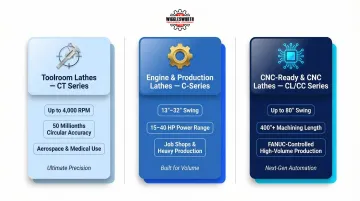
Clausing segments its lathe lineup into three distinct categories:
| Category | Swing Range | Power | Best For |
|---|---|---|---|
| Engine/Production Lathes (C-Series / Colchester) | 13" – 32" | 15–40 HP | Job shops, heavy production, general manufacturing |
| CNC-Ready & CNC Lathes (CL / CC Series) | 35" – 80" | Varies by config | High-volume production, FANUC-controlled operations |
A few specifics worth noting:
- C-Series and Colchester 8000-series machines reach bed lengths up to 275" between centers, with universal gearboxes covering wide threading pitch ranges
- CL and CC series CNC platforms support machining lengths exceeding 400" on select configurations, with full FANUC control integration
Clausing lathes from the 1960s and 1970s still trade actively on the used market — a reliable signal that these machines are built to last well beyond their original service cycles.
Key Features and Specifications of Clausing Lathes
Cast Iron Construction and Bed Design
Clausing bed and slideway construction varies by machine family. For example, the CT618CNC uses a solid, hardened and ground alloy-tool-steel bed with a Turcite-B bearing surface between the carriage and bed, while the C1330SVSJ uses an induction-hardened and precision-ground bed.
Buyers should compare the bed design, way construction, spindle arrangement, machine mass, foundation requirements, and published acceptance specifications for the exact model rather than assuming identical construction across the full Clausing lineup.
Spindle Specifications Across Representative Models
Two models illustrate the range of Clausing's lathe lineup — the CT618CNC toolroom lathe for high-precision work and the C2080J for production-scale operations:
| Specification | CT618CNC (Toolroom) | C2080J (Engine/Production) |
|---|---|---|
| Swing Over Bed | 14.96" | 20" |
| Distance Between Centers | 17.99" | 80" |
| Spindle Bore | 1-1/4" | 3.125" |
| Spindle Speed Range | 50–4000 RPM | 20–1600 RPM |
| Motor Horsepower | 3 HP (5 HP optional) | 15 HP |
| Spindle Speeds/Feeds | Infinitely Variable | 16 Speeds / 45 Inch + 39 Metric threads |
| Published Tolerance | Circular accuracy to 0.00005" | Not published |
| Tailstock Quill Travel | 3.74" | 7" |
| Carriage Travel | X: 8.66", Z: 13.38" | Cross Slide: 10.5" |
Gearbox and Feed Systems
Clausing's all-geared headstocks deliver consistent power across the speed range without belt-slip variability. The C2080J provides 16 discrete speeds and handles 45 inch threading pitches (2–72 TPI) plus 39 metric pitches (0.2–14 mm). That threading range makes these machines well-suited for aerospace fastener work and custom repair jobs where precise thread matching is non-negotiable.
Variable-speed Clausing models use inverter-controlled drive arrangements that provide speed adjustment within the model’s published range. On the CT618CNC, Clausing states that its current-vector inverter increases low-end torque, while the C1330SVSJ combines an inverter drive with a two-speed motor. Actual torque and power availability should be confirmed from the specification and drive data for the selected model.
Standard Accessories and Options
Standard and optional equipment varies substantially by model. For example, the C1330SVSJ lists a 4-way tool post, coolant system, one-shot lubrication pump, interlocked chuck guard, leadscrew cover, roller steady rest, and five-position micrometer bed stop among its machine features. Other models may use different workholding, guarding, lubrication, tooling, or accessory packages.
CNC controls also vary. The CT618CNC uses a Fanuc control, MultiTurn models are offered with Fanuc or Siemens platforms, and the Power Turn uses an Acu-Rite Turn Power control. Every quotation should identify the exact control, included accessories, optional equipment, and programming capabilities.
Performance: What Clausing Lathes Deliver in Real-World Use
Turning and Boring Accuracy
Clausing states that the CT618CNC has spindle runout within 50 millionths of an inch or better and circular accuracy to 50 millionths. That specification describes particular elements of machine performance; it is not a guarantee that every workpiece will hold a 0.00005-inch dimensional tolerance.
Finished-part capability depends on the workpiece, tooling, chucking, spindle and machine condition, thermal environment, cutting parameters, inspection method, and process stability. Standards such as AS9100 and ISO 13485 establish quality-management requirements but do not assign universal turning tolerances or surface finishes to aerospace and medical parts. Machine acceptance and process capability should be verified against the actual drawing and production method.
Surface Finish Quality
Heavy castings and precision-ground ways combine to deliver consistently clean surface finishes. The mass absorbs vibration that would otherwise transfer to the cutting tool, while hardened, ground surfaces maintain consistent carriage travel without stick-slip behavior that mars finish quality.
Users working with stainless steel and titanium—materials prone to work hardening and chatter—report that Clausing's rigidity delivers cleaner cuts with longer tool life compared to lighter-duty machines.
Vibration and Chatter Control
Cast iron construction reduces chatter during interrupted cuts. This becomes critical in aerospace and defense applications where machinists regularly work with interrupted surfaces (keyways, cross-holes) in hardened materials. A machine that chatters requires multiple finishing passes, consuming time and tooling while risking part rejection.
Competitive Comparison
The table below places Clausing's precision claims alongside the manufacturers most commonly considered in the same purchasing decision.
| Brand | Precision Claim | Manufacturing Location | Warranty |
|---|---|---|---|
| Hardinge HLV-DR | 0.000025" max TIR | USA/Switzerland/China | 3 Years |
| Monarch 10EE | 0.00004" standard | Sidney, Ohio, USA | Not published |
| KENT USA | Precision tier (unspecified) | Taiwan | 15 Months |
| Acer | Precision tier (unspecified) | Taiwan | 1 Year |
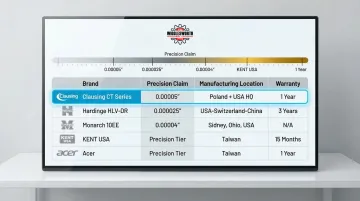
Hardinge and Monarch remain the apex for sub-micron toolroom precision. However, Clausing's 50 millionths claim positions it firmly in the high-precision tier, often at more accessible price points than fully rebuilt Monarch 10EEs, while offering stronger domestic parts support than many Taiwanese imports.
Longevity in Production Environments
Clausing’s strongest verifiable longevity proof point is its support infrastructure: the Clausing Service Center states that it supports machines purchased more than 50 years ago. Older machines also remain available in the used market, but age alone does not establish their accuracy, condition, remaining life, or production capability.
Total cost of ownership should include acquisition, financing, freight, rigging, foundation and electrical work, tooling, labor, maintenance, repairs, downtime, energy, inspection, productivity, resale value, and any rebuilding required during ownership. An older Clausing may offer strong value, but its economics should be based on inspection and the intended workload rather than an assumed 20-, 30-, or 40-year service life.
Pros and Cons of Clausing Lathes
Advantages
Clausing lathes earn their place in precision shops through three consistent strengths:
- Model-specific precision capability: Clausing publishes accuracy and construction information for individual models, including the CT618CNC’s spindle-runout and circular-accuracy claims. Production repeatability must still be validated for the workpiece, tooling, workholding, environment, inspection system, and run length
- Long-term parts support: The Clausing Service Center maintains more than 74,000 parts, supports machines purchased more than 50 years ago, and reports that 95% of parts orders ship within 24 hours. This can support maintainability, but actual downtime depends on diagnosis, parts availability, shipping, technician access, and repair complexity
- Material and operation flexibility — Aluminum, steel, titanium, and stainless steel all cut well. Universal gearboxes on engine lathes handle turning, boring, threading, and taper turning in the same setup, reducing changeover time.
Disadvantages
Those strengths come with real trade-offs worth weighing before purchase.
High Upfront Cost
New Clausing pricing varies by machine family, capacity, control, accessories, guarding, electrical configuration, freight, and project scope. Clausing’s current CT618VS product page directs buyers to request a quote rather than publishing a fixed list price.
Buyers with lower capital budgets should compare a properly inspected used machine, financing, and alternative new configurations on total delivered cost and application fit—not on an unsupported universal price gap between domestic and imported equipment.
Size and Weight
Larger models demand serious infrastructure. The C2080J weighs several thousand pounds and requires precise leveling to hit published tolerances. Budget for professional rigging, a reinforced concrete pad, and dedicated three-phase power (all costs on top of the purchase price) before committing. Home shops and facilities without that groundwork will face significant added expense.
Learning Curve and Setup Demands
Getting the most from a Clausing lathe requires skilled operators: proper alignment, correct tool height, appropriate cutting parameters, and bearing preload adjustment all matter. Shops may get better results from a simpler, more forgiving machine if experienced machinists aren't available to dial it in.
Clausing Lathe Pricing and Value: New vs. Used
New Machine Pricing
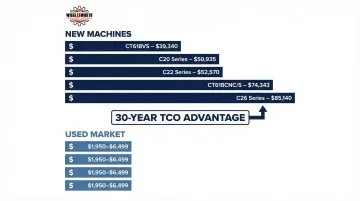
Current verified pricing for new Clausing lathes:
| Model | Configuration | Price (USD) |
|---|---|---|
| CT618VS | Manual Toolroom Lathe | $39,340 |
| C20 Series | 20"x40" Variable Speed, 15 HP | $50,935 |
| C22 Series | 22"x40" Variable Speed, 15 HP | $52,570 |
| CT618CNC/5 | CNC Toolroom, 5 HP | $74,343 |
| C26 Series | 26"x43" Variable Speed, 20 HP | $85,140 |
Secondary Market Pricing
The used market for Clausing and Colchester lathes is robust, reflecting their durability:
- 17" x 60" Clausing Colchester (As-Is condition): $1,950
- 13" x 40" Variable Speed (Used): $5,950
- 17" x 78" Clausing Colchester (Used with DRO): $6,499
- 17" x 83" Clausing Colchester (Used): $5,099
Total Cost of Ownership Considerations
Modern Machine Shop emphasizes that true machine cost encompasses acquisition, operation, maintenance, and decommission expenses. A cheaper lathe suffering from spindle deflection requires more finishing passes and consumes more tooling, eroding initial savings through increased cycle times and scrap rates.
Parts support is a relevant total-cost-of-ownership factor. The Clausing Service Center reports that it carries more than 74,000 parts and ships 95% of parts orders within 24 hours of receipt.
That statistic does not guarantee a 24-hour repair. Actual downtime depends on fault diagnosis, whether the correct part is stocked, shipping time, technician availability, installation, testing, and any related damage. Each manufacturer’s parts and service capability should therefore be evaluated against the shop’s own cost of downtime and maintenance resources.
Who Should (and Shouldn't) Buy a Clausing Lathe?
Ideal Buyer Profile
Clausing lathes make economic and operational sense for:
- Aerospace and defense manufacturers whose drawings, process plans, work envelopes, materials, and production volumes match the capability of a specific Clausing manual, teach, or CNC lathe
- Medical-device manufacturers that have validated the selected machine, tooling, workholding, inspection, and process controls under their applicable ISO 13485 quality-management system and product requirements
- Toolrooms and job shops handling diverse work — from one-off prototypes to short runs — that need threading capability and consistent performance across multiple materials
- Vocational and trade schools where machines must survive 20-30 years of student use while teaching professional-grade setup and precision measurement
Who Should Consider Other Options
A particular Clausing model may not be the best fit when:
- Its work envelope, spindle bore, speed range, horsepower, control, or electrical requirements do not match the intended parts or facility
- The expected utilization does not justify the delivered cost of the selected new machine
- A smaller manual lathe, different CNC platform, or another machine architecture can meet the drawing and production requirements more economically
- The shop lacks the tooling, inspection capability, operators, power, floor space, or material-handling infrastructure required by the selected model
Budget alone should not automatically exclude the brand. T.R. Wigglesworth offers new and used Clausing equipment, allowing buyers to compare several capacity and investment levels.
Decision Framework
If you're still on the fence, these criteria should clarify the call.
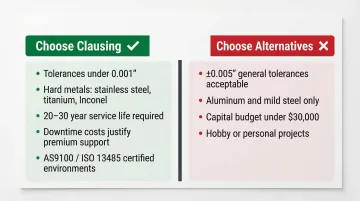
Choose a Clausing model if:
- Its swing, distance between centers, spindle bore, horsepower, speed range, workpiece capacity, and control match the required parts
- The machine’s published specifications and a proposed test cut support the required process
- Parts support, service access, expected utilization, and total delivered cost justify the investment
- The facility can accommodate the machine’s power, foundation, rigging, tooling, guarding, and material-handling requirements
Consider alternatives if:
- Another machine better matches the work envelope, process, automation level, or production volume
- The required capability is already available on existing equipment
- The selected model would be materially underutilized
- A different new or used configuration provides a stronger application and financial fit
T.R. Wigglesworth’s stated approach is to collaborate with customers on shop-floor machining solutions, so the decision should begin with the application rather than a single tolerance, material, certification, or budget cutoff.
| Product | Product Details |
|---|---|
| 8044VSJ - Clausing/Colchester Variable Speed Lathe with 15.75" Swing over Bed, 3 Gear Infinitely Variable Speed Manual Gap Bed Engine Lathe | Explore Product |
Frequently Asked Questions
What is a Clausing lathe?
Clausing is an American industrial machine tool brand manufacturing precision metal lathes—including toolroom, engine, and CNC-ready models—for demanding manufacturing environments. The company has produced machine tools for over 100 years, serving aerospace, defense, medical device, and precision manufacturing industries.
What are the best lathe machine brands?
Top industrial lathe brands include Hardinge (sub-micron precision, 25 millionths TIR guarantee), Monarch (legendary 10EE toolroom standard), Clausing (industrial-grade precision, strong U.S. parts support), KENT USA (Taiwanese precision at competitive pricing), and Acer (heavy-duty production). Selection depends on application requirements, precision needs, and budget.
What is the lifespan of a lathe machine?
There is no universal lifespan for an industrial lathe. Service life depends on operating hours, loading, maintenance, lubrication, crashes, environment, machine construction, control obsolescence, rebuild history, and the accuracy the work still requires. Clausing’s verifiable long-term-support claim is that its Service Center supports machines purchased more than 50 years ago, but every used machine should be inspected individually.
Is a Clausing metal lathe suitable for turning wooden pens?
Clausing lathes are industrial metalworking machines intended for machining operations such as turning, facing, boring, and threading. Wood-pen turning normally uses purpose-built woodworking equipment, so buyers seeking a Clausing lathe should evaluate it against metal-part size, material, tolerance, spindle, tooling, production, and facility requirements.
Are Clausing lathes still made in the USA?
Clausing is headquartered in Kalamazoo, Michigan, where it operates its parts-and-service organization. According to Clausing’s official company history, it has a wholly owned production facility in Poland and represents and distributes machine-tool manufacturers located in England, Spain, and Taiwan. Country of origin should therefore be confirmed for the exact model being considered. Clausing also reports more than 74,000 parts in inventory and states that 95% of parts orders ship within 24 hours.
Are used Clausing lathes worth buying?
A used Clausing lathe can offer strong value when its capacity, condition, controls, tooling, and delivered cost match the intended work. Inspection should cover way wear, spindle condition and runout, headstock and feed gear operation, leadscrew and backlash condition, lubrication, electrical systems, guarding, accessories, and a test cut where practical.
Purchasing through an established machinery dealer such as T.R. Wigglesworth can provide clearer listing information, inspection access, and commercial accountability. Maintenance records and service history should be treated as available only when the seller can supply them.
About T.R. Wigglesworth Machinery Company
T.R. Wigglesworth Machinery Company is a four-generation family machinery business operating since 1935. Based in Bedford, Ohio, the company sells new and used industrial machinery and states that its aim is to collaborate with customers on lasting, mutually profitable shop-floor machining solutions.
Wigglesworth lists Clausing equipment across manual turning, CNC turning, milling, drilling, and grinding categories. Manufacturers evaluating a Clausing lathe can contact Wigglesworth to discuss the required work envelope, spindle capacity, control, tooling, facility requirements, current inventory, and project scope.
Contact T.R. Wigglesworth at 440-359-2655 or through its Bedford, Ohio office.