
Introduction
Choosing the right knee mill can determine whether your shop runs profitably for decades or bleeds money on downtime and rebuilds. Dozens of manufacturers offer machines that look nearly identical on spec sheets, yet vary widely in cast iron quality, way surface treatments, and dealer support. The decision demands more than a glance at table travel dimensions and horsepower ratings.
The consequences are real: a knee mill built with lower-grade cast iron will deflect under load, producing scrap parts. Flash chrome ways will peel within five years of heavy use, forcing costly resurfacing. And when a critical part fails, the difference between a one-day repair and a two-week shutdown often comes down to your dealer's parts network.
Those risks are avoidable with the right information. This guide compares the top knee mill brands on the factors that determine long-term value—build quality, spindle design, control integration, and parts availability—so your decision is based on total cost of ownership, not sticker price alone.
Key Takeaways
- Knee mills remain essential for toolroom work, second-ops, prototyping, and precision milling in job shops
- Brands compared: KENT International, Bridgeport/Hardinge, Sharp Industries, and DAH LIH
- Key differentiators: cast iron grade, way surface treatment, spindle drive type, CNC integration, and dealer support
- Sticker price misleads: parts availability and distributor networks typically drive total ownership costs higher than the purchase price
- T.R. Wigglesworth Machinery Company (est. 1935) is an authorized KENT and DAH LIH dealer offering delivery, installation, and training
What Is a Knee Mill and Why Does It Still Matter?
Technical Definition
A knee mill is a vertical milling machine where the worktable rides on a knee casting that moves up and down the column to provide Z-axis travel. The spindle head remains vertically fixed but includes a quill for additional short-stroke Z-axis motion. Unlike a bed mill, where the spindle head travels in Z while the table stays fixed in height, the knee mill puts vertical movement in the operator's hands.
Why Shops Still Choose Knee Mills
Despite CNC vertical machining centers (VMCs) dominating production floors, 62% of surveyed U.S. job shops still maintain non-CNC milling machines and lathes in their operations. Knee mills continue to outperform alternatives in specific applications:
- Toolroom operations requiring head tilting or ram extension for complex setups
- Second-ops work such as tapping, drilling, and light milling where CNC setup time is cost-prohibitive
- Prototyping and short-run production where fixture simplicity and operator control matter more than automation
- Budget-conscious shops where a full CNC VMC is oversized or financially out of reach for the work at hand
Modern CNC knee mills bridge both worlds, adding servo motors, ball screws, and conversational controls while retaining the mechanical flexibility of the classic turret design. The sections below break down both manual and CNC configurations so you can match the right machine to your shop's actual requirements.
Top Knee Mill Brands: Side-by-Side Comparison
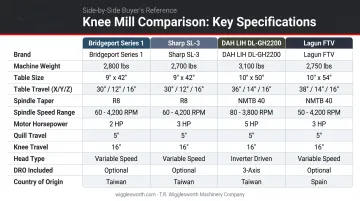
Five brands dominate the U.S. knee mill market for shops that won't compromise on accuracy or longevity. Each was selected based on market availability, build quality, parts infrastructure, and proven performance from toolroom to production environments. The table below gives you a quick cross-brand snapshot before diving into the details.
| Brand | Weight | Table Size | Spindle Taper | Spindle HP | Standout Feature |
|---|---|---|---|---|---|
| Bridgeport Series 1 | 1,930 lbs | 9" × 49" | R-8 | 2–3 HP | Universal tooling ecosystem |
| Sharp SL-3 | ~2,800 lbs | 10" × 50" | R-8 | 3 HP | Turcite B ways + box guide system |
| DAH LIH DL-GH2200 | ~5,500 lbs | 13.25" × 51.125" | NST 40 | 3/5 HP | Dual vertical/horizontal spindle |
Bridgeport / Hardinge Series 1
Bridgeport originated the turret knee mill design in 1938, and the Series 1 is still the machine every competitor is measured against. Now produced under Hardinge ownership, it carries the most recognized name in milling — and a tooling ecosystem no other brand can match.
Key Differentiators:
- Universal familiarity — any machinist can run it without retraining, which matters when hiring or cross-training
- Hand-scraped ways on current production models for tight surface contact and long-term accuracy retention
- Chrome-plated ways and gibs — current models use improved treatments; older budget-era flash chrome was prone to peeling
- R-8 spindle taper, the most common knee mill standard, with the largest available tooling selection of any taper type
Specifications:
| Feature | Specification |
|---|---|
| Machine Weight | 1,930 lbs (net) |
| Table Size | 9" × 49" |
| Spindle Taper | R-8 (NMTB-30 optional) |
| Spindle Drive | 3 HP (30 min rating) / 2 HP (continuous), mechanical variable speed |
| Control Options | ACU-RITE MILLPWR G2, 2/3-axis DRO; CNC conversions often aftermarket kits |
Sharp Industries (SL-3 / SL-3VS Series)
Sharp Industries is a U.S.-based distributor of Taiwan-manufactured knee mills with a reputation for solid mid-range quality and strong domestic parts availability.
Key Differentiators:
- Hardened and ground box ways maintain geometric accuracy longer under sustained production loads
- Turcite B liner(PTFE-based) eliminates stick-slip on the ways, a common cause of positioning error in older machines
- Available in gear-head or variable-speed EVS configurations to match different production environments
Specifications:
| Feature | Specification |
|---|---|
| Machine Weight | ~2,800 lbs |
| Table Size | 10" × 50" |
| Spindle Taper | R-8 |
| Spindle Drive | 3 HP, variable-speed or EVS options |
| Control Options | ACU-RITE or FAGOR 2/3-axis DRO, CNC-ready configurations available |
DAH LIH (DL Series)
DAH LIH is a Taiwan-based manufacturer known for precision-ground construction and consistent geometric tolerances. T.R. Wigglesworth carries the DAH LIH line and can specify the right configuration for toolroom or production use.
Key Differentiators:
- Precision-scraped and ground ways deliver tight geometric accuracy straight off the truck — minimal setup adjustment required
- Consistent tolerance repeatability makes it a reliable choice for toolroom work and light production runs
- The DL-GH2200 offers both vertical and horizontal spindles, giving shops flexibility without a second machine
Specifications:
| Feature | Specification |
|---|---|
| Machine Weight | ~5,500 lbs (DL-GH2200 model) |
| Table Size | 13.25" × 51.125" |
| Spindle Taper | NST 40 (vertical & horizontal) |
| Spindle Drive | 3 HP (vertical) / 5 HP (horizontal), variable speed |
| Control Options | FAGOR or ACU-RITE DRO, CNC control options available |
Key Specs to Evaluate When Comparing Knee Mills
Cast Iron Grade and Machine Weight
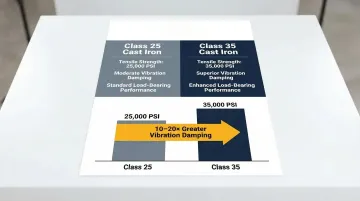
Higher-grade cast iron resists deflection under cutting loads and dampens vibration more effectively. ASTM A48 Class 35 cast iron provides a minimum tensile strength of 35,000 psi (241 MPa), compared to Class 25's 25,000 psi. The predominantly pearlitic matrix (80-95% pearlite) in Class 35 delivers:
- Superior load-bearing capacity under heavy cuts
- Excellent thermal conductivity for heat dissipation
- 10-20 times greater vibration damping capacity than steel
To confirm cast iron grade, look for "ASTM A48 Class" or "Meehanite" references in the machine's material specification section. If not listed, ask the dealer directly — manufacturers using premium castings will advertise it; those using standard Class 25 often omit the detail.
Heavier machines (3,500+ lbs) with Class 35 castings produce more accurate parts under interrupted cuts and when milling harder materials like tool steel or stainless.
Way Surface Treatment
The way surface treatment determines how long your machine maintains accuracy and how much friction resists smooth motion.
Hardened and ground ways with Turcite liner offer the stronger long-term choice:
- Turcite B (PTFE-based) shows only slight difference between static and dynamic friction, eliminating stick-slip for precise positioning
- Properly maintained Turcite ways last 20+ years in production use
- Self-lubricating properties reduce maintenance requirements
Flash chrome plating costs less upfront but carries real tradeoffs:
- Prone to flaking and adhesion failure over time
- Requires resurfacing or replacement within 5-10 years of heavy use
- Higher stick-slip tendency compared to Turcite
That gap matters at resale and repair time. Replacing or resurfacing ways typically costs $8,000-$15,000 including labor and machine downtime.
Spindle Drive Type
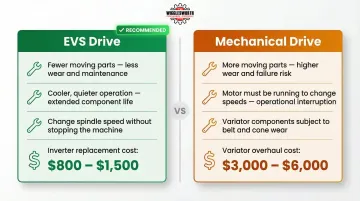
EVS (Electronic Variable Speed) inverter drives are the lower-maintenance option:
- Simpler design with fewer moving parts
- Runs cooler and more energy-efficient than mechanical systems
- Allows speed changes without stopping the spindle
- Lower rebuild costs — inverter replacement typically $800-$1,500
Mechanical cone-pulley variable speed systems carry higher long-term costs:
- More moving parts prone to wear over time
- Requires motor to be running to change speeds
- Mechanical variator overhauls typically run $3,000-$6,000
On CNC models, also check for AMI (Automatic Motor Interlock) — a safety circuit that links spindle rotation to machine functions and E-stop. It automatically shuts down the machine if the spindle stalls and manages direction reversal when shifting gears, preventing both tool breakage and operator injury.
Control System and CNC Integration
Factory-integrated CNC knee mills are built from the ground up for precision:
- Precision ball screws (±0.0002" repeatability typical)
- Servo motors matched to axis loads
- Control systems (ACU-RITE MILLPWR G2, FAGOR) designed for the machine's kinematics
Retrofit CNC kits add motors and controls to machines originally designed for manual operation. They can work, but typically deliver:
- Lower repeatability (±0.001" common)
- Less reliable performance due to backlash in original leadscrews
- Warranty complications when failures occur
Factory-integrated systems run $15,000-$35,000 versus $5,000-$15,000 for manual. For shops running tight-tolerance work, the reliability gap justifies the premium.
Dealer Support, Parts Availability, and Training
The average cost of unplanned downtime in manufacturing is approximately $260,000 per hour, with manufacturers experiencing an average of 800 hours annually. Parts lead time directly determines whether a spindle bearing failure costs one day or two weeks of lost production.
Before committing, verify:
- Parts lead time for common wear items (spindle bearings, ball screws, way wipers)
- Proximity of service technicians for on-site support
- Whether the dealer offers installation and operator training
- Dealer's inventory depth for emergency parts orders
A knee mill is a 20-40 year asset. A dealer who can't get you a spindle bearing in 48 hours isn't a partner — they're a liability.
How We Chose the Best Knee Mills for This Guide
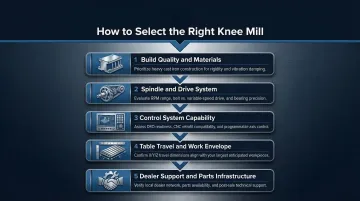
Evaluation Framework: Machines were assessed on five criteria:
- Build quality and materials (cast iron grade, way construction)
- Spindle and drive system design (EVS vs. mechanical, horsepower, control integration options)
- Control system capability (factory CNC vs. retrofit, repeatability specs)
- Table travel and work envelope (X-Y-Z capacity, quill travel)
- Domestic parts and dealer support infrastructure (lead times, service network)
Common Buyer Mistakes to Avoid:
- Over-indexing on spindle horsepower or table travel while ignoring way surface quality and cast iron grade—two machines can have near-identical spec sheets but vastly different real-world durability
- Assuming all "CNC knee mills" are equal: factory-integrated systems offer measurably better repeatability than retrofit kits
- Ignoring dealer support infrastructure: parts lead time and local service determine whether a breakdown costs one day or two weeks
The Distributor Relationship Matters: Before purchasing, verify:
- Parts lead times for common wear items
- Proximity of service technicians
- Whether the dealer offers installation and operator training
- Post-sale support quality and responsiveness
T.R. Wigglesworth Machinery Company — in business since 1935 — is an authorized dealer for KENT International, DAH LIH, and other premium brands, providing delivery, installation, training, and ongoing technical support across their service area.
| Product | Product Details |
|---|---|
| 3VS08 - Clausing Knee Mill 54" Long x 10" Wide Table | Explore Product |
Conclusion
The best knee mill is not the one with the most impressive spec sheet or the lowest purchase price. It is the machine whose build quality, control system, and dealer support best match your specific operational demands.
Evaluate total cost of ownership over a 10-20 year horizon. Factor in:
- Way replacement or resurfacing ($8,000-$15,000)
- Spindle rebuilds ($3,000-$8,000 depending on drive type)
- Control system upgrades or replacements
- Parts availability and downtime costs
A $5,000 savings on purchase price vanishes quickly when you face a two-week parts delay or need to resurface flash chrome ways after five years.
That's where dealer selection matters as much as machine selection. T.R. Wigglesworth Machinery Company has served the machine tool industry since 1935 as an authorized dealer for KENT and DAH LIH, with deep experience matching shops to the right equipment for their production demands and budget horizon. They carry new and used knee mills and can walk you through delivery, installation, and training. Reach out with your spindle speed requirements, table size needs, and volume expectations — they'll narrow it down from there.
Frequently Asked Questions
What is the life expectancy of a milling machine?
A well-maintained knee mill with quality cast iron and lubricated ways can last 20–40+ years in production use. Spindle wear, way condition, and control obsolescence are the main limiting factors — machines with Turcite-lined ways and inverter drives tend to outlast those with flash chrome and mechanical variable speed systems.
What is the difference between a knee mill and a bed mill?
On a knee mill, the worktable moves up and down in Z while the spindle head remains vertically fixed (with quill providing additional Z travel). On a bed mill, the spindle head travels in Z while the table remains stationary in height. Knee mills offer greater setup flexibility (head tilt, quill, ram extension) while bed mills provide greater rigidity for production CNC work.
Is a manual or CNC knee mill better for a toolroom?
For most toolrooms, a CNC knee mill with conversational programming delivers far more capability per square foot — making it the preferred choice for prototyping, second-ops, and fixture work. Manual mills remain practical when experienced machinists need quick one-offs where setup time would exceed actual machining time.
What should I look for in a knee mill's spindle?
Focus on four factors: taper type (R8 is most common; NMTB-40 suits heavier work), drive system (inverter EVS beats mechanical variable speed for long-term reliability), horsepower relative to your materials, and — on CNC models — whether AMI spindle control is included for safety and automatic gear-range compensation.
How much does a new knee mill cost?
Manual knee mills generally run $5,000–$15,000; CNC models with factory-integrated controls range from $15,000–$35,000+.