Large horizontal boring and milling machines (HBMs) have become the solution of choice for machining complex, oversized workpieces across multiple heavy industries. These machines consolidate boring, milling, drilling, and tapping operations into a single setup—eliminating costly re-clamping, reducing tolerance stack-up, and cutting cycle times on components that can weigh tens of tons.
The market confirms this strategic importance: Verified Market Research projects the global horizontal boring milling machine market to grow from $3.34 billion in 2024 to $4.45 billion by 2032, a 6.2% CAGR driven by increasing demand for precision manufacturing across aerospace, energy, and heavy machinery sectors.
Key Takeaways
- HBMs handle oversized, heavy, or complex workpieces that exceed standard machining center capacity
- Five industries lead adoption: aerospace & defense, energy, shipbuilding, heavy construction equipment, and mold/die/tooling
- Reduce setups, maintain dimensional accuracy across long cycles, and machine parts weighing tens of tons
- Selection requires matching spindle torque, table load capacity, and axis travel to specific workpiece and tolerance demands
What Are Large Horizontal Boring & Milling Machines?
Large horizontal boring and milling machines feature a horizontally oriented spindle that can bore, mill, drill, and tap large or heavy workpieces—often within a single setup—using CNC-controlled axes for precision movement. The defining characteristic is the extendable W-axis quill that allows the tool to reach deep into a workpiece without dangerously long tool holders, distinguishing them from standard horizontal machining centers.
What makes them "large" in practical terms:
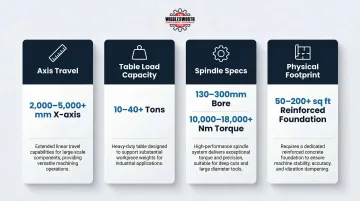
- Axis travel ranges: X-axis travel of 2,000–5,000+ mm (78–200+ inches), with floor-type models offering unlimited travel through modular extensions
- Workpiece weight capacity: Tables supporting 10–40+ tons depending on configuration
- Spindle specifications: Bore diameters of 130–300mm with torque levels far exceeding conventional machining centers—often 10,000–18,000+ Nm
- Physical footprint: Installations typically requiring 50–200+ sq ft of dedicated floor space with reinforced concrete foundations
HBMs vs. Vertical Boring Mills
Spindle orientation drives the choice between these two machine types. HBMs are preferred when multi-face machining, deep-hole boring, and multi-operation consolidation are the priority. Vertical boring mills rotate extremely heavy, symmetrical workpieces—large rings, cylinders—on a table beneath a vertical spindle, better suited for components where rotational access matters more than multi-face versatility.
That distinction—consolidating multiple operations on one machine—is what makes HBMs indispensable across heavy industry, where repositioning a 20-ton component between machines isn't just inconvenient; it's a productivity and tolerance liability.
Top Industries Using Large Horizontal Boring & Milling Machines
While HBMs appear across general manufacturing, five industries represent the most demanding and consistent users—driven by the size, precision, and structural integrity required of their components.
Aerospace & Defense
Typical components machined:
- Large structural frames and bulkheads
- Wing spars and fuselage fittings
- Landing gear housings
- Defense-grade assemblies requiring multi-axis access
- Fixture tooling for assembly operations
Why HBMs are essential: Aerospace structures demand repeatable accuracy across large work envelopes while handling difficult-to-machine alloys including titanium, aluminum 7075, and high-strength steel. HBMs consolidate boring and milling operations, reducing part handling and the risk of tolerance stack-up that occurs when transferring workpieces between multiple machines.
The compliance dimension matters: AS9100D and NADCAP standards require strict dimensional measurement and traceability for aerospace components. HBMs equipped with CNC probing systems support in-process measurement without removing the workpiece, maintaining documented dimensional verification throughout the machining cycle.
Energy & Power Generation
Typical workpieces:
- Turbine housings and casings
- Generator frames and stator bodies
- Large valve bodies for pressure control
- Compressor casings
- Pressure vessels for nuclear and thermal plants
Why HBMs are essential: These components are thick-walled, heavy (often 20–40+ tons), and must maintain precise bore alignment for safe operation under high pressure or thermal load. HBMs are built for exactly these demands:
- Deep-hole boring with high spindle torque
- Large-surface milling for flange faces and mating surfaces
- Long axis travel to accommodate oversized castings
- Stable, vibration-controlled cutting throughout
The consequence of inaccuracy: API RP 686 limits angular misalignment to 0.03 degrees and offset to 0.02 mm; exceeding these tolerances in turbine or valve components creates safety risks, excessive forces on rotating shafts and bearings, and expensive field failures. A single out-of-tolerance bore can mean a catastrophic field failure—not a warranty claim.
Shipbuilding & Marine Engineering
Typical workpieces:
- Propulsion system components and stern frames
- Rudder assemblies and steering gear housings
- Large marine engine blocks
- Structural marine castings and hull components
- Multi-ton steel or iron components requiring machining on multiple faces
Production advantage of HBMs: By enabling multiple machining operations (boring, milling, drilling) in a single setup, they eliminate re-clamping errors that would compromise bore alignment across large assemblies. Classification societies establish a misalignment angle limit of 0.3 mrad for stern tube bearings, with acceptable slope boring tolerance of ±0.1 mrad—precision only achievable when the workpiece remains fixtured throughout the operation.
HBMs also reduce total cycle time on slow-moving production schedules typical of marine component manufacturing, where a single stern tube boring operation may run 10–20+ hours continuously.
Heavy Machinery & Construction Equipment
Typical workpieces:
- Machine bases and excavator frames
- Gear housings for industrial transmissions
- Hydraulic cylinder bores
- Crane components and structural assemblies
- Industrial press structures
How HBMs deliver value: These parts must withstand extreme cyclic loads and often require precise mating surfaces for assembly. HBMs handle the full range:
- Aggressive roughing cuts with controlled vibration
- Consistent tolerances across thick cross-sections
- Component sizes from compact gear housings to multi-meter equipment frames
This flexibility matters in a sector where a single shop may machine a 200 kg gearbox housing one week and a 15-ton press frame the next.
Mold, Die & Tooling
Typical workpieces:
- Large injection mold bases (automotive, appliance)
- Die casting molds
- Stamping dies for sheet metal forming
- Precision tooling fixtures used in industrial manufacturing
The HBM advantage in mold production: Minimizing repositioning between faces is critical to maintaining mold parting line accuracy. HBMs allow multi-face machining in fewer setups, support both heavy roughing and controlled finishing, and reduce lead times on long-cycle mold production.
High-precision encoders allow indexing to 0.001 degrees, enabling the machine to finish roughing, semi-finishing, and drilling on all four sides in one uninterrupted 14-hour cycle. When machining high-precision guide pillar bores spaced 1.5 meters apart, horizontal machines can align them within 0.02 mm from one side to the other. That level of alignment cannot be achieved when heavy blocks are flipped between separate setups.
Key Machine Capabilities That Make These Machines Industry-Ready
Structural rigidity drives everything else. Wide guideways, large-diameter spindles, and robust column and bed construction determine whether a machine can suppress vibration during heavy cutting and hold accuracy across long machining cycles. Miss that mark, and a $50,000 casting ends up as scrap — with ±0.02mm tolerances across a 3-meter workpiece leaving no room for error.
PAMA Speedram machines adopt preloaded hydrostatic guides on X and Y axes to maximize rigidity and vibration damping, while floor-type models feature foundation-anchored columns that transfer cutting forces directly into the building structure.
Rigidity alone isn't enough — spindle torque and axis travel must match what the application actually demands:
- High spindle torque (10,000–18,000+ Nm) handles deep-hole boring and heavy material removal in energy and shipbuilding work
- Long axis travel across X, Y, Z, and W axes determines whether the machine can physically accommodate a given component class
- Table-type HBMs typically offer X-axis travel of 2,000–5,000mm; floor-type models extend this through modular construction
CNC integration and automation features separate production-capable machines from basic boring equipment. Modern HBMs include:
- In-process probing for dimensional measurement without stopping the cycle
- Pallet changing systems that allow setup on one part while another is being machined
- DNC/IoT connectivity for production monitoring and quality documentation
These features are particularly relevant for aerospace and defense shops with strict traceability requirements, and for mold and tooling operations running high-volume mixed-part production.
Siemens SINUMERIK measuring cycles allow touch-trigger probes to calibrate and measure workpiece dimensions without operator intervention, supporting lights-out operation on long machining cycles.
How to Select the Right Large Horizontal Boring & Milling Machine for Your Operation
Frame the selection decision around three operational inputs:
- Size and weight of largest workpieces you regularly machine → determines table load capacity and axis travel requirements
- Materials you cut (cast iron, steel, titanium, aluminum) → determines spindle torque and rigidity needs
- Tolerances required (±0.1mm vs. ±0.02mm) → determines whether CNC probing and thermal compensation features are necessary
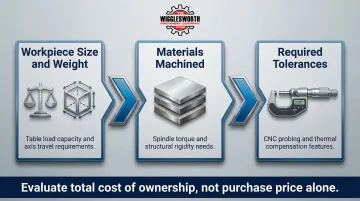
Don't specify on brand or price alone — total cost of ownership is what matters. Unplanned downtime costs Fortune Global 500 companies an average of $129 million per facility annually, reaching $2 million an hour in the automotive sector. Spare parts availability and service responsiveness carry more long-term weight than the purchase price gap between comparable models.
That service equation makes dealer selection a meaningful part of the buying decision. T.R. Wigglesworth Machinery Company, as an authorized dealer for FEMCO, KENT, and DAH LIH, supports buyers with technical assistance, parts availability, and factory-trained installation teams — not just the equipment itself.
New vs. Used HBMs
Both are viable depending on budget and timeline. Before purchasing a used machine, verify:
- Spindle condition — run-out test and vibration analysis
- Guideway wear — check for backlash and surface condition
- CNC control compatibility — confirm software and hardware are serviceable
ISO 230-2 specifies testing methods for positioning accuracy and repeatability using laser interferometers to measure actual versus programmed position — a useful benchmark when evaluating any used HBM.
| Product | Product Details |
|---|---|
| BMC-110R1 | Explore Product |
| BMC-135TN | Explore Product |
| BMC-100HT | Explore Product |
Conclusion
Large horizontal boring and milling machines are purpose-built for industries where workpiece size, multi-operation consolidation, and long-cycle accuracy are non-negotiable. Aerospace, energy, shipbuilding, heavy machinery, and mold & tooling all share the same fundamental need: reliable precision at a scale that standard machining centers simply can't deliver.
If you're evaluating HBM equipment, the right machine tool partner makes a measurable difference. T.R. Wigglesworth Machinery Company has been working with industrial manufacturers since 1935, with hands-on expertise across:
- New and used horizontal boring mills from brands including FEMCO and Fermat
- OEM replacement parts with deep inventory for Webster & Bennett machines
- Delivery, installation, and operator training support
- Equipment financing, consignment, and liquidation services
Reach out to discuss your application requirements and current inventory availability.
Frequently Asked Questions
What industries use horizontal boring and milling machines?
The primary sectors are aerospace & defense, energy & power generation, shipbuilding & marine engineering, heavy machinery & construction equipment, and mold & tooling. These industries share a need for large-format, multi-operation machining on heavy or oversized workpieces that exceed the capacity of standard machining centers.
What are the applications of horizontal boring and milling machines?
Core operations include boring large-diameter holes to precise tolerances, milling flat and contoured surfaces, drilling, and tapping. A key advantage is combining these operations in a single setup on complex parts like turbine housings, gear cases, and structural frames — eliminating re-clamping errors and reducing cycle time.
What is the difference between a horizontal boring mill and a vertical boring mill?
The key difference is spindle orientation: horizontal boring mills use a horizontally mounted spindle suited for multi-face access and deep-hole boring, while vertical boring mills rotate the workpiece on a table beneath a vertical spindle, making them better suited for extremely heavy, symmetrical parts like large rings or cylinders.
What workpiece sizes can large horizontal boring and milling machines handle?
Large HBMs typically handle workpiece weights from several tons up to 40 tons or more. X-axis travels run 2,000–5,000mm on standard models, with floor-type configurations offering modular extension beyond that. This range covers components from large gear housings to turbine casings and marine engine blocks.
What should manufacturers consider when selecting a large horizontal boring mill?
Primary factors include workpiece size and weight (determines table capacity and travel), material and cut type (determines spindle torque needs), required tolerances (determines rigidity and probing requirements), and long-term support availability from the dealer or manufacturer. Total cost of ownership, not just purchase price, should drive the decision.
Can large horizontal boring mills support automation?
Modern large HBMs can be equipped with pallet changing systems, in-process probing, and CNC interfaces compatible with factory automation and MES systems. This supports lights-out operation on long machining cycles with minimal operator intervention between setups.