
Introduction
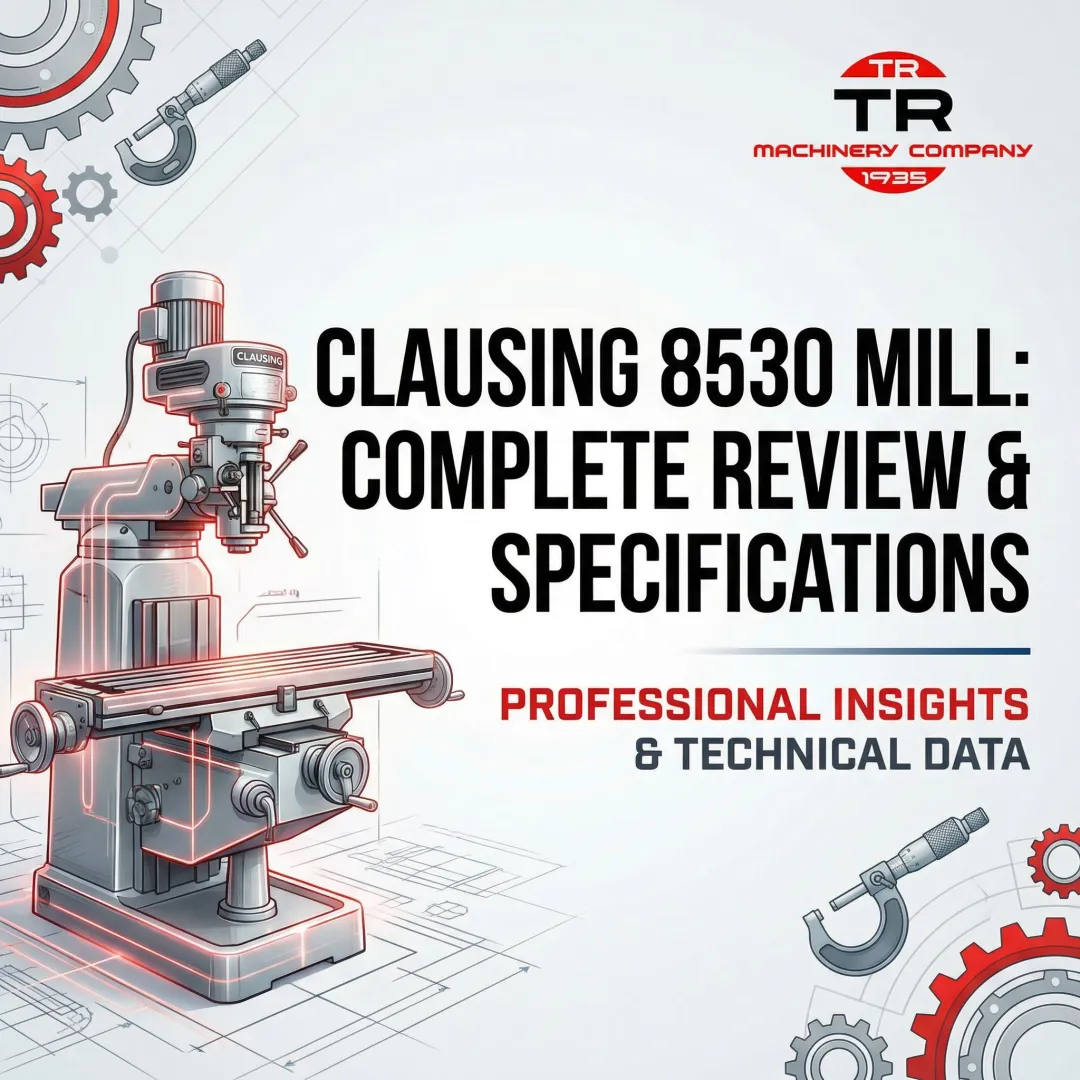
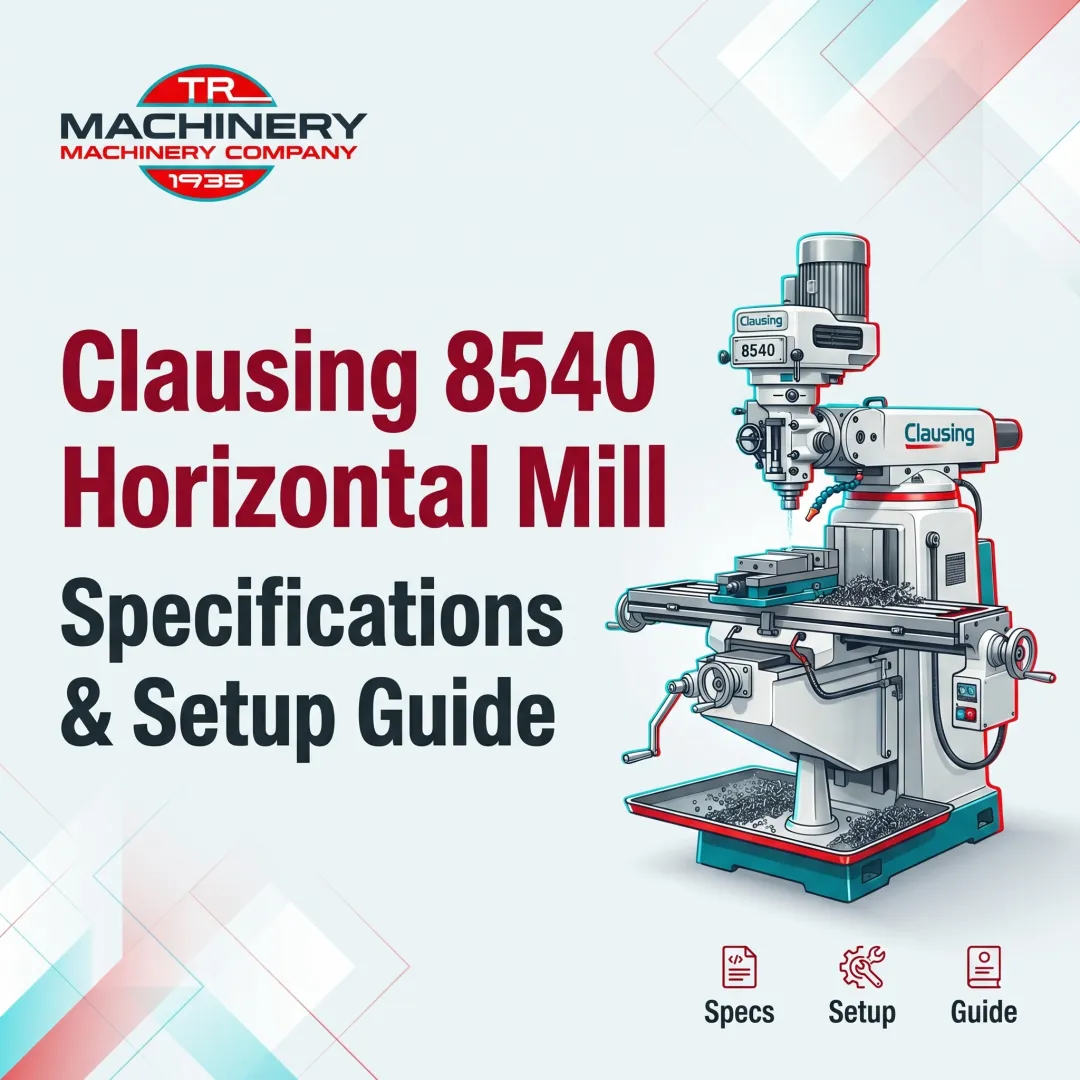
For nearly six decades, the Clausing 8520 knee mill has held its ground as one of the most practical vertical mills built for small shops and toolrooms. Its compact 24" × 6" table and 650-pound base weight make it manageable even in tight basement shops.
Unlike full-size Bridgeport-class machines, the 8520 can be disassembled and moved through standard doorways — yet its precision ground ways and Morse Taper 2 spindle handle everything from prototype work to light production milling.
Whether you're a hobbyist machinist or a shop foreman adding a second mill, here's what you need to know before buying — specifications, model variants, condition assessment, and sourcing options.
TLDR:
- 24" × 6" table, 15" longitudinal travel, MT2 spindle with widely available tooling
- Choose 8520/8530 (MT2 taper) over 8525/8535 variants — the B&S #7 taper is obsolete
- Production ceased decades ago; all units are used, with pricing from $1,500 to $3,200+ based on condition
- Inspect spindle runout, quill play, table wear, and lower bearing condition before buying
- Clausing Industrial still supports these machines with 73,000+ parts in stock
What Is the Clausing 8520 Mill?
The Clausing 8520 is a small vertical knee mill that became the workhorse of Clausing's vertical milling line from the mid-1960s onward. First documented in OEM manuals dating to 1966, the 8520 was designed as a lightweight alternative to full-size Bridgeport mills, aimed squarely at toolrooms, training facilities, and small production shops.
Its practical design philosophy made it stand out. The 8520 could be broken down into manageable components — letting two people move it into basement shops or through tight industrial spaces. Despite the compact footprint, it delivered:
- Precision ground ways for accurate, repeatable cuts
- Six-speed spindle ranging from 180 to 3,250 RPM
- Enough rigidity for most toolroom and light production work
Production History and Current Market
Clausing (formerly Atlas Press Company) manufactured the 8520 family from the mid-1960s through the 1980s. The 8530 and 8535 models followed in 1968 as "improved versions" with structural upgrades. Production ceased decades ago, but used units still trade regularly — a sign of how well these machines hold up in working shops.

Parts availability is not a concern. Clausing Industrial supports these legacy machines from their Kalamazoo, Michigan service center, which stocks over 73,000 parts and ships 95% of orders within 24 hours.
The MT2 Spindle: A Critical Advantage
The defining feature of the 8520 and 8530 is the Morse Taper 2 (MT2) spindle with 3/8-16 drawbar thread. MT2 tooling—collets, end mill holders, drill chucks, and arbors—is widely available today from industrial suppliers like MSC and Grainger.
In contrast, the 8525 and 8535 variants use a Brown & Sharpe #7 taper, which has become nearly obsolete. Finding B&S #7 collets or adapters can be difficult and expensive, making these models far less practical unless they come with a comprehensive tooling set.
Clausing 8520 Key Specifications
Core Dimensional Specs:
| Specification | Value |
|---|---|
| Table Size | 24″ × 6″ |
| Longitudinal Travel (X) | 15″ |
| Cross Travel (Y) | 5″ |
| Vertical Knee Travel (Z) | 11-3/8″ |
| Quill Travel | 3″ |
| Table T-Slots | 3 slots (9/16″ T-nuts standard, 1/2″ compatible) |
Spindle & Drive System
- Spindle Taper: Morse Taper 2 (MT2)
- Drawbar Thread: 3/8-16 (design revised several times during production)
- Spindle Speeds: 6 steps — 180, 350, 600, 1,000, 1,900, 3,250 RPM
- Drive System: All V-belt with intermediate jockey pulley
- Belt Part Numbers: 4L-220 and 4L-480 (off-the-shelf V-belts available from Grainger)
Motor Specifications
- Power Rating: 1/2 or 3/4 HP, 1,725 RPM
- Voltage/Phase: Single-phase or three-phase (60 cycle)
Physical Footprint & Weight
The OEM sales brochure lists the 8520 at 650 lbs (less motor) — one of the lightest full-featured vertical knee mills in its class. Shipping weights typically fall in the 700–780 lb range when crated, depending on configuration and included tooling.

Work-Holding Details
The table features 9/16-inch T-slots as standard. Compatible work-holding includes:
- 1/2-inch T-nuts (drop-in compatible)
- Most 4–5 inch milling vises
- Standard clamping kits and step-block sets
Clausing 8520 Model Variants: Which One Do You Have (or Need)?
The 8520 family includes several variants — spindle taper and structural features are where they diverge. Know which model you're looking at before making any buying decision.
Main Model Family
8520 vs. 8525:
- 8520: MT2 spindle (preferred)
- 8525: Brown & Sharpe #7 spindle (avoid unless heavily discounted with full tooling set)
8530 vs. 8535:
- 8530: Heavier, updated version of the 8520 with a reinforced knee, column distance piece (riser), two-speed table hand-feed, and MT2 spindle
- 8535: Same structural upgrades as 8530, but with B&S #7 spindle
The 8530's column riser and heavier knee add meaningful rigidity and vertical capacity, making it the most desirable variant in the family when found in good condition.
Special Variants & Early Production Quirks
- 8512: Sold without a head or custom-configured for specific applications
- Bridgeport M-head option: Some units were fitted with Bridgeport-compatible heads
- Early production quirks: Hand wheels on right side only; tan paint instead of standard gray
When evaluating any used Clausing vertical mill, confirm the spindle taper first. An 8525 or 8535 may look identical to an 8520 or 8530, but the B&S #7 tooling scarcity makes these models far less practical today.

Who Is the Clausing 8520 Best Suited For?
The 8520 excels in applications where precision matters more than raw horsepower and where floor space is at a premium.
Ideal Use Cases
- Prototype machining: Single-part and small-batch work in aluminum, steel, and plastics
- Toolroom operations: Jig and fixture work, gauge making, tool and die repair
- Light production milling: Short runs of small components
- Training environments: Technical schools and apprenticeship programs
- Small-batch precision work: Medical device components, aerospace prototypes, mold details
T.R. Wigglesworth Machinery Co. stocks new and used 8520s for exactly these shops — precision and mold machining operations that need a capable, accurate mill without committing to the footprint or cost of a full-size machine.
Size & Weight Advantages
The 8520's 650-pound weight and bolt-together construction make it uniquely practical for:
- Shops with limited floor space or low overhead clearance
- Basement and garage workshops
- Operations needing a capable second or backup mill
- Facilities that relocate equipment frequently
Limitations Compared to Bridgeport-Class Mills
The 8520 has real constraints worth understanding before you buy:
- 24" × 6" table — workpiece dimensions are hard-capped; long or wide parts won't fit
- Lighter castings — less mass than a Bridgeport means more vibration during aggressive cuts
- 1/2–3/4 HP spindle — handles small end mills and drills well, but not large face mills or heavy slab milling in steel
If your work regularly involves large parts, heavy stock removal, or face mills over 3 inches, a full-size Bridgeport or a knee mill with 2+ HP is a better investment.
Buying a Clausing 8520: New vs. Used Considerations
Current Market Reality
The Clausing 8520 is no longer in active production. All available units are used, with condition ranging from well-worn project machines to carefully maintained examples with recent rebuilds. Occasionally, you'll encounter "new old stock" or professionally reconditioned machines from established dealers, but these are rare.
Key Inspection Points
When evaluating a used Clausing 8520, prioritize these checkpoints:
Spindle & Quill:
- Spindle runout: Should be under 0.001" at the taper with a test bar; anything over 0.002" indicates bearing wear
- Quill play: Check for radial movement when the quill is extended; excessive play suggests worn bushings or bearings
- Quill gears: These are known to crack or wear; listen for grinding or skipping during quill operation
Table & Ways:
- Table wear: Check for grooves or low spots on the table surface
- Way condition: Look for scoring, rust pitting, or excessive wear on the dovetails
- Lead screws: Inspect for backlash and worn threads; replace if necessary
Bearings & Mechanical Condition:
- Lower spindle bearings: These are precision-matched angular contact pairs that require specific preload procedures; improper handling can damage them
- Evidence of bearing replacement: Ask if the lower bearings have been replaced and by whom
- Overall mechanical condition: Test all feeds, speed changes, and adjustments under power

Drawbar Warning:The OEM drawbar uses a captive nut design that pushes the collet out when loosened. Never hammer on the drawbar to release tooling—this can severely damage the precision spindle bearings.
Pricing Expectations
Used Clausing 8520 mill prices vary widely based on condition, included tooling, and geographic location. Based on recent auction results and dealer listings, expect:
- $1,500-$2,000: Project machines with wear, missing components, or significant maintenance needs
- $2,200-$2,800: Functional machines in average condition with basic tooling
- $2,800-$3,200+: Well-maintained or reconditioned units with full tooling sets, DROs, or power feeds
Prices also vary by region — machines listed in the Midwest and Southeast often run $200-$400 below comparable listings on the coasts, making it worth searching auction platforms like Bidspotter or Machinio beyond your immediate area.
Dealer vs. Private Sale
Where you source a machine affects more than price — it shapes what you know about it before it arrives in your shop. Established dealers offer clear advantages over private sales:
- Reconditioned units typically include 30-90 day warranties covering mechanical function
- Dealers document inspection history and any refurbishment work performed
- Professional rigging and transportation support is available, preventing damage in transit
- Post-sale technical support and OEM parts access come with the relationship
T.R. Wigglesworth Machinery Co. has bought and sold machine tools since 1935 and offers delivery, installation, and training. As an authorized Clausing dealer for over 40 years, the company stocks OEM parts and can source components through Clausing's service center — useful when you need to get a newly purchased machine running quickly.
Buyer's Checklist: Questions to Ask Any Seller
- Is the spindle runout within 0.001-0.002"?
- Has the machine been rewired for single-phase or three-phase power?
- What tooling, vises, or accessories are included?
- What is the condition of the DRO (if installed)?
- Have the lower spindle bearings been replaced or inspected recently?
- Are all speed changes and feeds functional?
- Is there any visible table wear or way damage?
Parts, Tooling & Ongoing Maintenance
Parts Availability
Still Commercially Available:
- MT2 tooling: Widely stocked by MSC, Grainger, and other industrial suppliers
- Standard belts: 4L-220 and 4L-480 automotive V-belts from any industrial supplier
- Common bearings: Many use standard sizes available through bearing distributors
- Clausing OEM parts: Clausing's service center stocks over 73,000 parts for legacy machines
Requires Sourcing from Used Market or Custom Machining:
- Lower spindle bearings: Precision-matched sets; availability is limited to used-market pulls or Clausing direct — not interchangeable with generic bearings
- Quill gears: Clausing-specific; used examples are often worn — budget for replacement when purchasing a machine with heavy use history
- Clausing-specific castings or brackets: May require used parts or custom fabrication
Common Maintenance & Upgrades
Once sourcing is sorted, these maintenance tasks are straightforward for any experienced machinist:
- Belt replacement: Standard 4L automotive V-belts take 15-20 minutes to change
- Quill spring plunger adjustment: Periodic adjustment maintains smooth quill action
- Gear cleaning: Remove old grease and inspect for wear or cracks
- DRO installation: Improves precision and reduces setup time; kits available from multiple suppliers
With the machine in good mechanical shape, choosing the right tooling and work-holding makes the difference between a capable setup and a frustrating one.
Compatible Tooling & Work-Holding
Recommended Accessories:
- MT2 collets and arbors: Stock ER32, R8, or direct MT2 end mill holders
- 4–5 inch milling vises: A 4-inch vise without swivel base fits well and saves vertical height
- 4–6 inch rotary tables: Optimal size for the 24" table; 8-inch tables are too large for practical use
- T-nuts: 9/16-inch standard; stock spares for clamping kits
Frequently Asked Questions
How much does a Clausing 8520 weigh?
The OEM sales brochure lists the 8520 at 650 lbs (less motor). Shipping weight varies by configuration and crating, typically 700-780 lbs total. This makes it one of the lightest full-featured vertical knee mills available, practical for basement shops and facilities with limited rigging capacity.
What is the difference between the Clausing 8520 and the 8530?
The 8530 is an improved version featuring a heavier knee with horizontal base, a taller column (via a distance piece/riser), and a two-speed table hand-feed. These structural upgrades improve rigidity and vertical capacity, making the 8530 the most desirable variant in the family.
What spindle taper does the Clausing 8520 use?
The 8520 and 8530 use a Morse Taper 2 (MT2) spindle with 3/8-16 drawbar thread. MT2 tooling is widely available today from major industrial suppliers. Avoid the 8525/8535 variants, which use the obsolete Brown & Sharpe #7 taper.
Is the Clausing 8520 still being manufactured?
No — the 8520 family is discontinued, and all available units are used. Clausing Industrial continues to support these machines with parts and service through their Kalamazoo, Michigan center. T.R. Wigglesworth Machinery Co. has represented Clausing for over 40 years and is a reliable source for quality used units.
Where can I find replacement parts for the Clausing 8520?
Clausing's service center stocks over 73,000 parts and ships 95% of orders within 24 hours. Standard components — bearings, belts, MT2 tooling — are also available through MSC and Grainger. T.R. Wigglesworth can assist with sourcing and advise on compatible alternatives.
What size vise fits a Clausing 8520 mill table?
A 4-5 inch milling vise is optimal for the 24" × 6" table. Skip the swivel base to save vertical height under the spindle. The table uses 9/16-inch T-nuts (1/2-inch also compatible), so ensure your vise base or clamping kit matches.