
Introduction
U.S. manufacturing is entering 2026 with momentum not seen in years. Reshoring initiatives are accelerating, defense budgets are climbing, and aerospace order backlogs have hit record levels—driving demand for precision machine tools to historic highs. U.S. machine tool orders reached $5.74 billion in 2025, a 22.5% year-over-year increase, with December alone surging 86.7% over November.
For manufacturers, shop owners, and procurement teams, this is a structural shift—not a cyclical blip. Domestic machine fleets are aging, capability gaps with current-generation equipment are widening, and real capacity constraints are colliding with strong end-market demand.
This post delivers a practical market snapshot: global market size data, the investment drivers pushing capital deployment, the technology changes transforming turning centers, key industry end markets, and what U.S. manufacturers should be thinking about right now.
TLDR
- Global CNC turning center market growing at 6.6% CAGR through 2030, driven by aerospace, defense, medical, and energy demand
- Multi-tasking turning centers that handle turning, milling, drilling, and tapping in a single setup represent the fastest-growing product segment
- North America leads investment activity due to reshoring incentives, defense modernization, and aging machine tool infrastructure upgrades
- AI-assisted machining, IoT connectivity, and CAD/CAM automation transitioning from premium features to baseline expectations
- Skilled operator shortage is the top constraint for shops expanding turning capacity — an estimated 2.4 million manufacturing positions are projected to go unfilled through 2028
CNC Machining and Turning Center Market at a Glance: 2026
Overall Market Size and Growth Trajectory
The global CNC machining and turning center market is on a sustained growth path. The market was valued at $27.64 billion in 2024 and is projected to reach $40.61 billion by 2030, growing at a 6.6% CAGR. This growth sits within the broader CNC metal-cutting machine market, which reached $96.38 billion in 2024 and is estimated to hit $156.04 billion by 2033 at a 5.5% CAGR.
Turning centers represent a significant and growing share of this total, driven by their critical role in producing precision cylindrical components across aerospace, defense, energy, and medical sectors.
The Vertical Turning Center Sub-Segment
Vertical turning centers (VTLs) command their own distinct market dynamic. The CNC vertical lathe and vertical turning center segment was valued at approximately $3.8 billion in 2024 and is projected to reach $6.2 billion by 2033, growing at a 5.2% CAGR.
That distinct trajectory reflects a specific capability gap vertical configurations fill: gravity stabilization for heavy workpieces and large-diameter component production. These are non-negotiable requirements in aerospace turbine disc manufacturing, wind turbine hub machining, and energy sector pressure vessel production.
Primary Machine Configurations Driving 2026 Sales
Two configurations dominate the market:
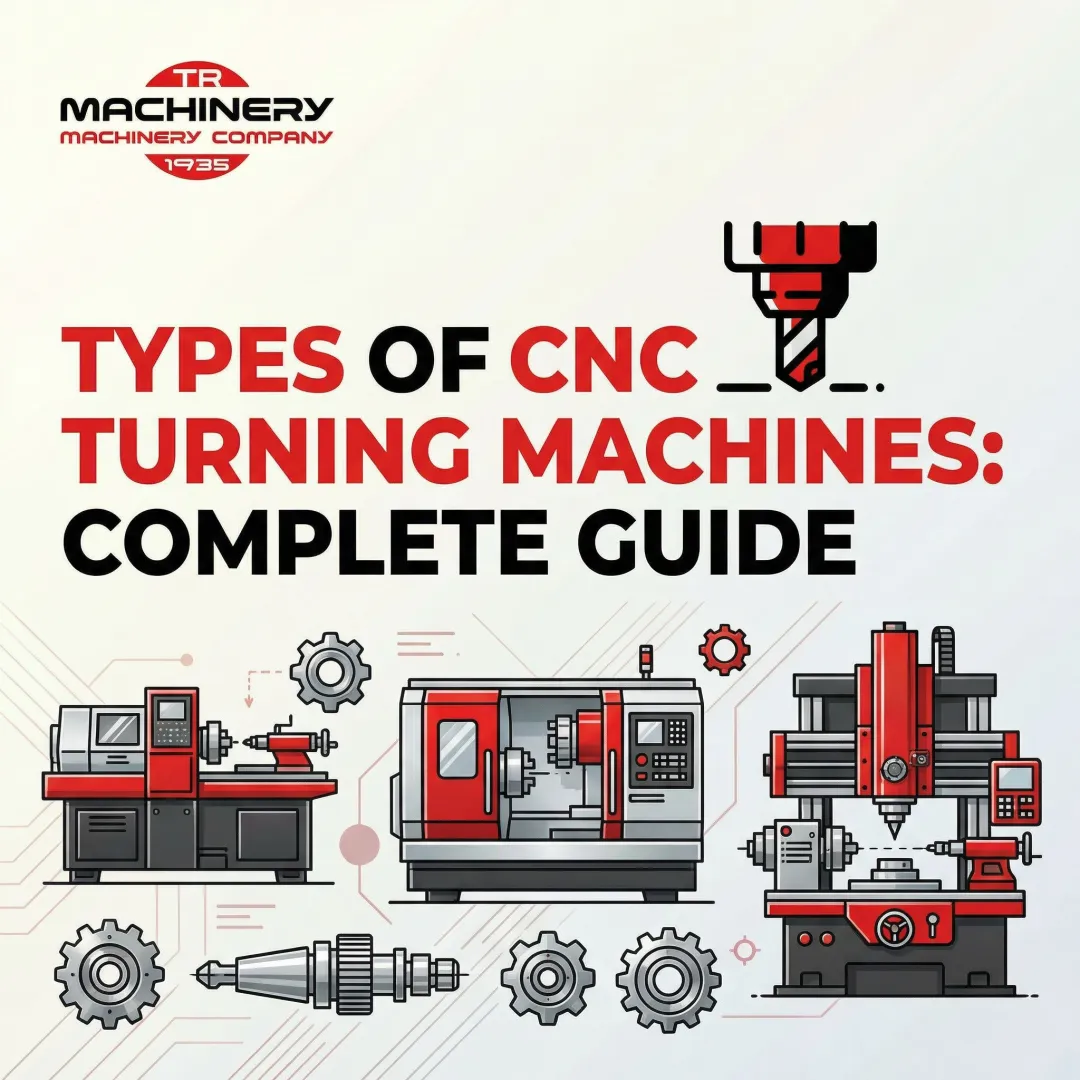
Horizontal turning centers remain the workhorse configuration for cylindrical parts and high-volume production — shafts, flanges, bushings, and general cylindrical components. They're the default choice for automotive manufacturers and general machining shops.
Vertical turning centers handle heavy, short workpieces and large-diameter components in aerospace, energy, and defense. Machining a 72-inch turbine disc or wind turbine hub requires that vertical orientation — gravity keeps massive workpieces stable and accessible.
Modern turning centers go well beyond basic lathes, offering:
- 3-5+ axes of motion
- Automatic tool changers
- Live tooling with milling capability
- Fully enclosed work envelopes with integrated chip management
Market Segmentation by Spindle Configuration
The turning center market segments by spindle count and capability:
| Machine Type | 2025 Market Share | Projected CAGR (2026-2034) | Primary Applications |
|---|---|---|---|
| Horizontal CNC Turning | 48.7% | 5.9% | Shafts, flanges, bushings (automotive & general manufacturing) |
| Vertical CNC Turning | 22.4% | 6.4% | Large rings, discs, pump housings (heavy industrial and energy) |
| Multi-Spindle CNC Turning | 17.6% | 7.2% | Fittings, pins, connector bodies (high-volume fasteners) |

Multi-tasking machines — turning centers with live tooling, Y-axis capability, and sub-spindle configurations — are gaining share rapidly. These platforms eliminate secondary setups entirely, processing complete parts in a single fixture. The result: fewer fixturing errors, shorter cycle times, and less work-in-process inventory sitting on the floor.
The Aftermarket Segment
OEM replacement parts, control system upgrades, and reconditioning of existing turning center assets represent an active and growing portion of total market activity. For shops managing capital budgets tightly, refurbishing existing equipment — replacing worn components or upgrading aging controls — delivers a measurable production capability gain without the lead time or cost of new machine acquisition. This is especially relevant for vertical turning center operators, where replacement parts and control retrofits can extend machine life by a decade or more.
What's Driving Market Growth in 2026
Aerospace and Defense Manufacturing Expansion
Airbus reported a commercial aircraft backlog of 8,770 aircraft as of February 28, 2026, while Boeing's backlog stood at 6,734 aircraft—a combined backlog exceeding 15,400 commercial aircraft. Each aircraft requires dozens of precision-turned components: engine shafts, landing gear housings, turbine discs, structural airframe elements.
Defense modernization is generating parallel demand across multiple markets:
- U.S. FY2026 defense budget: $839.2 billion
- NATO allies in Europe and Canada invested $574 billion in 2025, a 20% real-terms increase
- Japan approved a $58 billion defense budget for FY2026
Fulfilling these programs requires CNC turning center capability, especially large-format precision turning for aerospace-grade materials.
Reshoring and Nearshoring Activity
North American manufacturers bringing production back from overseas need modern machine tool infrastructure to establish competitive domestic capacity. 244,000 reshoring jobs were announced in 2024, with 1.7 million jobs reshored since 2010.
While Q1 2025 saw some moderation in overall reshoring announcements, transportation equipment reshoring surged 139% compared to 2024—directly impacting machine tool demand as automotive and aerospace manufacturers expand domestic capacity.
Renewable Energy Infrastructure Buildout
Wind turbine hubs, tower flanges, and generator housings are among the largest and most precision-critical machined components in any industry. Each installation requires multiple large-diameter parts that can only be processed on CNC vertical turning centers.
In 2025, 7.7 GW of wind capacity was added to the U.S. grid, while globally, installations exceeded 150 GW for the year. Each gigawatt of wind capacity requires hundreds of precision-machined large-diameter components—every one of them a turning center application.

Medical Device Manufacturing Growth
Longer life expectancies, expanding global healthcare access, and a growing range of implantable devices are all driving demand for high-precision CNC turning capability.
The global orthopedic implants market was valued at $26.97 billion in 2025 and is projected to reach $36.63 billion by 2033, growing at a 3.94% CAGR. The U.S. market alone was worth $22.98 billion in 2023 and is growing at a 5.0% CAGR.
Surgical instruments, orthopedic implants, and spinal hardware all require tight-tolerance turning operations on biocompatible materials—titanium, cobalt-chrome alloys, and specialized stainless steels.
Replacement and Upgrade Cycle
A large portion of the installed base of CNC turning equipment in North America is aging—many shops operate machines 15–25+ years old. Current-generation turning centers outperform that legacy equipment by measurable margins:
- Cycle time reductions of 30–50% through optimized toolpaths and higher spindle speeds
- Surface finish improvements from improved thermal stability and control resolution
- Expanded axes of motion (Y-axis, sub-spindle, live tooling)
- Digital connectivity enabling real-time production monitoring
This performance gap is increasingly making the capital case for replacement compelling, even without external demand pressure.
Technology Trends Reshaping Turning Centers in 2026
AI-Assisted Machining and Autonomous Optimization
Leading CNC control platforms are incorporating AI functions that fundamentally change how turning centers operate:
| OEM | Feature | Turning-Specific Function |
|---|---|---|
| FANUC | Servo Learning Oscillation | Performs oscillation cutting in turning applications, producing small chips and avoiding entanglement |
| Siemens | Adaptive Control | Monitors current cutting conditions in real-time and automatically adjusts feedrate to optimum speed |
| Mitsubishi | Real-time Tuning 2 | Estimates workpiece inertia and optimizes acceleration/deceleration automatically, reducing cycle time when workpiece weight changes significantly |
| Heidenhain | Adaptive Feed Control | Automatically controls feed rate during program run as a function of current spindle power consumption |
These systems self-optimize cutting parameters, monitor tool wear in real time, and adapt to material variation mid-cycle—without programmer intervention. The machine is no longer just a cutting tool — it's an active participant in process control.
Multi-Tasking and Done-in-One Machining
The dominant product development trend across all major turning center manufacturers is the integration of milling, drilling, tapping, and turning capability in a single machine—often with live tooling, Y-axis movement, and sub-spindle configurations.
The business case comes down to two compounding advantages:
- Fewer setups, lower cycle time — a part requiring three operations (turning, milling, drilling) completes in one clamping
- Less repositioning error — each machine transfer introduces positioning variation; single-setup machining removes that variable entirely
- Reduced work-in-process — parts don't queue between machines, freeing floor space and cash tied up in partially finished inventory

CAD/CAM System Integration and Offline Programming
Direct integration between design (CAD) and manufacturing (CAM) environments has transformed CNC turning center programming. Advanced toolpath strategies like Sandvik Coromant's PrimeTurning have enabled cycle time reductions of 30% to 50%, while Mastercam users report cycle time reductions of 20% and tool life improvements of 150%.
Offline programming eliminates manual G-code entry for complex parts and enables simulation of cutting paths before a single chip is made. For shops running high-mix, lower-volume production, programming efficiency directly impacts profitability.
Industry 4.0 Connectivity and IIoT Integration
Modern turning centers are increasingly designed with native data output capability—machine utilization, spindle load, cycle counts, alarm history—that feeds into manufacturing execution systems (MES) and shop floor analytics platforms.
This connectivity layer enables predictive maintenance, OEE tracking, and production scheduling optimization in real time. 72% of large manufacturers have at least one IIoT pilot or production deployment, though only 25-30% have scaled beyond pilot to enterprise-wide deployment.
Shops that complete the transition report OEE improvements of 5-7 percentage points and productivity increases of 5-10% — gains that compound quickly at high production volumes.
Industry Applications and Regional Demand
Sectors Driving Turning Center Investment
Four end markets dominate CNC turning center investment in 2026:
- Aerospace and defense — The largest and fastest-growing segment by spend. Turbine discs (±0.0005" tolerances), titanium landing gear housings, and exotic-alloy airframe elements demand turning centers with thermal stability, multi-axis capability, and advanced controls.
- Automotive — High-volume and increasingly EV-focused. Electric motor shafts, gearbox housings, and battery cooling components require tight tolerances and consistent surface finishes across long production runs.
- Medical device manufacturing — The tightest tolerances in the market, with biocompatible materials (titanium, cobalt-chrome) and full regulatory traceability required. Orthopedic implants and surgical instruments are typically turned from bar stock to micron-level precision.
- Energy — Covers both oil and gas (valve bodies, pump housings, drilling components) and renewables (wind turbine hubs, tower flanges). Component scale in this sector—often measured in feet—drives demand for large-format vertical turning centers.

Understanding which sectors are investing helps clarify where that investment is concentrated geographically.
Regional Investment Activity
North America is experiencing one of its most active machine tool investment cycles in recent memory. The convergence of defense spending, reshoring incentives (CHIPS Act, IRA, infrastructure legislation), and genuine manufacturing capacity gaps for precision components is driving capital deployment.
U.S. machine tool orders in December 2025 grew 86.7% over November and 59.9% over December 2024, bringing the 2025 total to $5.74 billion—a 22.5% year-over-year increase. This represents real capacity expansion, not replacement-only investment.
Asia-Pacific remains the fastest-growing region by volume. China dominates the installed base, Japan and South Korea maintain technology leadership in control systems and precision components, and India is emerging as a significant new demand center for both domestic production and export-oriented manufacturing.
Europe serves as the precision technology innovation center. Germany, Italy, and Switzerland produce the highest-specification turning center platforms, often setting global standards for thermal stability, accuracy, and control system sophistication.
For U.S. buyers, these regional dynamics create both opportunity and complexity:
- European platforms offer maximum capability at premium pricing
- Asian platforms deliver strong value with increasingly capable technology
- North American manufacturers provide proximity, responsive support, and familiarity with domestic application requirements
What This Means for U.S. Manufacturers: Investment Decisions in 2026
The current market environment creates a genuine window for U.S. manufacturers to upgrade turning capability strategically rather than reactively. Active reshoring, strong aerospace and defense order books, and aging domestic turning center fleets are converging.
Manufacturers should ask:
- Can current machines hold the tolerances customers will require in 2-3 years?
- Are setup times limiting throughput on multi-operation parts that could be completed in one setup on a multi-tasking turning center?
- Is the lack of digital connectivity creating a blind spot in production visibility—do you know machine utilization rates, actual cycle times, and downtime causes?
- Are you passing on work because existing equipment can't handle the size, material, or complexity?
Those questions point toward the same decision: whether to invest in new capacity, upgrade existing machines, or source parts to extend the life of current equipment. Each path involves different lead times, capital requirements, and risk profiles — and working with a dealer experienced across all three simplifies the evaluation.
T.R. Wigglesworth Machinery Co. has served the machine tool industry since 1935. As an authorized dealer for FEMCO, KENT, and DAH LIH turning centers — and a specialized OEM parts source for Webster & Bennett vertical turret lathes and boring mills — the company supports manufacturers through equipment selection, delivery, installation, and training.
New vs. Used Equipment Considerations
In the current market, both new and certified used equipment have merit depending on budget, production requirements, and timeline.
New turning centers offer full technology integration — AI-assisted machining, IIoT connectivity, advanced toolpath capability — along with warranty coverage and current-generation control systems. For shops that need maximum capability from day one, new equipment carries the lowest operational risk.
Certified used equipment delivers comparable capability at lower capital outlay, making it a practical option for shops entering a new machining segment, working within tight budgets, or needing to expand capacity faster than new-equipment lead times allow.
Machine specification should match actual production requirements, not anticipated future needs that may never materialize. A 15-year-old horizontal turning center with a recent control upgrade and sound mechanical condition can outperform a basic new machine on most standard applications, often at half the capital cost.
Frequently Asked Questions
What are the trends for CNC machining in 2026?
Dominant trends include:
- AI-assisted machining optimization that automatically adjusts cutting parameters
- Multi-tasking turning centers enabling done-in-one setups
- Industry 4.0 connectivity for real-time production monitoring
- Reshoring-driven capital investment in North America
What is the difference between a CNC turning center and a CNC lathe?
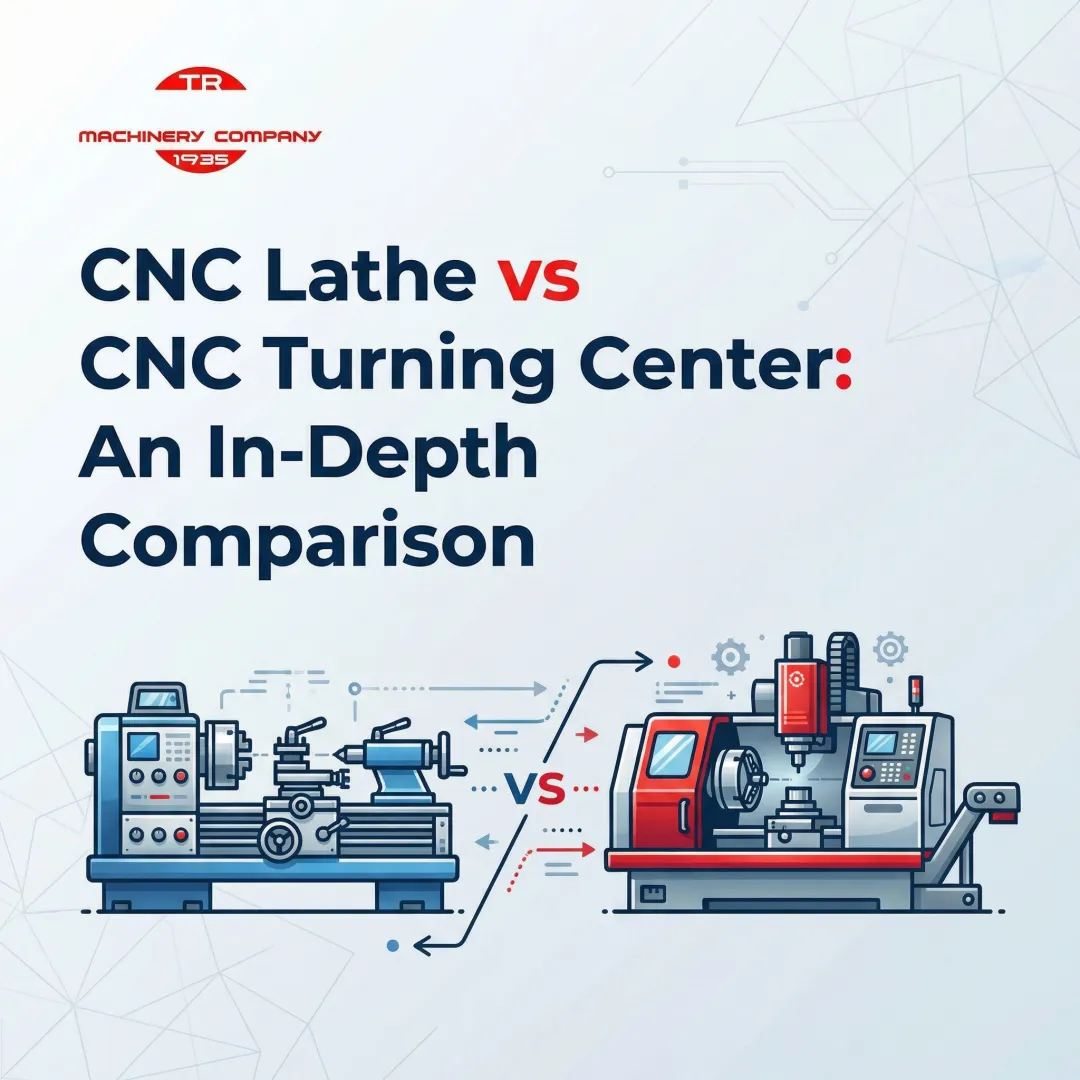
CNC turning centers are more advanced than basic lathes—they typically offer 3-5 axes of motion, automatic tool changers, live tooling for milling and drilling operations, and enclosed work envelopes with integrated chip management. Conventional CNC lathes are typically 2-axis turning-only machines without these additional capabilities.
What industries are driving the most demand for CNC turning centers in 2026?
Aerospace and defense represent the largest share, driven by record aircraft backlogs and defense modernization programs. Automotive (especially EV components), medical device manufacturing, and energy (wind turbine infrastructure and oil and gas equipment) are the other primary demand drivers for turning center investment in the current market cycle.
What is the projected market size for the CNC turning center market?
Key segments by 2024 valuation and growth projections:
- CNC metal-cutting machines (total market): $96.38B in 2024, growing through 2033
- CNC machining & turning centers: $27.64B in 2024 → $40.61B by 2030 (6.6% CAGR)
- Vertical lathes & turning centers: $3.8B in 2024 → $6.2B by 2033 (5.2% CAGR)
What is the biggest challenge facing CNC turning center operators in 2026?
The skilled operator and programmer shortage remains the most significant constraint. Many shops cannot fully utilize existing machines due to the trades gap—let alone justify new investment without a workforce development plan or automation strategy in place.
Is now a good time to invest in a new CNC turning center?
For shops whose current turning capacity is constraining throughput or limiting achievable tolerances, 2026 conditions—strong aerospace, defense, and medical demand, active reshoring, and an aging domestic fleet—make a credible case for investment. The decision should match machine capability to actual production requirements, not react to emergency capacity needs.