Introduction
Factories across aerospace, heavy equipment, and energy sectors are accelerating production capacity at a pace not seen in years. U.S. manufacturing technology orders reached a record $814.3 million in December 2025, closing the year up 22.5%. At the heart of this expansion are horizontal boring milling machines (HBMs) — the precision workhorses capable of machining engine blocks, turbine housings, and gearboxes to micrometer tolerances.
This article breaks down the HBM market in 2026: current valuations, projected growth rates, the industries and regions driving demand, and what it means for manufacturers making capital equipment decisions now. T.R. Wigglesworth Machinery Company — sourcing and selling HBMs since 1935 as an authorized dealer for brands including FEMCO and KENT — draws on nearly nine decades of firsthand market experience to frame the analysis.
Key Takeaways:
- HBM market valued at $3.3B–$4.2B in 2024; projected 4.2%–6.2% CAGR through the 2030s
- Aerospace orders surged 45.1% in 2025; F-35 contract adds 296 jets starting 2026
- Reshoring brought 244,000 jobs back to North America in 2024, fueling HBM demand
- CNC upgrades, digital twins, and predictive maintenance are shortening equipment replacement cycles
- Extending lead times and growing backlogs are pushing buyers to weigh new against used equipment
What Is a Horizontal Boring Milling Machine?
Horizontal boring milling machines are specialized machine tools designed to enlarge pre-drilled holes with high precision — often to micrometer tolerances — while also performing milling, drilling, and threading operations.
Their horizontal spindle orientation makes them uniquely suited for large, heavy workpieces like engine blocks, gearboxes, and turbine housings that would be impractical to position on vertical machines.
Three Main HBM Types:
- Table/Universal Type — Movable table on a cross slide handles medium-to-large box parts and engine bases; the most common configuration for general job shops
- Floor Type — Movable column along X-axis with stationary floor plate; handles oversized workpieces up to 100+ tons for shipbuilding and energy turbines
- Planer/T-Type — T-bed configuration with a movable column along the Z-axis, built specifically for complex prismatic aerospace structural components
All three configurations adopted CNC integration as standard by the 1980s, which transformed repeatability and sharply reduced manual setup time. Modern HBMs now feature multi-axis CNC control, automatic tool changers, and real-time feedback systems that enable fully unattended production of complex parts.
Market Size and Growth Projections for 2026 and Beyond
The HBM market is experiencing steady expansion, though published estimates vary significantly by scope and methodology. Multiple syndicated research firms project growth rates between 4.2% and 6.2% CAGR through the 2030s, with baseline valuations ranging from $1.59 billion to $4.2 billion depending on whether analysts are tracking HBMs specifically or broader boring/milling categories.
Published Market Estimates:
| Publisher | Base Year | Forecast Year | CAGR | Base Valuation | Forecast Valuation |
|---|---|---|---|---|---|
| Verified Market Research | 2024 | 2032 | 6.2% | $3.34B | $4.45B |
| Dataintelo | 2025 | 2034 | 5.5% | $4.2B | $6.8B |
| WiseGuyReports | 2024 | 2035 | 4.2% | $1.59B | $2.5B |
These ranges reflect different methodologies — some track HBMs exclusively, while others include broader milling machine categories. Across all three, the direction is the same: mid-single-digit growth driven by accelerating precision manufacturing demand.
Why 2026 Matters:
Oxford Economics projects a 4.3% decline in machine tool orders for 2026 before a sharp 12.7% rebound in 2027. This temporary dip reflects financing conditions and capital equipment cycles — not a collapse in underlying demand.
Several structural forces are converging to sustain HBM purchases even as broader machine tool orders soften:
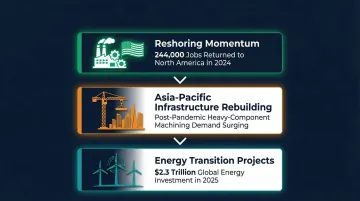
- Reshoring momentum in North America is driving capital equipment investment at domestic facilities
- Asia-Pacific infrastructure rebuilding post-pandemic is generating sustained orders for heavy-component machining
- Energy transition projects require large, precision-bored parts for wind turbines, grid hardware, and power generation equipment
The global machine tool market correlates tightly with industrial production indices — when manufacturing GDP rises, equipment purchases follow within 6-12 months. With global energy transition investment hitting a record $2.3 trillion in 2025, shops machining large structural components for those projects are among the clearest near-term buyers of horizontal boring mills.
Key Drivers Fueling Market Growth in 2026
Aerospace and Defense Procurement
Aerospace orders jumped 45.1% in 2025 driven by both defense and commercial programs. Lockheed Martin finalized a $24.3 billion contract for 296 F-35s (Lots 18-19), with deliveries starting in 2026. Each airframe requires precision-machined landing gear, engine mounts, and fuselage sections — work that depends on large HBMs capable of holding tight tolerances on complex geometries.
Reshoring and Near-Shoring to North America
The Reshoring Initiative tracked 244,000 announced reshoring and FDI jobs in 2024. Supply chain vulnerabilities exposed during 2020-2023 pushed U.S. and Mexican manufacturers to localize production of large components.
A 2025 survey found that shifting OEMs to a Total Cost of Ownership (TCO) model — rather than piece-price comparisons — increases the U.S. win rate against offshore suppliers from 8% to 32%. This shift is driving domestic HBM procurement as shops build capacity for heavy machining.
Infrastructure and Energy Sector Expansion
Large-scale infrastructure projects require large-bore precision components — bridge bearings, power generation casings, offshore platform structures. The U.S. Department of Energy reported $2.1 billion invested in the domestic offshore wind supply chain since 2023. Wind turbines, hydro equipment, and other energy transition projects generate demand for HBMs capable of machining oversized turbine hubs, nacelle bedplates, and generator frames — often weighing 20 to 100+ tons.
Industry 4.0 Technology Refresh Cycle
That same capital investment pressure is accelerating a parallel shift inside machine shops: the retirement of legacy equipment. Boring mills without CNC integration, IoT connectivity, or modern control systems are being phased out. This refresh cycle is boosting new HBM sales even in markets with large installed bases.
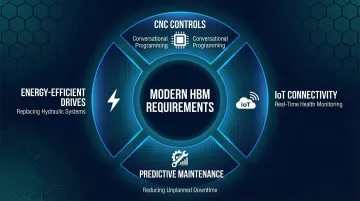
Procurement criteria in aerospace and precision manufacturing now routinely include predictive maintenance capabilities — a requirement that effectively rules out 1970s-1990s vintage equipment. Key capabilities buyers are requiring:
- Integrated CNC controls with modern conversational programming
- IoT connectivity for real-time machine health monitoring
- Predictive maintenance software to reduce unplanned downtime
- Energy-efficient servo drives replacing older hydraulic systems
Growing Component Complexity
As parts become geometrically complex — multi-axis bores, tighter tolerances, harder materials — manufacturers are pushed toward higher-specification HBMs. This trend raises average selling prices and drives market value growth beyond unit volume alone. A shop that could previously manage with a 3-axis table-type mill now requires 5-axis capability with hydrostatic guideways and active chatter suppression.
Technology Trends Shaping the HBM Market in 2026
CNC and Automation Integration
Modern HBMs feature multi-axis CNC control, automatic tool changers, hydrostatic guides, and real-time feedback systems. Together, these capabilities let shops maintain tight tolerances at scale without depending on a shrinking pool of experienced manual operators.
Key capabilities:
- Multi-axis simultaneous machining (4- and 5-axis)
- Automatic tool changers with 60-120 tool magazines
- Hydrostatic guideways supporting 100-200 ton workpieces
- Linear measurement scales on all axes for micron-level accuracy
IoT and Predictive Maintenance
Embedded sensors and cloud-connected diagnostics reduce unplanned downtime by flagging issues before failure. FANUC's AI Servo Monitor uses machine learning to analyze daily performance and predict drive system failures. For manufacturers running high-value aerospace parts, avoiding a mid-cut failure that scraps a $50,000 forging makes predictive monitoring a straightforward business case.
Digital Twin and Simulation Software
Digital twin technology allows manufacturers to simulate boring operations before cutting, reducing setup errors and material waste. A case study at HANOMAG Aluminium using Siemens NX CAM reduced machine downtime during part run-in from 15 shifts to just 1, saving approximately €11,000 per new component. For low-volume, high-value work, that kind of upfront simulation pays for itself on the first part.
Active Vibration Control
Vibration is one of the hardest limits on cutting performance in heavy machining. Soraluce's Dynamics Active Stabilizer (DAS) system detects mechanical vibrations and generates counter-oscillations, increasing cutting performance by up to 300% and reducing production time by 45%. On hardened steels or titanium, those numbers translate directly into fewer passes, less tool wear, and faster cycle times.
Sustainability and Energy Efficiency
Energy-efficient motors, reduced coolant waste, and eco-friendly lubricant compatibility increasingly influence purchasing decisions. Manufacturers operating under ESG mandates or pursuing ISO 14001 certification evaluate power consumption as a procurement criterion. Modern HBMs with variable-frequency drives and optimized hydraulic systems can reduce energy consumption 20–30% compared to machines from the 1980s-1990s.
Top Industries Driving HBM Demand
Aerospace, Defense, and Energy
These three sectors consistently account for a disproportionate share of HBM utilization because of their requirement for large, high-tolerance components:
- Aerospace: Turbine casings, landing gear forgings, airframe bulkheads
- Defense: Weapon system housings, armored vehicle frames, naval components
- Energy: Wind turbine hubs, generator housings, pump casings for hydro and offshore platforms
The $995 billion in total U.S. aerospace and defense business activity in 2024 creates sustained demand for precision heavy machining capacity.
Automotive and Heavy Equipment Manufacturing
The automotive sector's demand profile has shifted — but not disappeared. Traditional engine block machining is declining while new EV-related work is expanding. Heavy equipment remains a steady baseline. Key HBM applications across this segment include:
- Motor housings and battery enclosures for electric vehicle platforms
- Large gearbox housings and swing bearings for construction and mining machinery
- Structural castings for heavy commercial vehicles
Medical Device and Precision Instrumentation
Volumes are smaller, but this segment demands the highest tolerances and surface finish quality. Medical device manufacturers machining orthopedic implants, surgical robotics components, and precision diagnostic equipment require HBMs capable of sub-micron positioning accuracy and mirror-finish surface quality. Demand is concentrated in North America, where medical device manufacturing has expanded steadily — making it one of the faster-growing end markets for high-precision HBM capacity.
What Growing Demand Means for Equipment Buyers in 2026
Lead Times Are Extending and Prices Are Rising
Sustained demand from contract machine shops and aerospace suppliers is keeping lead times tight for custom heavy machinery. New HBMs from major manufacturers now carry lead times of 9–18 months for build-to-order configurations. Buyers waiting to purchase may face longer delivery windows and higher prices as backlogs grow.
New vs. Used HBM Considerations
Those extended lead times and rising new-machine prices are pushing more buyers to seriously evaluate the used market. Each path has real advantages:
Buying New: Latest CNC control systems, IoT integration, warranty coverage, optimized energy efficiency, digital twin compatibility
Buying Used: Lower capital outlay, faster availability, proven reliability for established processes, suitable when tolerances don't require latest technology
Companies like T.R. Wigglesworth Machinery Company carry both new and used HBMs from brands like FEMCO, FERMAT, and TOS — with nearly 90 years in the machine tool business, they stock everything from precision CNC models with Heidenhain 5-axis DRO to vintage Lucas floor-type machines from the 1960s–1970s in good condition, covering a wide range of budgets and applications.
Matching Machine Spec to Application
Buyers should evaluate these specifications against actual part requirements:
- Size the table to your largest workpiece — both dimensions and weight capacity
- Choose spindle diameter based on the boring bar size and rigidity your tolerances require
- Confirm axis travel covers the full part envelope plus tool clearance
- Verify CNC control compatibility with your shop's existing standards and programmer skillset
A shop machining 5-ton gearbox housings doesn't need a 100-ton floor-type machine. Buy to your application, not the market trend — over-specification is just as costly as under-specification.
| Product | Product Details |
|---|---|
| BMC-110R1 | Explore Product |
| BMC-135TN | Explore Product |
| BMC-135TNL | Explore Product |
Frequently Asked Questions
What is the projected market size for horizontal boring milling machines in 2026?
Market research firms estimate the HBM market between $3.3B–$4.2B in base valuations, with projected CAGR ranging from 4.2%–6.2% through the 2030s. Valuations vary by scope (HBM-specific vs. broader milling categories), so buyers should cross-reference multiple sources and focus on demand trends in their specific industry rather than absolute market size numbers.
Which industries use horizontal boring milling machines the most?
Aerospace, defense, energy, automotive, heavy equipment, and precision manufacturing are primary sectors. These industries require machining of large, complex components with tight tolerances — engine blocks, turbine housings, landing gear, gearboxes — where HBMs' horizontal spindle orientation and high rigidity make them essential for holding precision on heavy workpieces.
What is the difference between a horizontal and vertical boring mill?
Horizontal boring mills suit long, heavy workpieces — engine blocks, gearboxes — where the horizontal spindle delivers access and rigidity. Vertical boring mills handle large-diameter cylindrical components like turbine housings and ring gears. Choose based on part geometry: horizontal for length and depth, vertical for diameter.
How is CNC technology changing the horizontal boring milling machine market?
CNC integration has improved precision, repeatability, and automation while enabling predictive maintenance and digital twin compatibility. These advances are accelerating replacement cycles as manufacturers retire 1970s–1990s equipment that lacks IoT connectivity and multi-axis capability, driving new HBM sales even in markets with established installed bases.
Is it better to buy new or used horizontal boring milling machines in 2026?
New machines offer the latest control systems, warranties, and IoT features; used machines provide strong value for shops with proven processes and tighter budgets. The right choice depends on your required tolerances, automation level, available service support, and whether your application demands the latest technology or prioritizes proven reliability.
Which regions are seeing the fastest growth in HBM adoption?
Asia-Pacific (particularly China, India, and Southeast Asia) leads in growth rate due to rapid industrialization and infrastructure development. North America and Europe maintain strong demand driven by aerospace, defense, and reshoring investment, with focus on technologically advanced, highly automated HBMs to offset labor costs and meet stringent tolerances for precision applications.