Introduction
Warped surfaces, contaminated welds, and scrapped material rarely come down to poor technique. Most often, they trace back to the wrong table top material or thickness chosen before the first arc was ever struck.
A table that handles light fabrication easily may buckle under heavy structural assemblies. A stainless component welded on a carbon steel surface risks iron contamination that destroys corrosion resistance.
This guide focuses on the table top surface: the material type and thickness that determine flatness, heat resistance, durability, and workpiece compatibility. The right choice depends on your welding process, workpiece demands, and shop environment — not a universal specification.
Key Takeaways
- Carbon steel (A36 or A572-50) is the most practical choice for most fabrication environments
- Cast iron offers superior flatness but is brittle, heavy, expensive, and hard to repair
- Stainless steel and aluminum suit niche applications requiring contamination control or corrosion resistance
- Thickness depends on table design—3D ribbed structures can outperform thicker flat plates
- Match your choice to workpiece weight, welding process, flatness needs, and shop environment
Welding Table Top Materials: Pros, Cons, and Best Use Cases
Four primary materials dominate welding table construction: carbon steel, cast iron, stainless steel, and aluminum. Carbon steel accounts for the majority of tables in use, but the right choice depends heavily on your specific welding environment and industry requirements.
Carbon Steel
Carbon steel is the industry default for good reason:
- Acts as a heat sink during welding—high thermal conductivity draws heat away from the workpiece, reducing distortion
- Weldable and machinable, making field repairs or surface modifications straightforward
- Costs less than cast iron, stainless steel, or aluminum alternatives
- Widely stocked by suppliers and fabricators across the US
Two Common Grades:
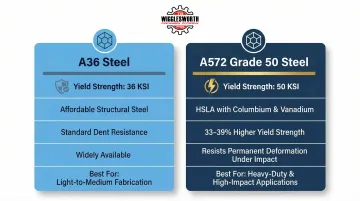
| Grade | Yield Strength | Key Characteristics |
|---|---|---|
| A36 | 36 ksi | Widely used structural steel since 1960; reliable and affordable |
| A572 Grade 50 | 50 ksi | High-strength low-alloy (HSLA) steel with higher yield strength and better toughness—can spring back from impact rather than permanently dent |
Critical distinction: A572 Grade 50 is not simply "stronger A36." It's a fundamentally different steel classification with HSLA alloying elements (columbium and vanadium) that provide 33-39% higher yield strength. Where A36 would dent under a heavy impact, A572-50 resists permanent deformation.
Main downside: Susceptibility to rust without proper maintenance—particularly in humid or outdoor environments.
Cast Iron
When carbon steel's flexibility isn't the priority, cast iron becomes the choice for precision work requiring exceptional flatness. High mass and density resist heat-induced warping, and machined cast iron surfaces achieve tight tolerances with minimal distortion under sustained loads—making them well-suited for high-tolerance fixturing environments.
Significant drawbacks:
- Cracks rather than bends under sudden impact—no warning before failure
- Weighs significantly more than steel per square foot, complicating installation and relocation
- Carries higher material and machining costs than steel alternatives
- Effectively unrepairable once cracked—replacement is the only option
- Holds heat longer than steel due to lower thermal conductivity
- Imported options may use undefined scrap-metal blends with inconsistent properties
Source only from manufacturers who disclose specific iron grades. Generic "cast iron" specifications offer no guarantee of consistent material properties.
Stainless Steel
For shops working with stainless components, surface material becomes a contamination issue—not just a durability one. Any contact with carbon steel surfaces can compromise the corrosion resistance of finished welds. Stainless table tops eliminate that risk, which is why they're standard in:
- Food processing facilities
- Pharmaceutical manufacturing
- Medical device production
- Stainless fabrication shops
Practical limitations:
- Holds heat longer than carbon steel due to lower thermal conductivity
- Weld spatter mars the surface more readily—protective agents are necessary during use
- Typically costs 3-4× more than equivalent carbon steel surfaces
Aluminum
Aluminum table tops serve three primary use cases:
- Portable setups where weight reduction matters—aluminum tables can be moved or repositioned without heavy lifting equipment
- Non-ferrous environments where iron contamination must be avoided, such as aluminum or stainless fabrication
- Processes requiring rapid cooling, where aluminum's heat dissipation rate outperforms steel
- Applications near electromagnetic-sensitive equipment, where aluminum's non-magnetic properties are required
Practical limitations:
- Scratches and dents under heavy use—noticeably softer than any steel option
- Reduced mass limits stability for heavy-duty welding applications
- Prone to surface deformation under clamping pressure from tooling fixtures
- Costs more than carbon steel despite the weight reduction
Welding Table Top Thickness: How to Get It Right
Thickness is not a standalone specification — it must be evaluated alongside table design. A well-engineered 3D table with interlocking ribs or sidewall support can outperform a bare flat plate of much greater thickness.
The reason: ribs transfer load and resist deflection across the entire structure rather than relying on the plate's mass alone. This changes what "thick enough" actually means in practice.
Table Design and Its Effect on Required Thickness
Two main design types drive thickness requirements:
Flat Plate Tables:
- Simple leg support with no internal structure
- Require substantial thickness (typically 1/2″ or more) to resist deflection under load
- More prone to warping and surface distortion
- Lower inherent flatness due to lack of edge support
3D Ribbed Tables:
- Cross-ribbing or boxed sidewalls carry structural load
- Can maintain flatness with tops as thin as 3/16″ to 1/4″
- Infrastructure distributes stress across entire surface
- Resist deflection more effectively than equivalent-weight flat plates
The real performance metric is deflection under load, not rated weight capacity. A 3D table with a thinner top can maintain tighter flatness tolerances than a heavier flat plate.
Thickness by Application and Workpiece Type
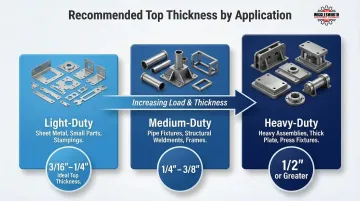
| Application Type | Recommended Thickness | Typical Workpiece |
|---|---|---|
| Light-duty fabrication | 3/16″ to 1/4″ (with 3D support) | Small parts, tubing, sheet metal |
| Medium-duty fabrication | 1/4″ to 3/8″ | Structural weldments, pipe work |
| Heavy-duty fabrication | 1/2″ or greater | Heavy assemblies, industrial components |
Material grade also affects how much thickness you need. A572-50 can withstand impact at a given thickness where A36 would permanently dent — so upgrading steel grade can compensate for a thinner top without sacrificing durability. Cast iron is the exception: despite its mass resisting warping, it requires greater thickness to offset brittleness risk under impact loads.
Key Factors When Choosing the Right Welding Table Top
Material and thickness specs only make sense in context. The following factors connect technical specifications to measurable shop outcomes like weld accuracy, setup time, surface longevity, and total cost of ownership.
Welding Process and Workpiece Compatibility
Your welding process directly affects material choice:
- MIG welding produces more spatter than TIG, increasing surface maintenance demands
- Welding stainless or aluminum on carbon steel surfaces risks contamination and may require spacers or a dedicated non-ferrous table
- Workpiece weight and impact frequency (e.g., dropping heavy assemblies) should drive thickness and material grade decisions
Flatness Tolerance and Precision Requirements
Applications requiring tight dimensional tolerances demand surfaces with the flattest possible baseline and the best resistance to heat-induced warping:
- Aerospace components
- Medical device fixtures
- Precision structural assemblies
Best choices: Cast iron or high-grade carbon steel 3D tables outperform basic flat plate setups, which typically have lower inherent flatness due to lack of edge support.
Environmental Conditions and Industry Requirements
Shop environment has a direct impact on material and treatment choices:
- High-humidity or outdoor environments accelerate rust on untreated carbon steel—surface treatment or stainless preferable
- Regulated industries (food, pharmaceutical, medical) may require stainless tops to meet hygiene standards
- Chemical exposure or moisture demands corrosion-resistant materials
Budget and Long-Term Cost of Ownership
Upfront material cost is only part of the equation. Each material carries a different long-term maintenance and replacement profile:
- Carbon steel has the lowest purchase price and is easiest to repair, but requires ongoing rust prevention maintenance
- Cast iron and stainless carry higher upfront costs — cast iron needs periodic seasoning, stainless requires less ongoing treatment
- 3D tables often cost more than thick flat plates upfront, but deliver better long-term performance and are easier to reconfigure as job requirements change
A well-maintained carbon steel table can last 15–20 years in a moderate-use shop; cast iron tops often outlast the frames they're mounted on. Run the numbers over a 10-year horizon — purchase price rarely tells the full story.
How T.R. Wigglesworth Machinery Company Can Help
T.R. Wigglesworth Machinery Company has served as a full-service industrial equipment provider since 1935, with deep expertise in precision-driven industries including aerospace, defense, medical device manufacturing, and heavy fabrication—sectors where equipment decisions directly affect part quality and production efficiency.
For shops sourcing welding tables, the company stocks fabricating equipment from established manufacturers and can help match table specifications—including top material and thickness—to your actual production requirements.
Key capabilities:
- Authorized dealer for fabricating equipment brands including Arclight Dynamics, covering welding tables and cutting tables
- New and used equipment options to fit different shop budgets and timelines
- Comprehensive support including delivery, installation, and training
- Experienced working with aerospace, defense, and heavy fabrication operations where table rigidity and flatness tolerances matter
| Product | Product Details |
|---|---|
| 4'x8' Welding Table | Explore Product |
| 4'x4' Welding Table | Explore Product |
| 3'x5' Welding Table | Explore Product |
Conclusion
There is no universal "best" material or thickness for a welding table top. The right answer depends on your welding process, workpiece demands, industry requirements, and shop environment. A high-strength carbon steel 3D table is right for most fabricators, but a stainless or cast iron surface may be non-negotiable in food-adjacent fabrication or precision reference work.
That initial choice, however, isn't permanent. As your shop takes on new contract types, switches welding processes, or faces tighter tolerance requirements, it's worth revisiting whether your current surface still fits. Common triggers for re-evaluation include:
- Flatness failures becoming routine despite regular maintenance
- Adding stainless or aluminum work to a previously carbon-steel-only shop
- Meeting industry certifications that specify contamination controls
- Upgrading to precision fixturing systems that demand tighter surface tolerances
Frequently Asked Questions
What steel is used for welding tables?
Carbon steel is the most commonly used material, with A36 and A572-50 (Grade 50) being the two most widely specified grades. A36 is affordable structural steel, while A572-50 is a high-strength low-alloy steel with better impact resistance and weldability.
What is the best thickness for a welding table?
Flat plate tops typically require 1/2″ or more, while 3D tables with rib infrastructure can perform well at 3/16″ to 1/4″. Heavier workpieces and demanding processes require more mass or a tougher steel grade.
What is the best surface for a welding table?
For most fabricators, a flat carbon steel surface (A572-50 or A36) with a 3D ribbed structure offers the best combination of flatness, heat resistance, and durability. Stainless is preferred in contamination-sensitive industries like food processing and medical device manufacturing.
Can stainless steel be used as a welding table?
Yes. Stainless table tops suit applications requiring contamination control — food processing, pharmaceutical, and medical device manufacturing. They cost significantly more than carbon steel and need surface protection against spatter marring.
Is 304 or 316 better for welding?
304 is more economical and covers most stainless welding table applications. 316 adds molybdenum for stronger corrosion resistance in chloride-heavy or chemical environments — worth the premium only when those conditions are present.
Is grade 50 steel the same as A36?
No. A36 is standard structural steel with a minimum yield strength of 36 ksi; A572 Grade 50 is a high-strength low-alloy steel rated at 50 ksi. Grade 50 is tougher and better suited for table tops facing heavy-cycle or high-impact workloads.