Introduction
Most welders accept the table height they inherit — whether it's a 36" shop fixture or a DIY build someone else measured. But a few inches of difference can determine whether you finish the day sharp or stiff, whether your torch hand stays steady, and whether your welds stay consistent or drift as posture deteriorates.
The industry default of 36" is not a universal fit. It works for welders in the 5'8"–5'11" range doing general standing work. It becomes problematic for anyone significantly taller, shorter, or seated — and even more so for task-specific work like TIG precision welding or heavy grinding. The right answer depends on your height, your work type, and whether you sit or stand.
What follows covers the standard height range, how to calculate your personal fit, and what to do if your current setup is working against you.
Key Takeaways
- Most commercial welding tables default to 28"–36", but this is a starting guideline, not a rule
- For standing work, measure floor-to-forearm at a 90° elbow bend, then subtract 2"–4" — that's your target height
- Taller welders (6'0"+) typically need 38"–42" to prevent back strain
- Seated welding requires 28"–32" table height for most adults
- Adjustable-height tables or leg extensions solve height mismatches without replacing equipment
What Is the Standard Welding Table Height?
Most commercially produced welding tables arrive at 34"–36", mirroring standard kitchen countertop height. That range emerged as a general-purpose baseline for average-height adults, not from any ergonomic standard specific to welding. Use the chart below to find a starting point for your height.
Height-to-Table Reference Chart
| Welder Height | Recommended Table Height |
|---|---|
| 5'2"–5'4" | 34"–36" |
| 5'5"–5'8" | 36"–38" |
| 5'9"–6'0" | 38"–40" |
| 6'1"–6'4" | 40"–42" |
| Over 6'4" | 42"–44" |
The 36" mark works well for welders in the 5'8"–5'11" range but becomes problematic outside that zone. In shared workshops where multiple welders use the same table, that standard is a compromise at best. That's why most shops opt for adjustable-leg systems.
Hidden Height Additions
The nominal leg height rarely matches the final working height. Accessories change the equation:
- Casters: Add 0.75"–2" to overall height. Siegmund casters add 0.78" (20mm), while others add up to 2"
- Leveling feet: Offer 1"–3" of fine adjustment for uneven floors. Fireball Tool leveling pads provide ±1" of adjustment
When specifying or purchasing a table, account for these additions. A 34" table with 2" casters becomes a 36" working surface.
Why Welding Table Height Matters More Than You Think
The Biomechanics of Bending
Nachemson's classic lumbar intradiscal pressure studies proved that forward leaning increases spinal load by over 100% compared to relaxed standing. A 1999 follow-up measured standing upright at 0.50 MPa and standing flexed forward at 1.10 MPa — a 120% increase. Even a modest 15–20 degree forward lean multiplies compressive load on the lumbar spine — and welders sustain that posture for hours at a stretch.
Cumulative Strain and Injury Rates
This load accumulates into measurable injury rates. In 2024, the Bureau of Labor Statistics reported 248,180 back injury cases involving days away from work in private industry.
A 2020 study of welders in the German steel industry found 12-month prevalence of 71% for low back pain, 61% for neck pain, and 55% for shoulder pain.
The Link to Weld Quality
Poor table height also degrades weld quality directly. When posture is compromised:
- Torch hand becomes less steady
- Visibility of the weld puddle deteriorates
- Fatigue sets in faster, reducing bead consistency
Research on fine manipulative tasksfound that inappropriate table height causes deltoid muscle fatigue, interrupting end-point control and deteriorating task performance. Specifically, it recorded decreased accuracy scores and increased tapping deviation as proprioception degraded.
The High Table Problem
A table that is too high causes the opposite issue: arms raised above elbow height cause shoulder fatigue and limit downward force control, problematic for grinding, fitting, and clamp tightening.
How to Find Your Ideal Welding Table Height
The Elbow-Height Formula (With Modifications)
The basic formula: stand upright with arms relaxed, bend elbows to 90 degrees, measure from floor to bottom of forearm — then subtract 2"–4" for welding.
How to measure:
- Stand in normal work boots on a level surface
- Relax arms at your sides, then bend elbows to 90°
- Measure from floor to the underside of your forearm
- Subtract 2"–4" to account for forward lean
Why the 2"–4" Subtraction Exists
Welding requires visual access to the work surface, meaning you naturally incline forward slightly. A table set exactly at elbow height forces the neck to crane downward. The drop brings the work into a more natural sightline without hunching.
Task-Specific Height Adjustments
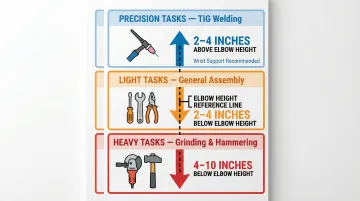
That baseline formula is a starting point. MSD Prevention Guidelines for Ontario recommend adjusting further based on task type:
- Precision tasks (TIG welding, small parts): 2–4" above elbow height with wrist/forearm support
- Light tasks (general assembly): 2–4" below elbow height
- Heavy tasks (grinding, hammering, structural welding): 4–10" below elbow height to use upper body downward forces
Accounting for Workpiece Thickness
If you routinely weld thick plate (½" or thicker), pipe, or raised fixtures, the actual work surface sits higher than the table surface. In these cases, set the table 1"–2" lower than the standard formula to compensate for added workpiece height.
Real-World Test
Set the table to calculated height, stand at it with a welding torch (or simulated posture), and check:
- Back is straight (not hunched forward)
- Elbows are slightly bent and close to the body
- Wrist is not cocked upward
- Neck is not straining downward
If any are off, adjust accordingly. Once you know your target height, the next step is choosing a table that can actually hit it — whether fixed or height-adjustable.
Adjusting for Sitting vs. Standing Work
Seated Welding Changes the Formula
When seated on a standard shop stool (typically 26"–30" seat height), the elbow-height reference point drops by several inches. A standing-height table (36"+) forces the welder to reach up — the opposite ergonomic problem. Seated welding typically requires a 28"–32" table height.
Industrial Stool Specifications
Seated welding only works if the stool can actually reach the right height — standard office chairs top out too low for most shop configurations. Industrial shop stools with extended cylinder ranges are the right tool:
- Cramer Fusion Round Stool: Seat height range of 21.00" to 31.00" (High cylinder)
- Bevco Maintenance Repair Stool: Height range of 20" to 27" (Mid)
- ULINE Shop Stools: Adjustable 25"–33" range
Solutions for Alternating Between Sitting and Standing
For shops where welders alternate between positions:
- Hydraulic or pneumatic height-adjustable tables let welders shift positions without stopping work
- Dedicated fixed-height stations — one for seated, one for standing — work well in higher-volume shops
- Modular leg systems offer a lower-cost way to reconfigure a single table for different tasks
The Precision Exception
For light precision or detail work (TIG welding small components), a slightly higher table — even when standing — brings the work closer to eye level and reduces hunching. This is the exception to the standard formula, driven by task type rather than body height.
When Work Type Changes Your Ideal Height
Heavy Fabrication: Lower Is Better
When building large weldments, frames, or structural components, welders frequently need to apply significant force — clamping, hammering, grinding. A lower table gives mechanical advantage. For this work, set the table 4"–6" below elbow height rather than 2"–4".
Precision/Detail Work: Higher Is Better
TIG welding, pipe fitting, or detailed custom fabrication all benefit from a higher table that brings the weld zone closer to eye level. This reduces neck strain and improves visual control of the puddle. Some precision fabricators prefer a table at or slightly above elbow height.
Tall Structure Assembly: When Short Tables Make Sense
Welders who assemble tall structures — or need to stand on the table itself — require a much lower work surface. This applies to:
- Automotive frame builders working on full chassis assemblies
- Large-format fabricators positioning heavy overhead components
- Any application where the welder needs safe elevation without the structure tipping
For these setups, tables in the 16"–24" range are common. Stability takes priority over ergonomics when you're working at height.
Work type is one variable; the other is the welder's own body. The next section covers how to dial in height based on individual measurements.
Solutions When Your Table Is the Wrong Height
Fixes for a Table That Is Too Low
- Adjustable leveling feet add 1"–3" of range; Siegmund standard legs offer 1.96" (50mm) of fine adjustment
- Aftermarket leg extensions or risers bolt to existing legs for modest height increases
- Anti-fatigue mats raise the welder's standing position rather than the table itself
Fixes for a Table That Is Too High (Less Common)
- Cutting down fixed legs is permanent — only recommended if the table has no resale value
- A raised platform or step elevates the welder behind the table without modifying the equipment
- Switching to lower-profile leveling feet replaces tall casters with a shorter foot system
- Modular leg replacement offers a cleaner fix if the table's design supports it
Premium Solution: Hydraulic Lift Tables
The fixes above address single, stable height configurations. For shops that regularly switch between projects, welders, or workpiece sizes, a hydraulic lift table eliminates the compromise entirely:
- GPPH XWT Series: Minimum 18.9" (480mm), maximum up to 57.1" (1450mm), capacities up to 3500 kg
- Southworth Heavy-Duty: Up to 25,000 lbs capacity, raises to 100", lowers to 13.25"
- Vestil Double Scissor: Raised heights of 70"–84", capacities from 1,000 to 5,000 lbs
The ROI of Adjustability
A case study at Nailor Industriesusing adjustable lift-and-turn fixtures reported:
- 67% reduction in welding labor (from 12 welders to 4)
- 50% reduction in setup time
- 57% reduction in welding time
- Eliminated dangerous overhead crane flips
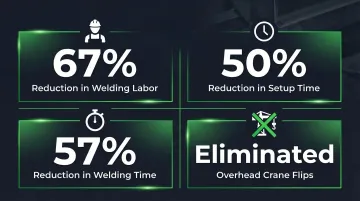
Those numbers reflect what ergonomic adjustability actually delivers at scale — not just comfort, but measurable throughput gains and lower overhead costs per part.
| Product | Product Details |
|---|---|
| 4'x8' Welding Table | Explore Product |
| 3'x8' Welding Table | Explore Product |
| 4'x4' Welding Table | Explore Product |
Frequently Asked Questions
What is the standard height of a welding table?
The industry standard is typically 28"–36", with 36" being the most common off-the-shelf height designed for a standing adult of average height. However, the optimal height varies based on the welder's individual height and work type.
Is 3/8" thick enough for a welding table?
3/8" steel plate is considered a practical minimum for a solid flat-plate welding table top, offering enough mass to resist warping and minor impact. However, ½" or thicker is preferred for heavy-duty work. Engineered 3D tables with support ribs can perform well with thinner tops due to their structural design.
How do I measure the right welding table height for my body?
Stand relaxed, measure floor-to-forearm at a 90-degree elbow bend, then subtract 2"–4" for a standing welding table height. For precision TIG work, add 2–4" above elbow height. For heavy grinding or structural work, subtract 4–10" below elbow height.
Can I adjust the height of an existing welding table?
Absolutely. Leveling feet extensions, leg risers, and replacement modular legs are all viable options. Hydraulic scissor bases work well for shops needing a wide adjustable range, letting you change height instantly based on task or welder.
Does welding table height affect weld quality?
It does — and more than most welders expect. Incorrect height causes postural strain that leads to hand tremor, reduced visibility of the weld puddle, and faster fatigue, all of which directly reduce weld consistency and increase defect risk. Proper height keeps your torch hand steady and your eyes aligned with the work.
What height should a welding table be for sitting?
Seated welding typically calls for a table height of 28"–32", depending on your shop stool. Apply the same elbow-height formula from a seated position. Make sure your stool has a high-cylinder range (21"–32") to dial in the right fit.