
Choosing the right machine impacts everything: setup time, datum consistency, throughput, floor space, and operator needs. In fact, a case study on one aerospace shop showed that adopting a horizontal boring mill with a rotary table led to a 75% reduction in setup time for their complex parts. This guide uses the FERMAT WFT 15 R as a practical example to help you determine if a 4th-axis boring mill is the right fit for your applications.
Key Takeaways
- A 4th-axis boring mill adds controlled rotary positioning, allowing you to machine features around a workpiece with fewer manual setups.
- The WFT 15 R must be evaluated against your actual part dimensions, weight, required operations, tolerances, and production constraints.
- It's crucial to distinguish between indexed 4th-axis positioning (3+1) and simultaneous rotary motion, and to confirm which capability a specific WFT 15 R configuration provides.
- The best machine isn't the one with the most axes; it's the one that produces accepted parts with a measurable improvement in efficiency, accuracy, or total cost.
- T.R. Wigglesworth Machinery Company can support your evaluation with application guidance, delivery, installation, and training.
What Is a 4th-Axis Boring Mill and the WFT 15 R?
A horizontal boring mill is a machine designed for boring, drilling, milling, and related operations on large or heavy workpieces. Its horizontal spindle provides excellent access to deep bores and surfaces that are often difficult to reach on a conventional vertical machine.
The "4th axis" is a controlled rotary axis—typically a rotary table—that positions the workpiece at programmed angles. This allows a machine to access multiple faces of a part in a single clamping. However, not all 4th-axis capabilities are the same. As explained in a 2022 article from machine builder DATRON, the two common setups work differently:
- Indexed 4-Axis (3+1): The rotary table rotates the part to a fixed angle, then locks in place. The machine then performs 3-axis milling or drilling operations.
- Simultaneous 4-Axis: The rotary table turns continuously while the other axes are cutting. This is necessary for creating helical or contoured features wrapped around a part.
The capability you need depends entirely on your parts. If you're drilling holes on four sides of a block, indexed positioning is likely sufficient. If you're machining a complex cam lobe, you’ll need simultaneous motion.
The FERMAT WFT 15 R's Role in the Decision
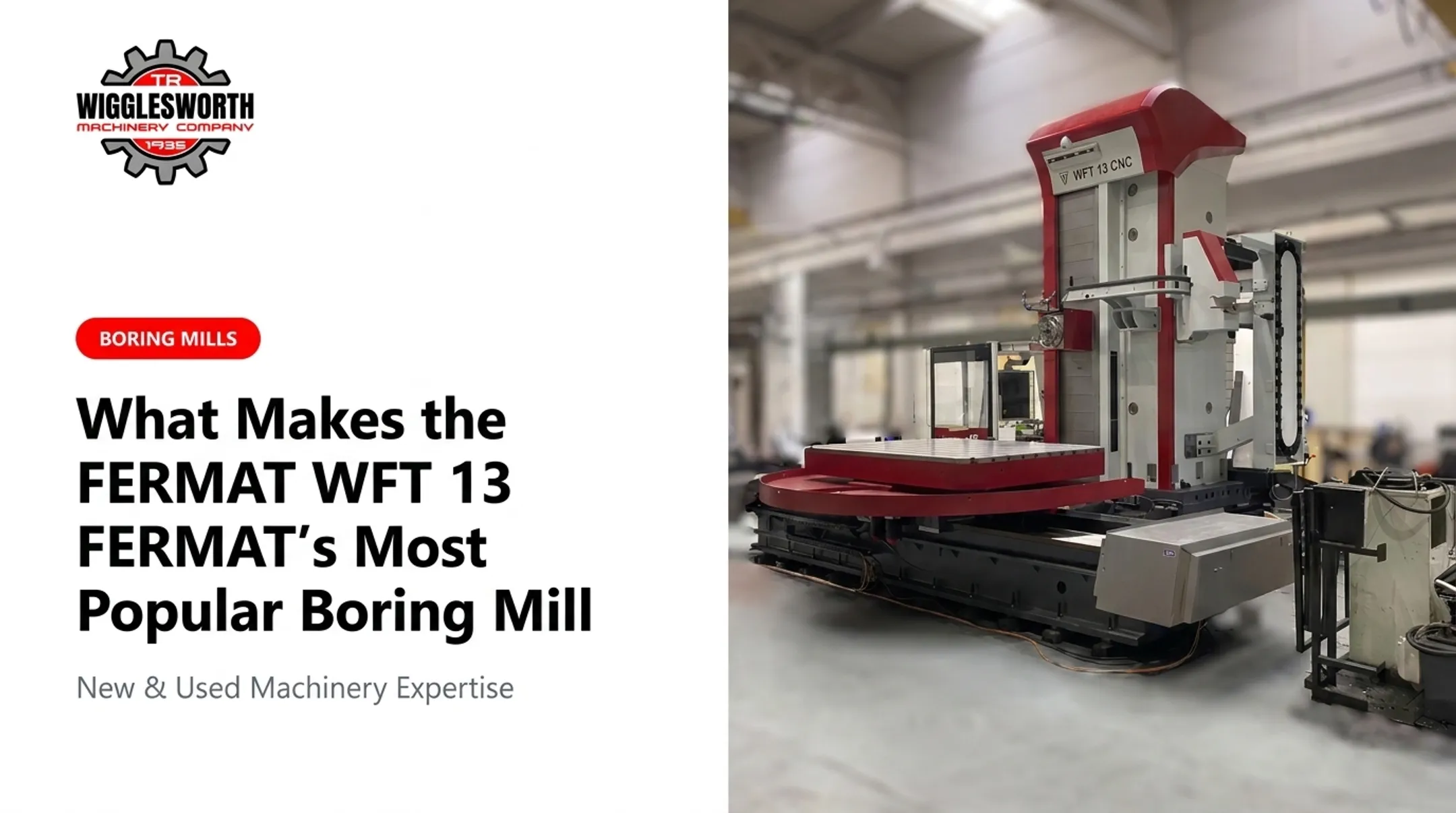
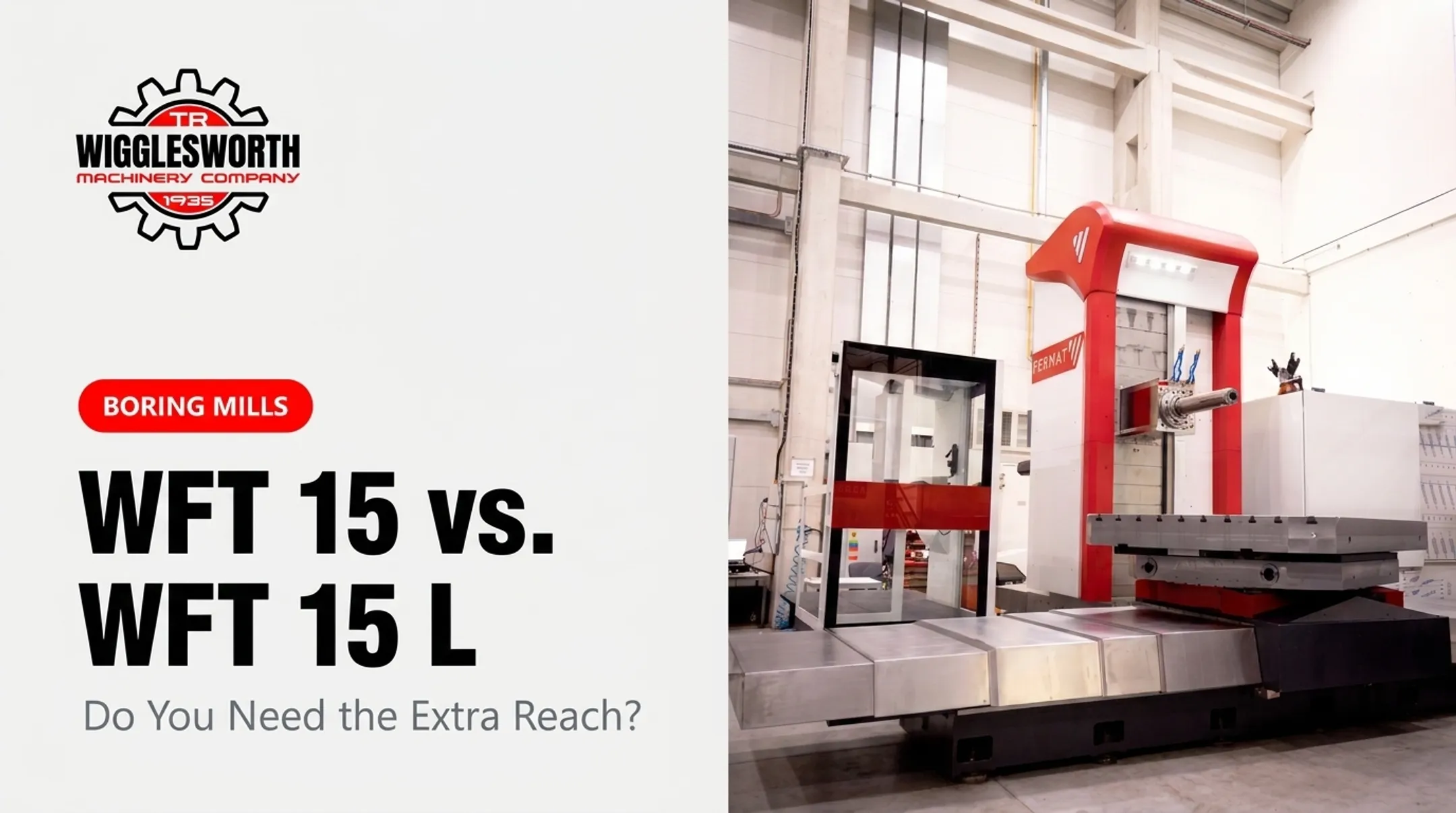
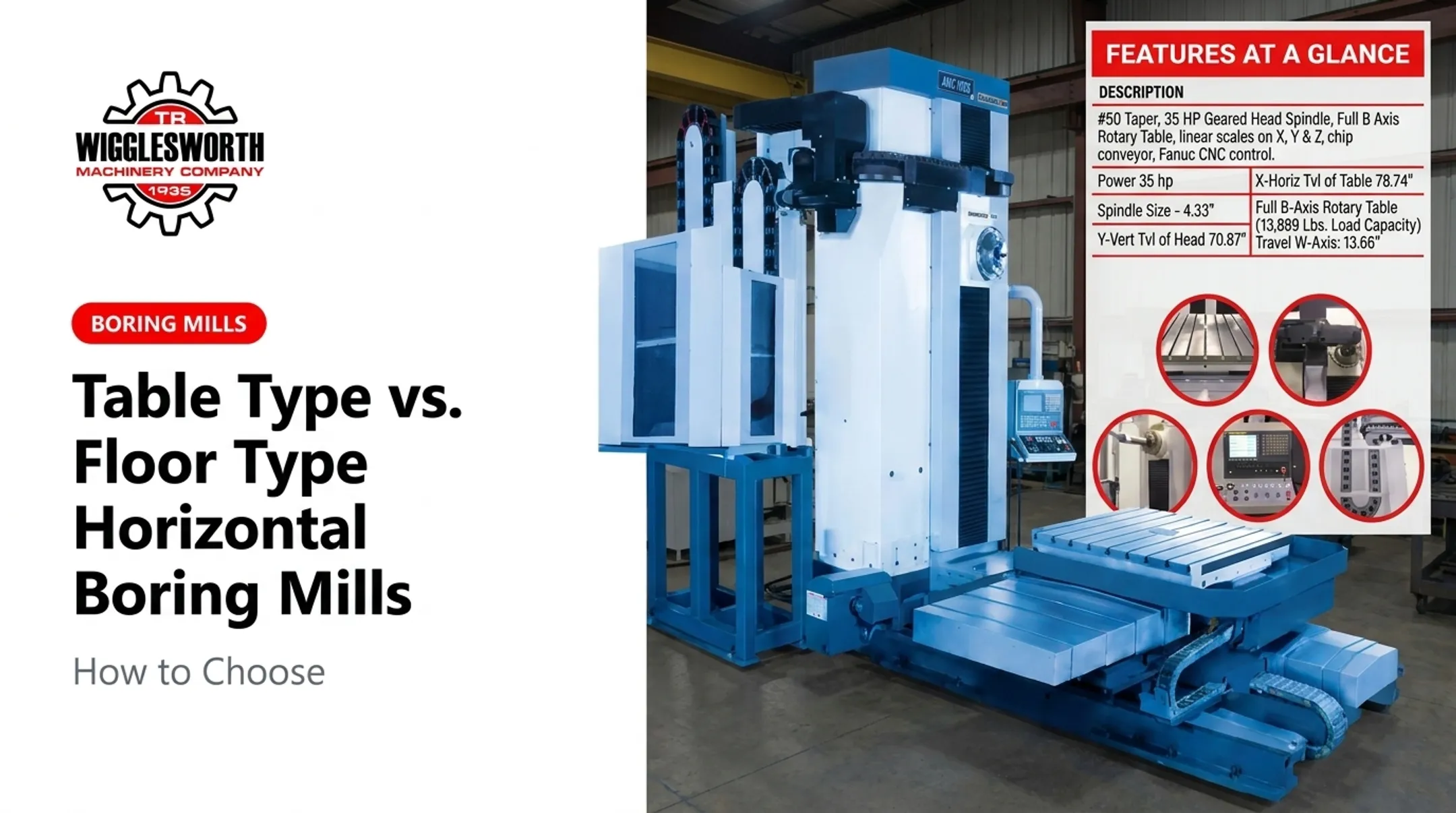
The WFT 15 R, manufactured by FERMAT, is a table-type horizontal boring mill built for heavy, precise work. It is highly configurable, so confirm the exact specifications on any model you evaluate.
Some FERMAT documentation calls the rotary table a "continuous fourth axis." If your jobs need simultaneous interpolation, get that capability in writing before you buy.
Here is a snapshot of the WFT 15 R's verified specifications. Remember that travels, table size, and other features are often configurable.
| Specification | Verified WFT 15 R Capability (Confirm with Quote) |
|---|---|
| Table Size | 70.8" x 86.6" (1,800 mm x 2,200 mm) |
| Table Load Capacity | 20 tons (20,000 kg) standard; options up to 25 tons available |
| Axis Travels (Typical) | X: 157.4", Y: 98.4", Z: up to 118" (configurable) |
| Spindle Diameter | 5.91" (150 mm) |
| Spindle Travel (W-axis) | 31.4" (800 mm) |
| Ram Stroke (R-version) | 27.56" (700 mm) |
| Spindle Speed | Up to 3,000 RPM |
| CNC Control | FANUC, Siemens, or Heidenhain options available |
Each of these specs directly impacts the work you can do. The 20-ton table capacity opens the door for large castings and fabrications. The combined reach of the 31.4" spindle travel and 27.56" ram stroke allows the machine to access deep internal features.

Core Components and Operating Advantages
On a machine like the WFT 15 R, the horizontal spindle, column, work table, and rotary axis have to act as one rigid system. The rotary table is what cuts setup count.
Rotate the part and you can reach multiple sides without unclamping, re-indicating, and building new work offsets. That reclamp cycle burns time and raises error risk.
This capability is ideal for operations such as:
- Boring holes on multiple faces of a gearbox housing.
- Drilling angled ports on a valve body.
- Milling features on several sides of a large die or mold base.
- Machining bolt-circle patterns around a cylindrical component.
A 4th axis still depends on rigid workholding, accurate rotary calibration, tool-clearance checks, and CAM verification so you avoid collisions.
Benefits and Appropriate Applications
The primary benefit is setup reduction. Combining work that once took three or four setups into one clamping saves hours of non-cutting time and limits datum shift every time a part would otherwise be reclamped.
This makes 4th-axis boring mills a strong fit for industries that handle large, complex components, including:
- Aerospace & Defense (landing gear components, structural frames)
- Heavy Manufacturing (power generation, oil & gas equipment)
- Precision Manufacturing (machine tool bases, large fixtures)
- Mold Machining (large injection molds, die sets)
One FERMAT installation for a customer in Washington featured a special two-table WFT 15 R configuration. This allowed the shop to set up a new workpiece on one table while the machine was cutting on the other, raising spindle utilization.

What to Consider When Choosing the WFT 15 R
Making a smart investment means connecting the machine's specifications to your production goals. Don't choose a machine based on axis count alone.
Before you request a quote, document your representative parts: drawings, materials, tolerances, batch sizes, and current setup times. That data drives every decision below.
Part Envelope, Weight, and Workholding
Base the decision on the largest and heaviest parts you plan to run, not the average.
- Weight: Confirm your heaviest workpiece plus fixture stays within the WFT 15 R's standard 20-ton table capacity
- Envelope: Map your largest part against travels of 157.4" in X and 98.4" in Y, including tool and fixture clearance
- Workholding: Plan rotation and support with fixtures, tombstones, angle plates, or tailstock-style supports for long parts
Required Operations and Axis Capability
Map each part feature to the machine motion it requires.
- Fixed-angle holes and faces usually need only an indexed 4th axis
- Helical grooves or contoured surfaces need simultaneous 4-axis motion—confirm the quoted WFT 15 R has it enabled in the CNC control
A quick fit check:
- Good fit: Multiple bores, faces, and holes reachable by rotating one large, heavy part in a single setup
- Poor fit: Work that is mostly small, flat, or one-sided—a VMC is often more cost-effective
Accuracy, Rigidity, and Process Control
The final accuracy of a bored hole depends on the entire system. The WFT 15 R is built for rigidity with features like box guideways and a large-diameter ram and spindle. However, you must verify its performance for your specific needs.
Manufacturer positioning accuracy and repeatability are not always in general brochures. Request a spec sheet for the quoted machine covering linear positioning, repeatability, and rotary axis accuracy, ideally tested to ISO 230-2.
For critical jobs, plan a practical acceptance test: run trial cuts on a representative part and measure the results.
Programming, Tooling, and Operator Requirements
A machine tool is only as good as the process supporting it.
- Programming: Match your CAM post to the quoted FANUC, Siemens, or Heidenhain control and machine configuration
- Tooling: Budget long-reach boring bars, holders, and right-angle heads needed to reach every feature
- Operator skill: Plan training on rotary kinematics, safe retracts, and collision avoidance before production
Throughput, Lifecycle Cost, and Service Support
Purchase price is only one part of the investment. Build a full lifecycle cost estimate that includes:
- Installation, rigging, and foundation preparation
- Tooling, workholding, and inspection equipment
- CAM software and postprocessor commissioning
- Operator and programmer training
- Preventive maintenance and potential downtime
Build a simple ROI case from your own data. Compare current setup hours, labor rates, and scrap costs with the gains a new machine should deliver. A dealer such as T.R. Wigglesworth Machinery Company also shapes long-term cost through parts availability, technical support, and service response.
Confirm the Selection Before Purchase
Before signing a purchase order, take these final steps:
- Send your hardest part drawings to the supplier for a detailed application review
- Get written confirmation of configuration, options, control functions, workholding, and tooling in the quote
- Define acceptance criteria so runoff proves machine, fixture, program, and tooling meet your quality standards

How T.R. Wigglesworth Machinery Company Can Help
Since 1935, T.R. Wigglesworth Machinery Company has been a full-service machine tool provider for manufacturers across the United States. We offer new and used equipment, parts, accessories, delivery, installation, and training. As an authorized dealer for brands including FERMAT, we provide expert application guidance on machines like the WFT 15 R.
We work with you to compare the WFT 15 R's capabilities against your parts, production targets, and budget. With nearly nine decades in heavy manufacturing, we know what a major capital buy has to deliver on the floor.
Full-service support covers:
- Delivery and installation
- Operator training
- Long-term parts service
That support lowers implementation risk and helps you get consistent results from day one.
If you're handling large parts and struggling with long setups and datum inconsistencies, the FERMAT WFT 15 R is worth a close look. Contact T.R. Wigglesworth Machinery Company today with your part drawing, and let's discuss your application.
Conclusion
A 4th-axis boring mill is most valuable when your shop regularly handles large or heavy parts with features distributed across multiple faces. If repeated setups are limiting your accuracy, capacity, or throughput, a machine like the FERMAT WFT 15 R is a strong fit.
Match a verified machine configuration to your full production needs: part envelope, tolerances, programming resources, and lifecycle support. Validate the process with part drawings, a thorough supplier review, and documented acceptance criteria so the machine earns its keep in accuracy, capacity, and throughput.
To discuss whether the WFT 15 R is the right choice for your shop, contact T.R. Wigglesworth Machinery Company.
Frequently Asked Questions
What is a 4th-axis boring mill?
It's a horizontal boring mill equipped with a controlled rotary axis (usually a table). It positions a workpiece at various angles so you can machine features on multiple faces in one setup.
What types of parts are best suited to a 4th-axis boring mill?
Large, heavy, or complex parts are ideal candidates. This includes components with multiple bores, angled holes, or features on several sides that would otherwise need many setups.
How is a 4th-axis boring mill different from a 5-axis machine?
A 4th-axis machine typically adds one rotary axis for workpiece positioning (3+1) or rotation during cutting. A 5-axis machine adds two rotary axes, allowing for more complex tool orientation and simultaneous five-sided machining.
Does a 4th axis reduce machining setups?
Yes, it can reduce re-clamping and re-indicating when features can be reached by rotating the part. Actual savings depend on your part geometry, workholding strategy, and machine configuration.
What specifications should be checked before choosing the WFT 15 R?
Verify the table's load capacity, axis travels, spindle and ram reach, and rotary axis function (indexed vs. simultaneous). Also confirm the CNC control, CAM compatibility, tooling needs, installation requirements, and service support.
Can T.R. Wigglesworth Machinery Company help with installation and training?
Yes, we offer delivery, installation, and training services. Scope depends on the equipment and purchase terms—confirm details during quotation.