
Introduction
Boring mill shops across the country are rethinking how much automation makes sense on the floor. Labor availability, production flexibility, machine utilization, and cost control have all become harder to manage at once.
The pressure is real. The U.S. manufacturing sector needs roughly 3.8 million new workers between 2024 and 2033, according to a Deloitte and Manufacturing Institute study. Nearly half of those positions could go unfilled without a change in hiring and training approaches.
Robotic tool changers can reduce manual intervention on a boring mill, but they aren't automatically the right answer. Their value hinges on the machine itself, your tooling mix, production volume, and how much integration work is required.
This article breaks down when a robotic tool changer earns its keep, what to measure to find out, and when a simpler approach is the smarter move.
Key Takeaways
- A robotic tool changer automates tool or end-effector swaps and is not the same as a machine's built-in ATC.
- Expect shorter changeovers, higher utilization, better repeatability, less manual handling, and stronger high-mix support.
- True cost covers hardware, integration, guarding, programming, maintenance, training, and compatibility, not sticker price alone.
- ROI is strongest on boring mills with frequent tool changes, multiple part families, or heavy manual intervention time.
What Is a Robotic Tool Changer? (Brief Context)
A robotic tool changer is a mechanical interface that lets a robot or automated handling system release one tool or end effector and lock onto another, without a person stepping in for each swap. It typically has two halves: a master side mounted to the robot, and a tool side mounted to each gripper, spindle attachment, or accessory.
This is different from two other setups you'll hear about:
- A CNC machine's built-in ATC swaps cutting tools between a magazine and the spindle, but it stays inside the machine's own control system, not a separate robot.
- A manual tool-change process relies entirely on an operator to remove, inspect, and install each tool by hand.
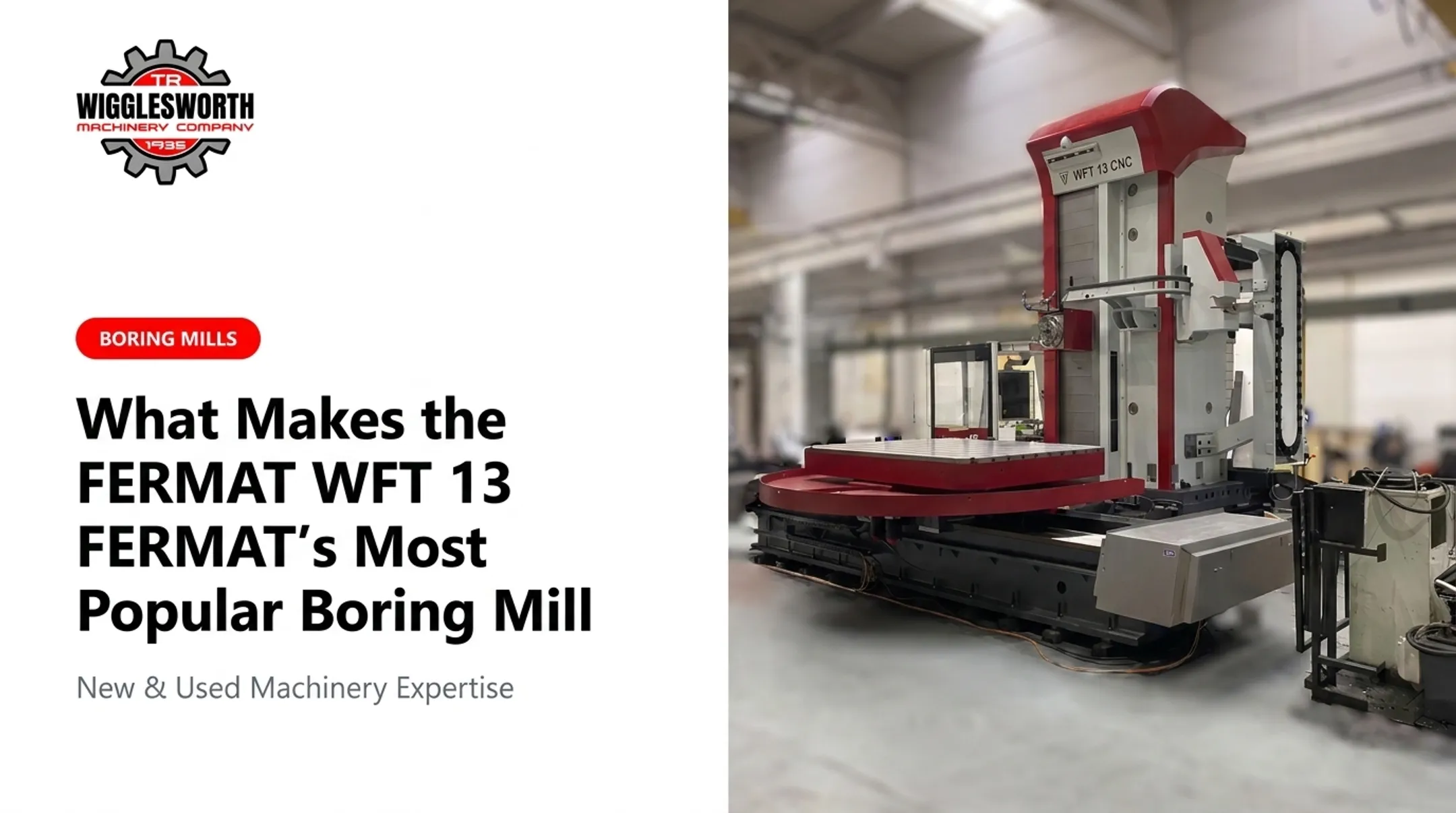
Some boring mills come with automation already built in. The FERMAT VARIANT 10000 FFM 140, for example, uses a Fanuc or Kuka robotic-arm-style tool changer paired with a 200-station tool crib.
A machine like the Giddings & Lewis 84VTC takes a different path: a 12-station built-in ATC, not a separate robotic arm. That contrast shows why "automatic" and "robotic" are not interchangeable terms.
A robotic tool changer never works alone. It's one piece of a cell that includes the robot, the boring mill's control, tool holders, storage, sensors, safety systems, and the software tying it all together.

Key Advantages of Robotic Tool Changers
A robotic tool changer only justifies the cost if it improves measurable production outcomes for your boring mill operation.
Changeover and Machine-Utilization Improvements
When a job calls for multiple tools, tool variants, or replacements mid-run, manual changeovers create operator-dependent gaps. The mill sits idle while someone locates, inspects, and installs the next tool.
Automated tool exchange closes that gap. Some integrators report automatic swaps completing in under 10 seconds, compared to several minutes for a manual change that halts production entirely.
Track the impact through:
- Spindle utilization
- Cycle availability
- Average changeover duration
- Unattended runtime
- Output per shift
This advantage matters most in high-mix work, repeat production runs with several daily changeovers, and any operation where the mill regularly waits on an operator.
Labor, Repeatability, and Process Control
Automation reduces routine manual handling and makes tool exchange more consistent, but it doesn't eliminate the need for people. Operators are still essential for setup, inspection, maintenance, supervision, and handling exceptions the system can't resolve on its own.
Standardized tool locations, programmed selection logic, presence sensing, and confirmation signals cut down on selection and setup errors that come with manual handling.
A useful reference point: Hitachi Powdered Metals deployed over 200 robots across its Indiana facility and saw production climb 400% while scrap on a fragile product line dropped from 11% to 0.5%, according to an International Federation of Robotics case study.
Manual handlers were reassigned to less repetitive roles rather than eliminated.
Watch these KPIs:
- Operator intervention frequency
- Tool-selection errors
- Non-cutting time
- Scrap or rework rates
- First-pass yield
Flexibility for Complex or Changing Production
A robotic tool changer can let one boring mill cell handle a wider range of tools, operations, and part families, without requiring an operator to perform every exchange by hand.
Before assuming compatibility, check:
- Tool-holder standards and spindle interface
- Robot payload capacity and reach
- Tool length and diameter limits
- Coolant and chip exposure
- Storage capacity and access inside the enclosure
The FERMAT VARIANT 10000 FFM 140 shows what this looks like at scale: a 200-station tool crib paired with control options including HEIDENHAIN iTNC 640, SIEMENS 840D SL, and FANUC 31i B. That mix lets shops run varied jobs on one platform.
Payload ranges across the robotic tool changer market run wide too, with vendors offering units from roughly 1.4 kg up to 2,500 kg or more, depending on application.

Flexibility pays off in aerospace, heavy manufacturing, mold work, and precision jobs with varied tooling. For stable, single-part production, a fixed dedicated setup is often more efficient and considerably cheaper.
What Happens When a Robotic Tool Changer Is Missing or Ignored
Frequent manual tool changes create their own set of problems. Waiting time piles up and setup practices drift from operator to operator. The whole operation becomes dependent on having the right person on shift, a real risk during labor shortages.
Even so, a robotic tool changer is not a cure-all. It won't fix:
- Poor tooling strategy or tool selection
- Unreliable machine controls
- Inadequate maintenance practices
- Insufficient tool storage capacity
- Inaccurate tool offsets
Choosing an incompatible system creates new risks:
- Undersized units can hit payload overload or tool retention failures once dynamic loads and acceleration forces are counted, not just static weight
- Poor fit can mean collision risk plus coolant or chip-related faults
- Integration often runs longer than expected and disrupts production during commissioning
Before committing, pull your own production records. Compare the real cost of continued manual changeovers and recurring downtime against the full cost of automation, not just the sticker price on a robotic tool changer.
How to Get the Most Value from a Robotic Tool Changer
The investment only makes sense when avoided downtime, reduced labor burden, lower quality risk, or added capacity generates more value than the complete cost of owning and integrating the system.
Build a Boring-Mill-Specific Business Case
Start your ROI estimate with these inputs:
- Tool-change frequency per shift or job
- Average manual changeover duration
- Labor time and machine hourly cost
- Downtime cost
- Production volume
- Expected utilization gain
- Number of tools or end effectors required
Compare total ownership cost (purchase, integration, guarding, programming, training, maintenance, and validation) against the annual value of recovered production time and reduced manual work. Run conservative, expected, and high-utilization scenarios rather than trusting a vendor's best-case number alone.
Current market pricing gives a sense of scale: a robot arm alone typically runs $25,000 to $180,000, while a fully deployed cell with tooling, safety systems, and integration can land anywhere from $80,000 to $400,000. The robotic tool changer itself usually accounts for 5% to 15% of total cell cost.
Verify Compatibility and Implementation Requirements
Before purchase, confirm:
- Machine control interface and spindle/tool-holder standards
- Robot payload and reach relative to your heaviest tool
- Tool dimensions and storage layout
- Pneumatic, electrical, and coolant connections
- Guarding and safety circuits
- Access for ongoing maintenance
Also evaluate the boring mill itself. Legacy controls, unavailable replacement parts, inconsistent positioning, spindle wear, or weak hydraulic and pneumatic systems can undermine an otherwise sound automation project.
Once specified, test the full tool-change sequence:
- Pickup confirmation and locking verification
- Tool identification
- Fault recovery and power-loss response
- Misalignment handling and safe return to operation
Work with a machine tool resource that knows equipment condition and history. T.R. Wigglesworth Machinery Company has served the machine tool industry since 1935 with guidance on new and used machines, specialized parts, delivery, installation, and training. That groundwork matters before you layer automation onto an existing or newly acquired boring mill.
Implement and Manage the System for Sustained Results
Successful deployment doesn't end at installation. It requires:
- Operator and maintenance training on the full tool-change process
- Documented setup procedures so results don't depend on one person's memory
- Preventive maintenance, including spare seals or sensors where applicable
- Clear escalation procedures for faults
Track baseline-versus-post-installation results on:
- Changeover time and unplanned downtime
- Operator interventions and utilization
- Tool-change faults and quality issues
Design programming and cell layout for future tool additions and product changes, not only the job in front of you today.

A robotic tool changer is usually a poor fit when you face:
- Infrequent tool changes or stable single-tool work
- Low machine utilization or limited production volume
- Tight floor space
- A boring mill that needs major refurbishment first
Conclusion
Robotic tool changers can genuinely improve control, flexibility, consistency, and utilization on a boring mill — but only where frequent tool changes are a real production constraint, not a hypothetical one.
The right call depends on several factors:
- Total cost of ownership
- Compatibility with your specific machine
- Safety requirements and maintenance demands
- Actual measured production need
The tool changer itself is just one piece of that equation.
Start by documenting your current changeover losses. Then bring those numbers to qualified machine tool specialists—such as T.R. Wigglesworth Machinery Company—before you commit to equipment.
Frequently Asked Questions
What is an automatic tool changer in a CNC machine?
An automatic tool changer (ATC) is a built-in mechanism that lets a CNC machine swap cutting tools between a magazine and the spindle without operator help. It's distinct from a robotic tool changer, which is a separate robot-side interface for swapping tools or end effectors.
How much does a CNC robot machine cost?
Cost varies widely based on the robot, boring mill, tool changer, tooling, guarding, controls, integration, and training involved. Current U.S. market data puts robot arms alone between $25,000 and $180,000, with fully deployed automated cells ranging from $80,000 to $400,000.
Are robotic tool changers compatible with boring mills?
Compatibility depends on the mill's control system, spindle and tool interface, enclosure access, and the robot's reach and payload relative to your tooling dimensions. Safety integration also needs to be verified before installation.
What factors determine whether a robotic tool changer is worth the investment?
Key factors include changeover frequency, machine utilization, labor requirements, production mix, downtime cost, integration expense, ongoing maintenance, and expected payback period. Frequent tool changes and high-mix production tend to justify the investment fastest.
What are the main disadvantages of an automatic tool changer?
Disadvantages include upfront cost, integration complexity, ongoing maintenance, floor-space requirements, and compatibility limits tied to tool weight and dimensions. In low-changeover applications, the system may add little measurable value.