
Introduction
A spec sheet that reads "20-ton table capacity" looks straightforward. That single figure still decides whether a boring mill fits your workpiece, fixture, and planned cutting operation. Misread it, and you set yourself up for a costly mismatch.
Manufacturers rate table capacity under specific, often unstated conditions: load position, distribution, and duty cycle. Two machines listing the same "20-ton" number can behave very differently once a real casting, fixture, and tool package land on the table.
This article separates the rated number from the usable machining capacity. We'll cover what the rating includes, which conditions change it, and a practical checklist for comparing machines before you buy.
Key Takeaways
- A 20-ton rating is a limit under defined conditions, not a guarantee for every 20-ton part
- Total supported load includes the workpiece, fixture, pallet, tooling, clamps, and rotary equipment
- Load position, center of gravity, and cutting dynamics can cut usable capacity
- Always verify ratings against the manual, load charts, and manufacturer documentation before comparing machines
What "20-Ton Table Capacity" Represents in a Machine
A table load capacity is the maximum supported load a manufacturer specifies for a machine's table under stated design and operating conditions. That's the key phrase: stated conditions.
It is a structural limit for the table, guideways, bearings, drive system, and foundation. It is not a description of the largest or heaviest part you can walk in the door with.
Here's where confusion starts. "20 tons" is not always the same unit:
- U.S. short ton: 2,000 lb each
- Metric tonne: 2,204.6 lb each
Across a 20-ton spec, that gap adds up to nearly 4,500 lb. FERMAT's WFT-13 and WFT 15R models, sold through T.R. Wigglesworth, are both listed for workpieces up to 20 tons. Confirm the unit and load-distribution notes in the manufacturer's docs for the exact configuration you're quoting.
Table capacity is distinct from other specs that determine machine suitability:
- Work envelope and axis travel: whether the part physically reaches the spindle
- Table dimensions: available support area and where the load can sit
- Spindle power and torque: whether the machine can cut the material
Stationary Load vs. Machining Load
A part sitting still on a table creates a static load. The moment cutting starts, you introduce cutting forces, vibration, table movement, acceleration, and braking — a dynamic load. The published rating may only describe one of these conditions, and it typically assumes the load is centered and evenly distributed across the table surface.
Consider two identical 15-ton castings. One sits low and centered on the table. The other is bolted to a tall fixture near one edge.
Same weight, very different outcome. The second setup shifts the center of gravity outward and upward, raising overturning force and guideway loading well beyond the first casting. Rated tonnage alone does not tell you which setup is safe; check the load chart.

The Operating Range and Conditions Behind the Rating
A published nominal rating describes a design limit. Real-world operation introduces variables the rating may or may not account for, and buyers need to know which is which before assuming a number applies universally.
Design and Material Constraints
Table construction, support points, guideway geometry, bearing arrangement, clamping method, and even the machine's foundation all influence how much load the table can safely carry. A rating written for a fixed table doesn't automatically transfer to the same machine equipped with a rotary table or auxiliary fixture — added hardware consumes part of the available capacity.
FERMAT listings from TOS America show the gap: the WFT 11 is rated for 10,000 kg table load, while the larger WFT 13/15 lists a base 20,000 kg table load with optional configurations up to 50,000 kg, depending on the build. The number changes with the platform, not just the marketing label.
Load Distribution and Center of Gravity
A load's footprint matters as much as its gross weight. Concentrated point loads, overhanging workpieces, tall fixtures, and offset parts all shift stress away from where the table structure is designed to handle it best. These conditions typically require manufacturer approval or a specific load-chart check rather than a simple green light from the general rating.
Operating and Duty-Cycle Effects
Rapid axis movement, indexing, acceleration, braking, interrupted cuts, and long cycle times all add dynamic stress on top of the static weight. ISO 3070-1:2007 covers geometric and machining accuracy tests for horizontal-spindle boring and milling machines. Those standards treat static geometry checks and operational behavior under load as separate concerns. A table that supports 20 tons at rest isn't automatically rated for 20 tons of heavy interrupted facing.
Allowable Margin
Responsible machine selection leaves margin below the published limit. Fixtures grow, future jobs get heavier, and cutting conditions vary. Operating continuously at the boundary of a rating risks:
- Loss of positioning accuracy
- Abnormal guideway or bearing wear
- Drive system overload
- Table deflection and vibration
- Increased safety exposure for operators
Technical Properties That Matter Alongside Capacity
A big capacity number only matters if it's compatible with the rest of the machine. Table size, spindle reach, torque, and workholding requirements all need to line up with the actual part and process.
Table Size, Travel, and Access
A heavy workpiece can be unsuitable even with plenty of rated capacity if it exceeds the machine's travel or can't be reached by the spindle. Compare these fields side by side, not the tonnage alone:
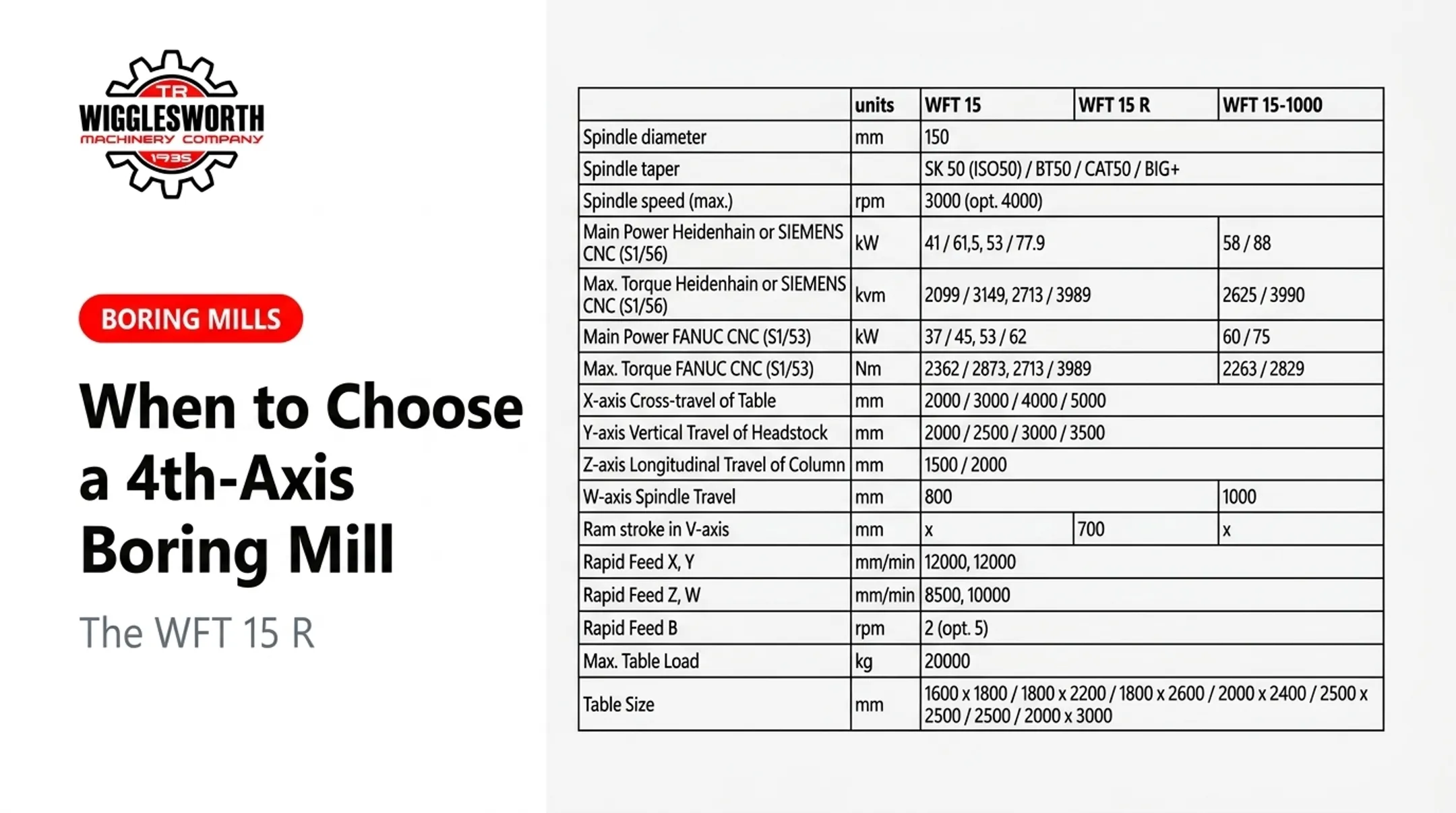
| Model | Table Size | X-Axis Travel | Spindle Travel | Max Torque |
|---|---|---|---|---|
| FERMAT WFT-13 | 62.9" × 70.8" | up to 157.5" | 31.5" | — |
| FERMAT WFT 15R | 70.8" × 86.6" | 157.4" | 31.4" | 2,210 Nm |
Both machines are marketed for workpieces up to 20 tons, but the WFT 15R's larger table and greater torque make it a better fit for bigger part footprints and heavier interrupted cutting.

Rigidity, Torque, and Cutting Capability
Spindle diameter, taper, motor power, and structural rigidity determine whether the machine can cut the material effectively, separately from whether the table can support its weight.
A machine can hold a 15-ton casting without issue and still lack the torque for heavy boring or facing on that same part. Check spindle horsepower, low-speed torque, and taper size (CAT 50 or SK 50, for example) against the operation you're planning, not just the table rating.
Workholding and Installation Requirements
These factors all affect whether a machine setup will work in your facility:
- Fixture and pallet weight
- Rotary table capacity
- Lifting access and crane coverage
- Anchoring and floor loading limits
A rotary table alone can carry significant weight. One common configuration used with these platforms lists a 70.9" × 86.6" (1,800 mm × 2,200 mm) rotary table with a 15,000 kg (33,069 lb) load capacity, which eats directly into the total table budget once a workpiece is added on top.
How to Verify Capacity Before Comparing Machines
Comparing published tonnage numbers side by side isn't enough. Use this review process when engineers and buyers evaluate new or used boring mills.
Gather the Complete Load
Build a total load calculation that includes:
- The workpiece itself: actual weight, not an estimate
- Fixture, pallet, or tombstone weight
- Rotary table or auxiliary equipment mounted on the table
- Clamping hardware, tooling, and coolant or chip-control equipment
Document the dimensions, contact points, estimated center of gravity, and how far the load sits from table center. Note whether the load is evenly distributed or concentrated at one point.
Check the Manufacturer's Definition
Confirm the unit of measure, whether the rating is static or dynamic, and whether it assumes a centered load. Pull the operator manual, spec sheet, table load chart, and any documented limits for rotary tables or auxiliary fixtures before assuming the number applies to your setup.
Validate the Intended Operation
Match the rating to your actual cutting cycle: roughing, boring, facing, drilling, feed rates, spindle speeds, and repositioning moves. If your load is offset, your fixture is tall, or you're working near the rated limit, involve the machine builder or a qualified applications engineer before running the job.
Inspect Used Equipment
For used machines, check table flatness, guideway condition, backlash, bearing condition, drive alarms, and lubrication history. Look for visible deflection or wear patterns that suggest previous overloading.
Modern Machine Shop's inspection guidance notes that tools like ball bars and grid encoders reveal contouring accuracy problems, but they don't catch every factor that affects a finished part. Service records and a qualified technician's evaluation still matter.

If you're comparing new or used machine tools and want a second set of eyes on parts, accessories, or delivery and installation planning, T.R. Wigglesworth Machinery Company can walk through the specifics with you. A rounded capacity number rarely tells the whole story.
What Happens When the Rating Is Misread
Exceeding or misapplying a table rating introduces more than a simple overload. It can create deflection, vibration, positional error, premature wear, and drive faults — often before anything visibly fails.
Common misinterpretations:
- Treating the 20-ton figure as the allowable workpiece weight alone, ignoring fixtures and accessories
- Assuming a centered load and an offset load carry the same risk
- Comparing a static rating from one machine against a dynamic or conditional rating from another
- Assuming a machine can perform heavy cutting simply because its table supports the part's weight
- Ignoring floor, foundation, and lifting limits during installation planning
Operating near a rating's limit can degrade repeatability and surface finish long before the table shows visible signs of stress. When the load, center of gravity, cutting cycle, or documentation is uncertain, stop and get a formal review rather than trusting a rounded number on a spec sheet.
Conclusion
"20-ton table capacity" is a governing specification with conditions attached. It does not fully describe what a machine can handle under real shop loads.
Reliable comparisons check these factors against the manufacturer's documentation:
- Total setup weight
- Load distribution
- Center of gravity
- Dynamic cutting forces
- Work envelope
- Rigidity
- Installation requirements
Before loading a machine anywhere near its published limit, apply engineering judgment and get guidance from a qualified machine tool specialist. The number on the spec sheet starts the conversation. It does not end it.
Frequently Asked Questions
What is the table load capacity of a boring mill?
Table load capacity is the maximum supported load specified for the machine table under stated conditions. Usable limit still depends on unit of measure, load distribution, center of gravity, fixture weight, and the cutting operation.
How much does CNC machining cost per hour?
Hourly CNC machining cost depends on machine type, labor, tooling, programming, overhead, material, and shop utilization. Rates vary widely by shop, region, and job complexity.
What does a 20-ton table capacity include?
It generally refers to the total load the table supports, including the workpiece, fixture, pallet, rotary equipment, and clamping hardware. That total is always subject to the manufacturer's stated conditions for the specific model.
Can a machine with a 20-ton table capacity machine a 20-ton workpiece?
Not necessarily. Table dimensions, load distribution, center of gravity, cutting forces, and axis movement all affect whether that specific workpiece fits within the manufacturer's approved conditions or load chart.
What is the difference between static and dynamic table capacity?
Static capacity describes a stationary setup load. Dynamic capacity accounts for forces created by table travel, indexing, acceleration, braking, and cutting. Check the machine manual for which definition applies to your model.
What should I check when buying a used boring mill?
Review original load documentation, table and guideway condition, backlash, bearing condition, drive alarms, and lubrication history. Have a qualified machine-tool professional inspect and test the machine before purchase.