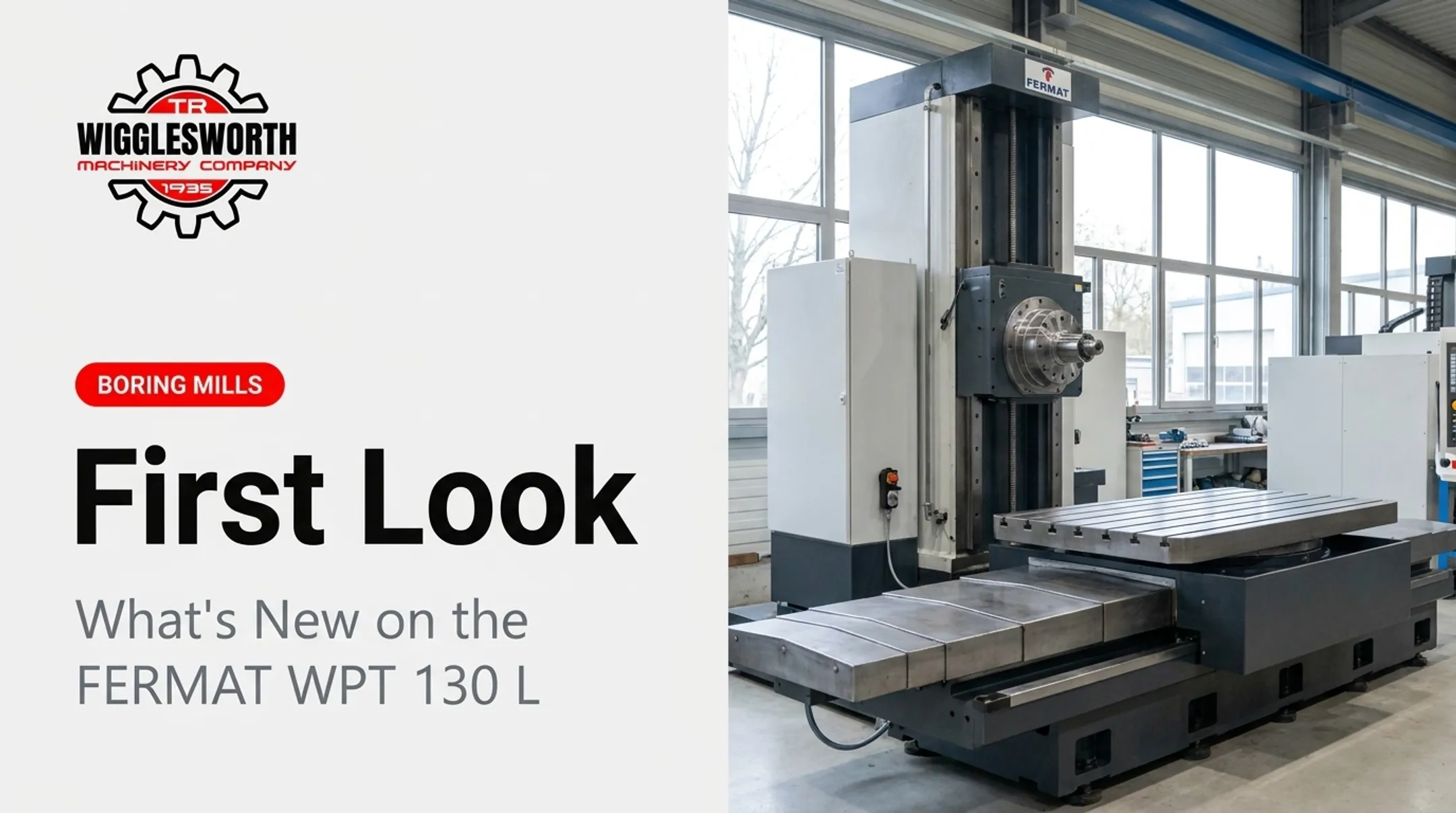

A compact table-type mill like a FERMAT WFC 10 (L) handles parts up to roughly 5 tons on a stationary column with a traveling table. On the opposite end, a floor-type FERMAT WRF 130/150/160 supports floor plates and rotary tables rated for 100 metric tons. That gap illustrates why this decision affects far more than sticker price.
Your choice shapes part handling, setup time, floor layout, foundation requirements, accuracy, and how your operators work day to day. This guide walks through a practical framework based on your workpiece envelope, mass, geometry, and production pattern, so you can match the machine to the job instead of the other way around.
Key Takeaways
- Table-type mills keep the column fixed while the workpiece travels, often on a rotary table for multi-face work.
- Floor-type mills run the column on floor rails so large or irregular workpieces stay stationary.
- Weight alone won't decide fit—dimensions, center of gravity, and fixture strategy matter equally.
- Choose table-type to cut repositioning on rotary-friendly parts; choose floor-type when parts can't be mounted.
- Factor in foundation needs, thermal control, CNC/CAM capability, service support, and total cost of ownership.
Table-Type vs. Floor-Type Horizontal Boring Mills: Quick Comparison
| Factor | Table-Type / T-Type | Floor-Type |
|---|---|---|
| Movement | Workpiece travels on a table; column stays fixed | Column travels along floor rails; workpiece stays fixed |
| Best fit | Medium-to-large parts that can be safely fixtured and moved | Exceptionally large, heavy, or irregular parts |
| Multi-face access | Rotary tables and indexing enable multiple faces in one setup | Column repositions around a stationary part, reducing crane handling |
| Footprint | More contained; requires table-loading clearance | Longer rail runs; larger installation footprint |
| Foundation | Some models install with minimal foundation work | Typically requires more extensive site preparation |
Configuration and Facility Realities
A FEMCO BMC-135TN offers 118 inches of X-axis table travel, with the workpiece riding on the table while the column stays put. Compare that to a FERMAT WRF Heavy, where the column itself covers 1,106 inches of travel while the part sits fixed on floor plates.

Neither design is universally "more accurate" or "more rigid." Both fall under ISO's accuracy testing standards for horizontal-spindle boring and milling machines, which apply configuration-specific test procedures rather than blanket claims.
Cost and Productivity Factors
No single price gap covers every table-type versus floor-type decision. Compare these items using quotes from your shortlisted suppliers:
- Purchase price and installation labor
- Tooling, fixtures, and loading equipment
- Foundation and site prep costs
- Cycle time and expected downtime
- Operator training requirements
What Are Table-Type and Floor-Type Horizontal Boring Mills?
Table-Type or T-Type Horizontal Boring Mills
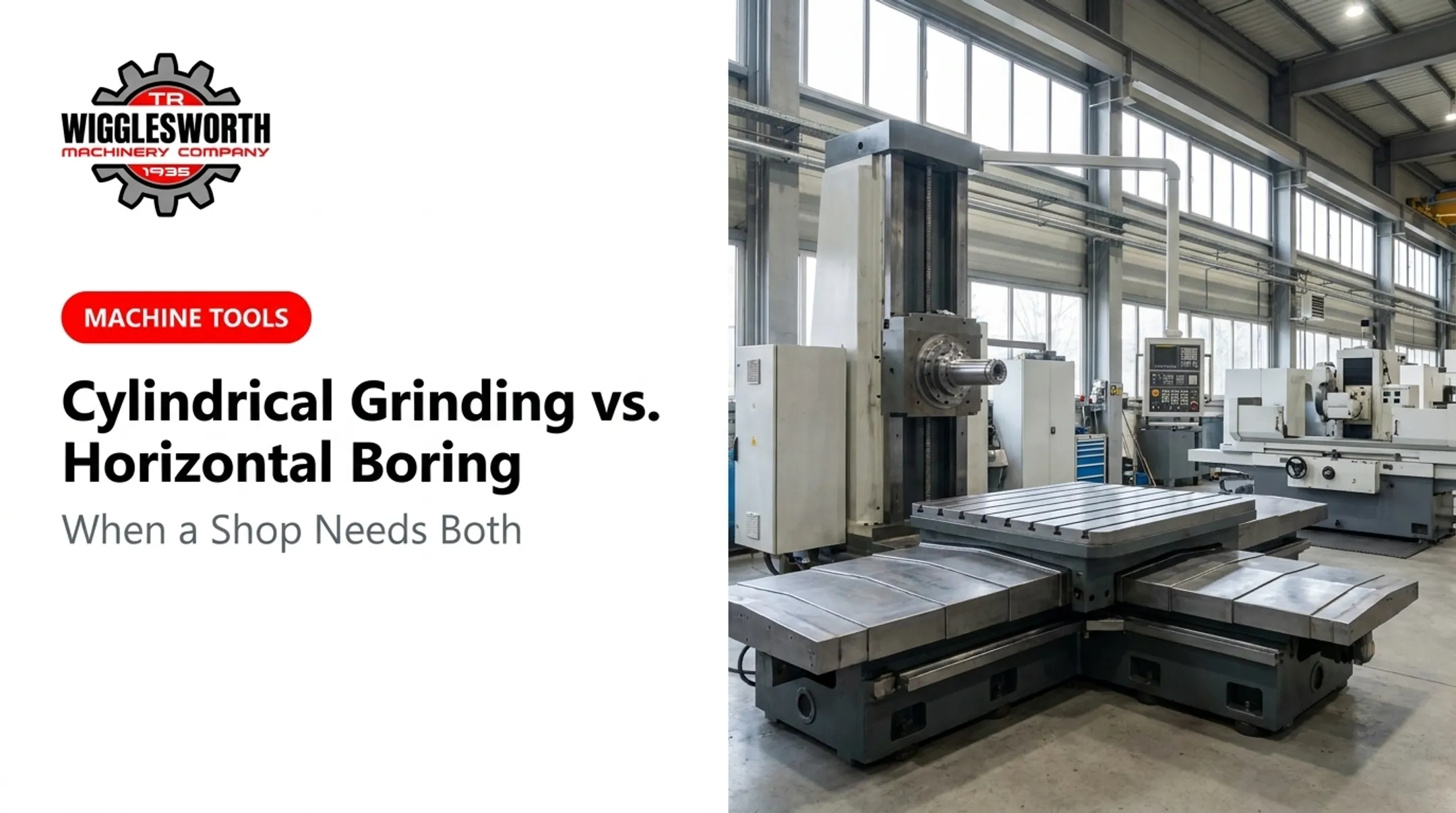
A table-type horizontal boring mill mounts the workpiece on a traveling table, often paired with a rotary table, while the spindle and column deliver the cutting reach. The FEMCO BMC-135TN is a good example: a T-Type traveling-column CNC machine with a 50 HP geared-head spindle and 27-inch W-axis bar stroke.
The W-axis is the practical advantage. An extending boring spindle reaches deep internal features with better support than an overly long toolholder, which helps control deflection and chatter on deep bores.
Common table-type benefits:
- Rotary positioning for multi-face machining in one setup
- Reduced crane repositioning between operations
- Strong fit for repeatable workholding and serial production
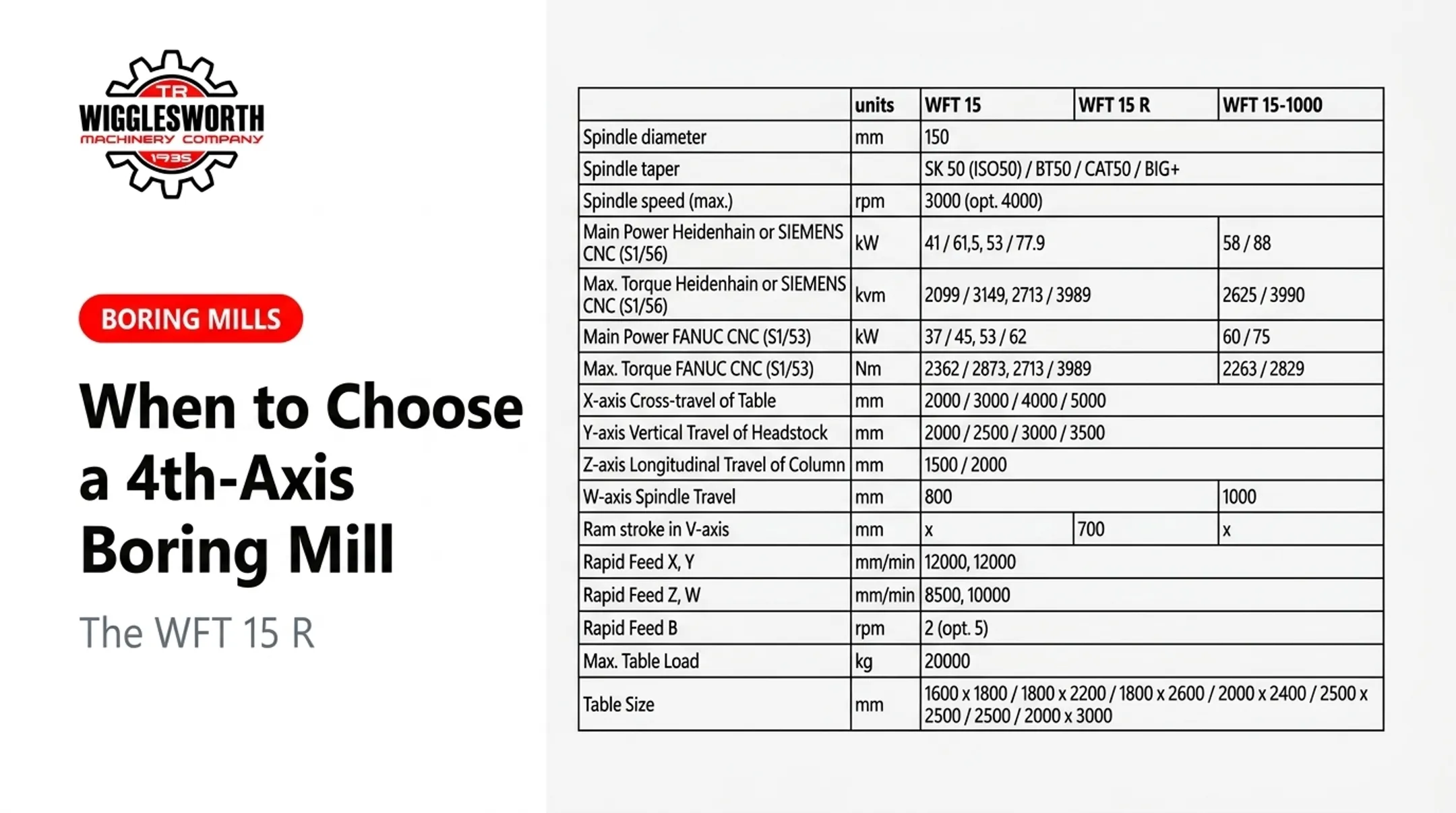
Variations run from compact machines like the FERMAT WFC 10 (L), built for shops with limited floor space, up to heavier options like the FERMAT WFT 15R. That model is rated for workpieces up to 20 tons, with combined ram and spindle travel for added rigidity.

Some models add pallet changers. The FERMAT WFT 11 W Twin Pallets, for example, supports a 22,000 lb (10,000 kg) maximum table load.
The table still has to match the part's footprint, weight, and center of gravity. Overhanging loads can hurt rigidity and accuracy, so confirm rated capacity before you assume a part will fit.
Floor-Type Horizontal Boring Mills
A floor-type boring mill flips the arrangement. The workpiece stays fixed on floor plates while the column travels along a prepared bed or rail system. The FERMAT WF 13 R (L) demonstrates the scale involved, with 22,000 mm of X-axis travel and a 130 mm or 150 mm spindle option.
This configuration suits large castings, weldments, structural frames, and mining or energy components that are difficult or unsafe to mount on a traveling table. Keeping the part stationary reduces handling, though it puts more weight on floor alignment and foundation stability.
Typical configuration choices include:
- Ram travel and boring spindle diameter selection
- Facing or milling heads for added versatility
- Rotary tables as auxiliary workholding — the FERMAT VARIANT 10000 FFM 140 handles up to 80 tons on an optional rotary table
The tradeoff is a longer footprint and a larger installation commitment. Floor-type machines usually need more site planning, alignment work, and thermal management than a comparable table-type setup.
Table-Type vs. Floor-Type: What Is Better for Your Work?
Start with one rule: choose the configuration that moves the manageable mass while preserving rigidity, access, and safe loading.
If the part is easier to move than the column, lean table-type. If the column can reach the part more practically than a crane can move it, lean floor-type.
From there, work through the specifics:
- Map the full work envelope — maximum length, width, height, bore depth, spindle reach, and fixture size all factor in.
- Plan the loading method — crane capacity, forklift access, table travel, and staging space determine what's actually feasible on your shop floor.
- Match the production pattern — table-type suits repeatable parts with rotary access and fewer setups; floor-type suits oversized or irregular parts where moving the column beats moving the component.
- Verify rigidity and accuracy — check guideway design, spindle support, ram extension, and any published thermal compensation or probing capability.
- Total the ownership cost — foundation work, tooling, programming resources, training, and expected utilization all belong in the comparison, not just the quote price.

Quick recommendations:
- Choose table-type/T-type when the part fits the table's rated envelope and rotary access reduces setups.
- Choose floor-type when the part is too large, heavy, or awkward for a table, or needs extensive column travel.
- Consider a planer-type configuration when heavy-duty rigidity matters more than rotary-table flexibility.
Real-World Applications and Buying Scenarios
A Table-Type Example: Aerospace Weldments
Ace Clearwater Enterprises, an aerospace supplier, brought previously outsourced machining of large weldments and dies in-house using a moving-table Femco horizontal boring mill. According to Modern Machine Shop's coverage of the shop's setup, a universal fixture let the shop machine compound angles with fewer repositions, cutting cycle times by roughly 50% and setup time by about 75%.
That's a shop-specific result, not a guaranteed outcome for every buyer, but it shows what rotary-table access can do for multi-face parts.
When parts outgrow practical table travel, shops often shift to floor-type mills and plan around a heavier install.
A Floor-Type Example: Mining Equipment
Liebherr Mining Equipment relocated a used COLGAR FRAL 515 floor-type mill to machine truck-frame components and other medium-duty parts. Per Pilsen Machinery's case study, the project involved disassembly, transport, reassembly, controls modernization, and operator training—the kind of footprint, foundation, and commissioning scope floor-type installs usually require.
Buyer's Pre-Quote Checklist
Before requesting quotes, gather:
- Representative part drawings and material/hardness specs
- Bore sizes, depths, and largest/heaviest parts you'll run
- Required tolerances and annual production volume
- Current setup times, plus foundation capacity
- Ceiling and aisle clearances, power, coolant, and chip management needs
- Operator skill level and available training time
Comparing new and used options? T.R. Wigglesworth Machinery Company can review machine-tool choices with delivery, installation, and training support matched to your application.
Choose the mill that safely carries your full workflow—from loading through final inspection—not simply the one with the biggest table or longest column travel.
Conclusion
Table-type mills generally favor parts that can be securely mounted and benefit from traveling or rotating workholding. Floor-type mills generally favor workpieces too large, heavy, or irregular to move efficiently.
Neither rule is absolute. Before you commit, check these factors against your production drawings:
- Capacity and travel envelope
- Rigidity under load
- Foundation requirements
- Lifecycle cost
T.R. Wigglesworth Machinery Company has supported machine tool buyers since 1935, offering new and used equipment along with delivery, installation, and training to help match the right configuration to your application.
Frequently Asked Questions
What are the three main types of boring tools?
Common categories include single-point boring bars, adjustable or modular boring tools, and fine-boring tools for tight tolerances. These are tooling types, separate from boring-machine configurations like table or floor.
What are the different types of boring machines?
Horizontal and vertical boring mills refer to spindle orientation, while jig borers handle precision hole work separately. Within horizontal boring mills, table-type, floor-type, and planer-type configurations cover most industrial applications.
When should I choose a horizontal mill over a vertical mill?
A horizontal spindle approaches the part from the side, which can aid chip fall-away and access to multiple faces on long or wide parts. A vertical spindle approaches from above, which often suits shorter parts, plate work, and simpler single-face setups.
What does the table do on a table-type boring mill?
The table supports and positions the workpiece or fixture, and it may travel along an axis. On a table-type boring mill, it often rotates or indexes to present different faces to the spindle.
Which is better for very large workpieces, a table-type or floor-type boring mill?
Floor-type machines typically suit very large, heavy, or irregular parts better, since the workpiece stays fixed while the column travels. Always verify rated capacity, foundation requirements, and workholding against your specific part.
What should I consider before buying a horizontal boring mill?
Evaluate part envelope, weight, bore depth, required accuracy, and setup frequency first. Then match those needs to table or floor travel, foundation requirements, tooling, CNC/CAM capability, and installation and training support.