
If you are evaluating a TOS W100A, the main questions are usually simple: what kinds of jobs is it built for, when does line boring make sense, and is buying a new machine the right move? This article covers where a horizontal boring mill like the TOS W100A fits, what line boring actually solves, the operational advantages of aligned-bore machining, and the factors that determine whether a new machine is the right call for your shop. T.R. Wigglesworth Machinery Co. currently has new TOS W100A machines in stock for immediate delivery, an important advantage for shops that can't wait through long production lead times.
Key Takeaways
- The TOS W100A is built for medium-to-large work that demands rigidity, reach, and accurate boring, such as gearbox housings, pump casings, weldments, and machine bases.
- Line boring creates or restores related bores on one shared axis for alignment and reliable assembly.
- Match any machine, including the TOS W100A, to specs, workpiece size, tolerance, and volume—not name alone.
- Line boring pays off through dimensional control, less rework, and protection of expensive components.
- A new, in-stock TOS W100A reduces the wear, refurbishment, and lead-time risks that often come with used equipment.
- T.R. Wigglesworth Machinery Co. helps U.S. manufacturers with equipment, accessories, installation, and training.
What Is the TOS W100A and Line Boring?
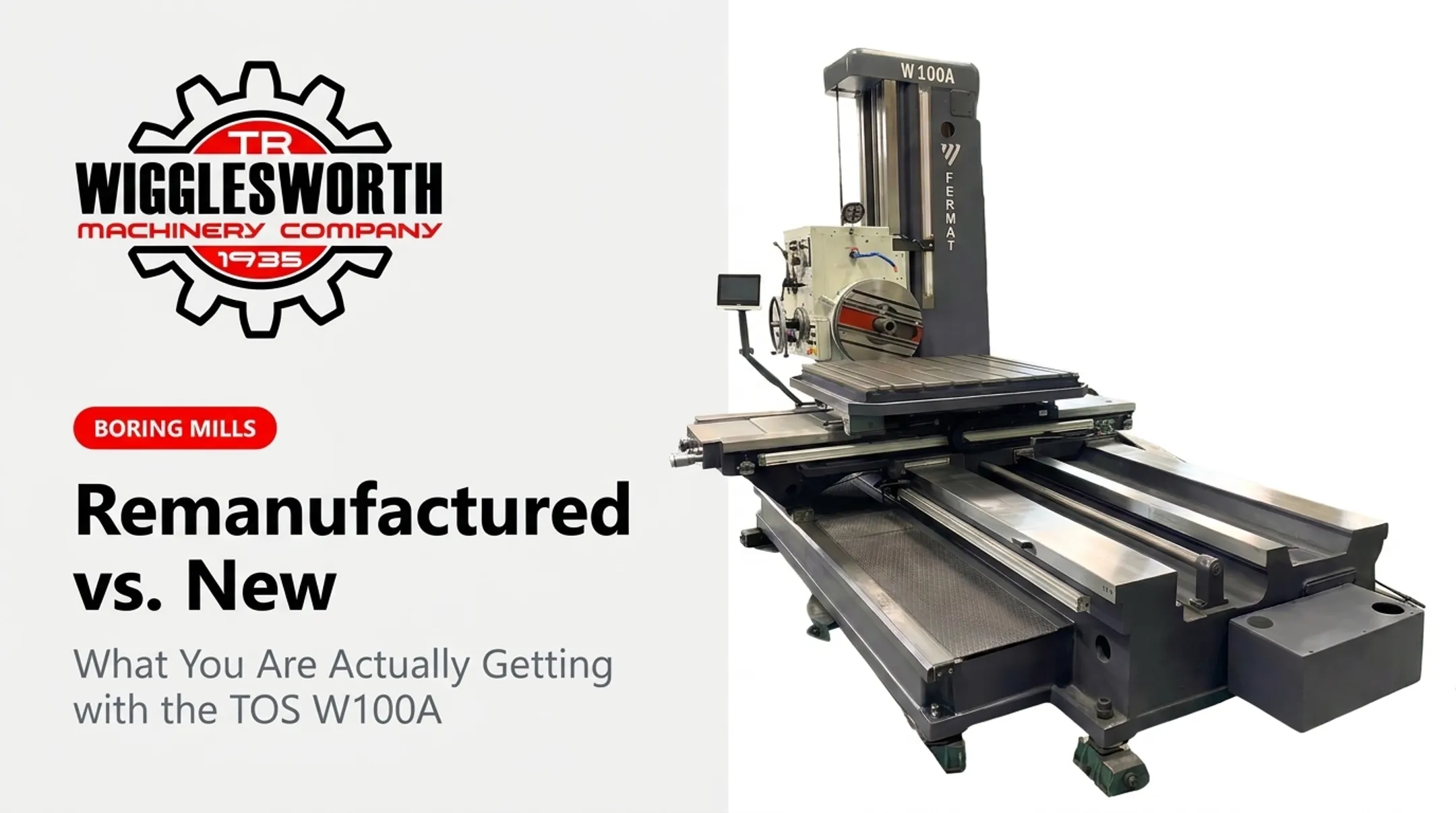
The TOS W100A is a horizontal boring mill generally selected for medium-to-large work that requires rigidity, reach, and accurate boring performance. Shops typically consider it when workpieces are too large, too heavy, or too accuracy-sensitive for lighter-duty machining methods, and when a part benefits from boring, facing, drilling, and milling in one setup instead of repeated rehandling.
Before you spec a job against this machine, get the current build sheet and configuration details for the specific unit you're evaluating, including table size, travels, spindle capability, and load rating.
What Line Boring Actually Means
Line boring machines two or more related holes so their centers share a controlled axis. That's different from ordinary single-hole boring, where the goal is simply hitting a diameter. With line boring, the objective is the relationship between bores, faces, datums, and how the finished part comes together in assembly.
Typical applications include:
- Engine blocks and main-bearing bores
- Gearbox housings and bearing seats
- Large fabricated frames and structural weldments
- Heavy machinery housings requiring aligned shaft bores
A horizontal boring mill like the TOS W100A is one possible platform for this kind of work. Depending on part size, tolerance, and site conditions, portable line boring or a different horizontal configuration might serve the job better. That's a decision worth making with actual drawing requirements in hand, not a machine catalog.
TOS W100A Applications: Where This Machine Fits Best
In real production environments, the TOS W100A earns its place on components that are difficult to reposition repeatedly or parts that benefit from multiple operations in one setup. Common applications include:
- Machining large gearbox housings
- Boring and milling pump casings and valve bodies
- Energy, oil and gas, and power generation components
- Mining and heavy equipment parts
- Finishing weldments and fabricated steel structures
- Machining machine bases, frames, and fixture plates
- Repair and remanufacturing of oversized industrial parts
Reducing setups matters on this class of work. Fewer setups can improve throughput, protect tolerances, and lower the risk of alignment errors on large workpieces.
What the TOS W100A Is Used For in Day-to-Day Production
From an operational standpoint, the TOS W100A handles heavy-duty tasks that are hard to do efficiently on smaller machining centers:
- Line boring and bore finishing on housings, castings, and large assemblies
- Facing flanges, mounting surfaces, and large flat areas
- Drilling and tapping heavy components where part movement is costly
- Milling complex surfaces on fabricated or cast workpieces
- Repair work where accuracy must be restored on worn industrial components
That versatility is one reason buyers keep the TOS W100A on their short list. Instead of moving a large workpiece from machine to machine, operators can often complete a wider portion of the job on a single platform, which translates into better part consistency and more predictable scheduling.
Industries That Commonly Benefit
The TOS W100A is especially relevant for operations serving:
- Heavy equipment manufacturing
- Mining
- Oil and gas
- Power generation
- Steel and metals processing
- General contract machining
- Industrial repair and rebuild
These industries deal with larger parts, tighter deadlines, and expensive material. In that environment, machine rigidity and the ability to hold accuracy on heavier work matter more than maximizing spindle speed or minimizing floor space.
Key Advantages of Line Boring
On the shop floor, the case for line boring shows up in alignment, quality, time, cost, and risk—not in brochure specs alone.
Improved Common-Axis Alignment
Machining related bores in one controlled setup helps maintain coaxiality. When bores are machined independently, on separate setups or separate machines, small errors compound. The result can be uneven bearing wear, binding, seal problems, vibration, or a part that simply won't assemble cleanly.
SKF's bearing-seat guidance draws a useful distinction for general industrial applications: housing seats typically use IT7 dimensional tolerances alongside IT6 total run-out tolerances, meaning bore size and geometric alignment are specified separately.
Get both right, or the diameter alone won't save the assembly. Watch these KPIs:
- Bore alignment and concentricity
- Cylindricity
- Bearing-seat condition
- Assembly fit
- Rework frequency
Better Control of Quality and Repeatability
A rigid setup, a defined datum strategy, and consistent tooling produce results you can repeat, shift after shift and part after part. That's harder to achieve when operations are improvised or split across disconnected machines.
Verify the bore relationship with appropriate metrology: calibrated gauges, probing, or precision measurement equipment matched to the tolerance on the drawing. Goltens' work on four large reel-hub bearing housings, with top bores at 2,100 mm ID, illustrates the process. The team laser-aligned the boring setup to a shipyard reference, ran post-machining laser checks, and secured approval from DNV, the owner, and the yard's own quality control.
That kind of inspection discipline, not just the cut itself, is what makes results defensible. Repeatability pays off in fewer rejected parts, more predictable fits, and a much simpler handoff between shifts or operators.
Reduced Lifecycle and Downtime Risk
Repairing or accurately remachining a valuable housing, frame, or structural component can avoid scrapping the whole assembly, provided engineering and material-condition checks confirm the part is actually repairable. Planned machining also reduces the guesswork tied to corrective fitting and repeated trial assembly.
Track these operational measures:
- Machine downtime and repair lead time
- Repeat visits or callbacks
- Scrap exposure
- Time from machining to final assembly
Line boring doesn't eliminate risk on its own. Distortion, inaccessible datums, damaged material, or an unsuitable machine envelope can still push you toward another process entirely.
Greater Suitability for Large or Complex Components
Those same risk factors grow with part scale. A horizontal boring platform earns its keep when a component's size, weight, or bore orientation makes conventional turning or small vertical equipment impractical. Whether the TOS W100A fits depends on the actual table size, travel, spindle capacity, and load rating of the configuration you're looking at, not the model name.
Shop-based machining tends to offer more rigidity, a more controlled environment, and more repeatable setups. Field or portable line boring reduces transportation and dismantling time when the part can't reasonably leave its installed location. Neither approach wins by default; it depends on the job.

More Informed Equipment and Process Decisions
Evaluating bore diameter, center distance, part weight, material, tolerance, surface finish, and production quantity up front prevents over-specifying (paying for capability you'll never use) or under-specifying (buying a machine that can't hold the tolerance).
A simple decision framework:
- Choose line boring when the primary requirement is a controlled relationship between bores.
- Consider another process when the job involves a single hole, needs extensive surface milling, or can't be securely referenced to a datum.
Before purchase or process selection, review utilization, setup time, throughput, first-pass yield, and cost per completed component.
What Happens When Line Boring Is Missing or Ignored
Treating related bores as unrelated features can produce alignment drift, difficult assembly, and uneven loading, even when each individual hole diameter measures within spec. The problem isn't visible until the parts try to go together.
Engine Builder has documented how bore misalignment can cause binding and premature main-bearing wear, sometimes worsening toward the center bearings.
That example is engine-specific, but the same mechanism—misaligned bores stressing bearings unevenly—shows up in gearboxes, housings, and other rotating assemblies.
Common operational consequences of skipping proper alignment work include:
- Repeated setup attempts
- Manual fitting on the shop floor
- Inconsistent results between parts
- Higher inspection burden
- Emergency repair work
- Rising scrap rates
Over-applying line boring is the other failure mode. When tolerance, datum access, or part geometry doesn't justify it, the process only adds cost and complexity. Match the method to the requirement—not the other way around.
Why Buy a New TOS W100A Instead of Waiting for Used Equipment?
Used horizontal boring mills can be attractive, but they aren't always the best answer. One of the strongest arguments for a new TOS W100A is predictability: less uncertainty around wear, prior maintenance history, and the hidden costs that often come with older equipment.
Key reasons buyers choose new:
- Known machine condition. You aren't inheriting unknown spindle hours, past crashes, or decades of wear in critical components.
- Better planning confidence. Quoting, scheduling, and long-term capacity planning are easier when the machine starts its life in your shop on a known baseline.
- Reduced refurbishment risk. Used boring mills can need alignment work, electrical updates, replacement parts, or geometry correction before they're production-ready.
- A stronger fit for demanding customers. If you run high-value work with little room for disruption, starting with a new machine is a sound risk-management decision.
Why Immediate Delivery Is a Major Advantage
Finding the right machine on paper is one thing. Getting it on your floor when you need it is another. Because T.R. Wigglesworth Machinery Co. has new TOS W100A machines in stock for immediate delivery, buyers can shorten the time between capital approval and production startup. That matters when:
- Your current boring mill is becoming a reliability risk
- You've won new work and need capacity quickly
- You want to avoid losing jobs to lead-time constraints
- You're replacing an older machine that no longer meets tolerance or uptime requirements
- You need to move before budget timing or customer demand changes
In heavy machining, delayed equipment delivery has a ripple effect. It can postpone staffing plans, slow quoting on larger parts, and force shops to keep outsourcing work they'd rather run in-house.
How to Get the Most Value from the TOS W100A and Line Boring
Begin with an Engineering Review
Start with the drawing: bore relationships, datums, material, stock allowance, surface finish, tolerance, and inspection method. Confirm whether the job is new manufacture or repair.
Then evaluate the TOS W100A against your actual work mix, not just your largest occasional part:
- What are the typical part sizes and weights you run each month?
- Are your bottlenecks related to boring accuracy, table capacity, setup time, or reach?
- Do your jobs involve large bores, multiple faces, or long components that benefit from fewer setups?
- How much production risk are you willing to accept with older used equipment?
- Would immediate delivery help you capture revenue faster?
Verify the machine's configuration against current documentation for the specific unit, including work envelope and table capacity; travel, spindle, and boring-bar capability; and control type and available accessories. Don't assume; verify.
Build a Stable Setup
Workholding, part support, datum transfer, and tool support all need to be locked down before you cut. A quick setup checklist:
- Confirm clamping won't distort the part, especially thin sections
- Verify fixture rigidity
- Ensure tool access and chip evacuation are clear
- Confirm coolant flow and safe operating clearances
Control the Process and Verify the Result
Run a staged process:
- Establish datums and verify alignment
- Rough machine where appropriate and leave a finishing allowance
- Complete the final cut
- Inspect each critical bore relationship

Match measurement and calibration practices to the tolerance on the drawing, not a generic figure borrowed from another job.
Review the Business Case and Avoid Common Buying Mistakes
Compare purchase, subcontracting, used-equipment acquisition, and portable or on-site machining using total cost, not sticker price alone. Factor in:
- Setup and transport
- Tooling and training
- Maintenance and calibration
- Inspection and downtime
- Expected utilization over the equipment's life
A few mistakes come up repeatedly when shops buy a boring mill:
- Buying only on price. The lowest upfront price can become the highest total cost if the machine needs unexpected correction or causes downtime.
- Overlooking setup efficiency. A machine that completes more operations in one setup creates value beyond simple spindle time.
- Ignoring delivery timing. A lower-cost option with a long wait may cost more in lost production opportunities.
- Not matching the machine to actual part work. Buy for the work you do regularly, not only the occasional extreme job.
For buyers balancing schedule pressure with capital discipline, a new in-stock TOS W100A can be easier to justify than a used machine that still needs inspection, transport coordination, and possible refurbishment before it earns revenue. Post-sale support matters too: T.R. Wigglesworth Machinery Co. has supplied new and used machine tools since 1935, along with parts, accessories, delivery, installation, and training that affect real operating cost.
Use Qualified Technical Support and Continuous Review
Operator training, preventive maintenance, tooling checks, and documented calibration keep equipment delivering repeatable results over time. After implementation, track first-pass yield, setup duration, rework rates, downtime, and cost per component. Those metrics confirm whether the process is performing as planned.

Who Should Seriously Consider a New TOS W100A?
A new TOS W100A makes the most sense for:
- Job shops expanding into larger, more complex work
- Manufacturers replacing an aging horizontal boring mill
- Operations bringing large-part machining back in-house
- Plants that need dependable heavy machining capacity without a long wait
- Buyers who want the benefits of a new machine and immediate availability
If your work involves large castings, housings, weldments, or critical bores, this machine belongs in the conversation.
Conclusion
The case for line boring rests on one idea: controlling the relationship between bores, not just enlarging a hole. That distinction matters more as parts get bigger, tolerances get tighter, and the cost of a bad fit climbs.
The TOS W100A remains a relevant choice because it addresses a need many shops still have: accurate, rigid machining on larger industrial parts with fewer setups. Whether it's the right platform depends on specs matched to the real part, including size, tolerance, material, setup, and volume. Skip that check and you risk overpaying for capacity you won't use, or buying too little machine for the job.
And while capability drives the search, availability often decides the purchase. T.R. Wigglesworth Machinery Co. has new TOS W100A machines in stock now for immediate delivery. If you're weighing equipment, tooling, installation, or training for line boring and heavy component work, our team can help match the TOS W100A to your parts and production needs.
Frequently Asked Questions
What is the TOS W100A used for?
The TOS W100A is a horizontal boring mill used for line boring, bore finishing, facing, drilling, tapping, and milling on medium-to-large parts such as gearbox housings, pump casings, valve bodies, weldments, machine bases, and heavy equipment components.
What is a line boring machine used for?
Line boring machines create, restore, or finish related bores along a controlled common axis in parts like housings, frames, gearboxes, and heavy machinery components. The goal is alignment between bores, not just diameter.
How much does line boring cost?
Cost depends on bore size, count and spacing, material, tolerance, setup, tooling, labor, and whether the work is done in-shop or on site. No single rate applies across jobs.
Is the TOS W100A suitable for line boring?
It can be, when the TOS W100A configuration matches the component's size, weight, bore layout, tolerances, and workholding needs. Confirm current capacity and travels for the specific unit before assuming fit.
What is the difference between line boring and regular boring?
Regular boring may finish a single hole to size. Line boring focuses on maintaining the required axis and relationship across two or more related bores in the same component.
Why buy a new TOS W100A instead of a used boring mill?
A new machine gives you a known condition, no inherited wear or crash history, and less refurbishment risk, which makes quoting and capacity planning more predictable. With in-stock availability, you can also avoid long lead times.
Is the TOS W100A available for immediate delivery?
Yes. T.R. Wigglesworth Machinery Co. currently has new TOS W100A machines in stock for immediate delivery. Contact the team for current availability and next steps.
When should a manufacturer choose portable line boring instead of a shop-based machine?
Choose portable line boring when removing or disassembling the component would cause excessive downtime. When transport is practical, a shop-based machine usually offers better rigidity, repeatability, and inspection control.