
That difference matters more than most buyers realize. A quoted lead time affects your production start date, customer commitments, installation schedule, and how much capital sits tied up before a single part gets cut.
Supplier delivery times across U.S. manufacturing have been stretching, not shrinking. The Institute for Supply Management's Supplier Deliveries Index hit 59.3 in August 2026, up from 58.9 in July. Any reading above 50 signals slower deliveries industry-wide.
This article breaks down what "in stock" and "built-to-order" actually mean for your timeline: delivery speed, configuration, cost, implementation work, and support risk, so you can match the right option to your production deadline.
Key Takeaways
- In-stock equipment can ship sooner, but shipping and production-ready aren't the same milestone.
- Built-to-order machines take longer due to engineering, sourcing, assembly, and testing.
- Total time to production includes freight, rigging, installation, and training, not just the ship date.
- The right choice depends on your deadline, specs, budget, volume, and supplier support.
In Stock vs. Built-to-Order: Quick Comparison
Here's how the two options stack up across the factors that drive your timeline:
| Factor | In-Stock | Built-to-Order |
|---|---|---|
| Delivery timing | Ships once availability, condition, and location are confirmed | Order review, engineering, manufacturing, and testing happen first |
| Configuration | Standard setup; you adapt your process to the machine | Specify controls, tooling, workholding, and automation before the build |
| Upfront cost | Lower entry cost; modifications may add expense later | Higher purchase price, offset by better fit and fewer later changes |
| Production readiness | Freight, rigging, install, and training still apply | Factory testing simplifies commissioning; site prep is still required |
| Supply/support risk | Missing accessories, parts availability, unclear used-machine history | Component shortages, engineering changes, schedule slips |
The gap between these two paths isn't small. The Association for Manufacturing Technology noted that machinery ordered in 2025 was expected to reach shop floors in the first quarter of 2026. Built-to-order timelines often span quarters, not weeks.
Compare that to T.R. Wigglesworth's FERMAT WFT-13, listed in stock now with installation and training included, against the FEMCO BMC-135TN, which starts with a specification review and price proposal before production even begins. Same category of machine, very different starting points.
What Is In-Stock Equipment?
In-stock machine tools are new or used machines that already exist. They're built, tested, and sitting at a supplier's facility, ready for near-term shipment. That's different from "available soon" or "in production," which describe equipment that hasn't shipped yet.
Because an in-stock machine skips the manufacturing queue, you move straight to freight, site prep, installation, and acceptance testing. T.R. Wigglesworth stocks machines such as the FERMAT WFT-13 horizontal boring mill, rated for workpieces up to 20 tons, when units are available in inventory.
In-stock equipment works well for:
- Replacing a failed machine before it stalls production
- Closing a short-term capacity gap
- Standard, repeatable machining work
- Projects with a firm deadline and little need for customization
Before buying, verify:
- Exact model, serial number, and control version
- Included accessories, tooling, and warranty terms
- Power requirements and condition, especially for used machines
- Inspection records and shipping point
- Expected dispatch date, confirmed rather than estimated
Who Buys In-Stock Machines
General machining shops, heavy manufacturing, and mold shops often lean on in-stock equipment for repeatable work. Aerospace and medical device manufacturers can too, but expect added documentation or traceability steps. IAQG's 9100 standard outlines configuration management and production-process verification clauses that may apply before a machine goes into service.
That same need for speed shows up on the shop floor. A Cleveland automotive plant needed equipment to grind fine tolerances on an irregular transmission cam. New machines were quoted at $18,000 each, with delivery a year out.
The plant sourced surplus Fellows gear slotters instead, converted with high-speed grinding spindles, at $1,700 each. The first converted machine was running within 30 days.

Before signing: confirm delivery method, installation scope, training, spare parts support, and acceptance criteria.
What Is Built-to-Order Equipment?
Built-to-order machine tools are manufactured or configured after you place the order. Specs are set around the performance, capacity, controls, automation, and tooling your application needs.
That customization is exactly what adds time. A built-to-order timeline typically includes:
- Technical review and quotation approval
- Engineering and configuration
- Component sourcing, including any long-lead items
- Fabrication, assembly, and factory testing
- Documentation, freight, and site commissioning
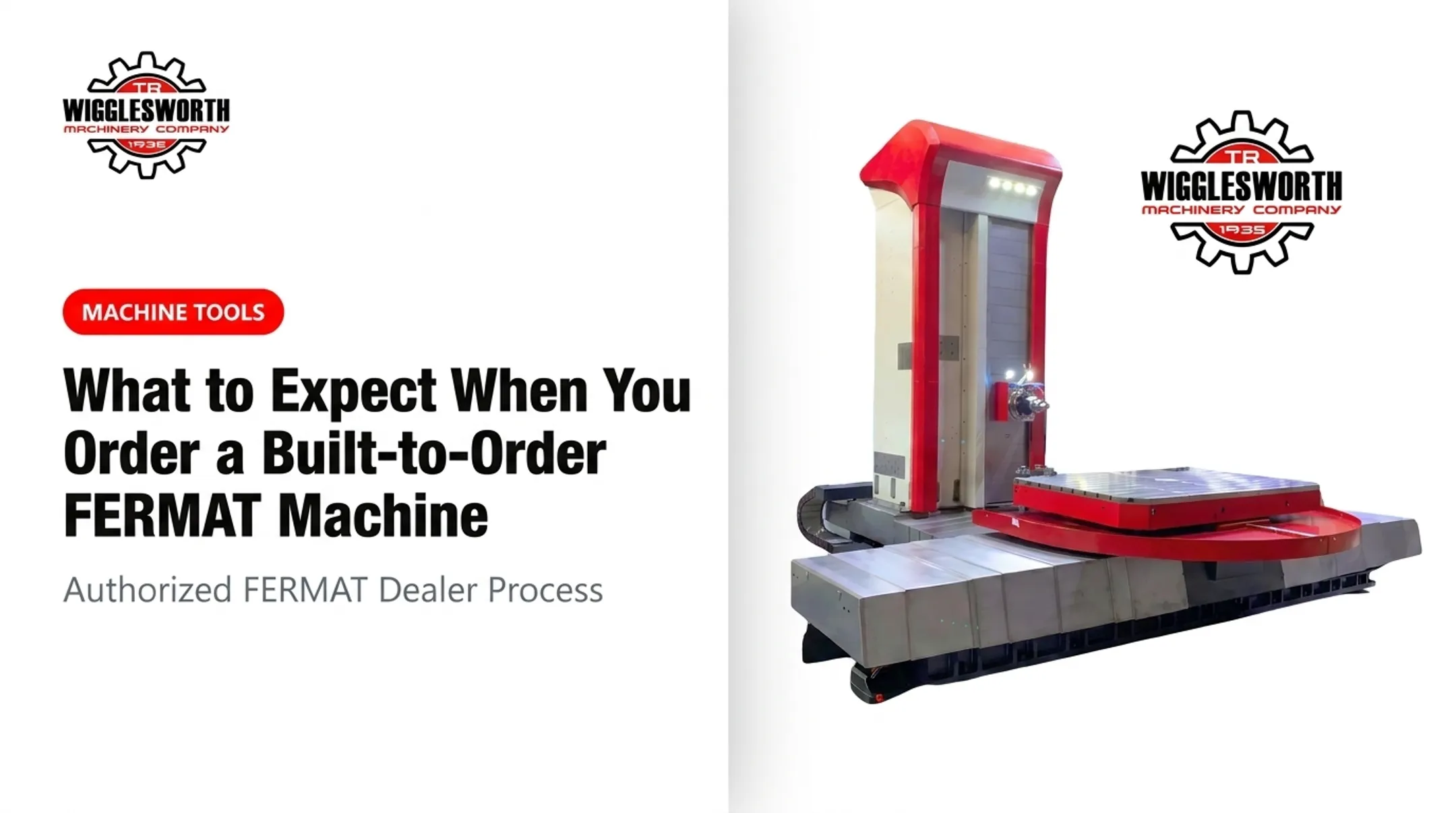
Real quotes show where the time goes. The FEMCO BMC-135TN starts with a specification review and detailed price proposal before production begins. The FERMAT WFT-11 quotes 90 days from purchase order and deposit—before freight and installation.
The payoff is fit. You match the machine to your work envelope, materials, tolerances, and floor layout instead of adapting the process to whatever is on the floor. The WFT-11, for example, offers 3-, 4-, or 5-meter X-axis extensions and multiple Y-axis options, so you spec the exact travel you need.
Use Cases of Built-to-Order Equipment
Built-to-order makes sense when off-the-shelf equipment would need major modification—specialized parts, unusual workholding, high-volume lines, integrated automation, or strict process control. It is common in aerospace, medical devices, mold machining, and heavy manufacturing, where documentation can stretch the schedule further.
That same logic shows up on the shop floor. Metal fabricator G.E. Mathis needed press brake capacity beyond a standard machine. Pacific Press built two custom 825-ton, 24-foot Fabri-K brakes with seven-axis backgauges and tandem operation, taking the shop from 40-foot parts to 48-foot tandem work.

How to Manage a Longer Built-to-Order Timeline
- Freeze specifications early and avoid late changes
- Approve drawings promptly to prevent schedule slippage
- Confirm material and long-lead component availability upfront
- Prepare your facility in parallel with the build
- Schedule operator training before delivery, not after
In Stock vs. Built-to-Order: What Is Better?
Neither option wins by default. The right call depends on your production start date, application complexity, budget, and how much waiting actually costs you.
Lean toward in-stock when:
- You need near-term capacity or emergency replacement
- The application is standard, not specialized
- You have a firm deadline with little room for delay
- You've verified condition, configuration, and support before buying
Lean toward built-to-order when:
- Your application needs specific capacity, controls, automation, or tooling
- Accuracy, integration, or documentation requirements rule out off-the-shelf machines
- You're planning for growth and want room to scale into the equipment
Compare total cost of ownership, not just purchase price. Include:
- Freight, rigging, installation, and utilities
- Training, tooling, and any modifications
- Maintenance, spare parts, and financing
- Downtime cost for every day production is delayed
Decision checklist:
- Required production start date
- Part, material, and tolerance requirements
- Work envelope and volume needs
- Automation and facility readiness
- Confirmed stock status from the supplier
- Warranty, parts support, and acceptance testing terms
- A contingency plan if timelines shift
Some buyers take a hybrid approach: bringing in a used or in-stock machine for immediate capacity while a built-to-order machine is engineered for long-term needs. It works, but watch for duplicative capital spending and the disruption of switching machines twice.
Whichever direction fits your requirements, talk through the specifics with someone tracking both new and used inventory. T.R. Wigglesworth Machinery Company can review available machines, built-to-order options, delivery timing, installation, training, and parts support against what you need to produce—without promising a date that hasn't been confirmed.
Real-World Examples/Case Studies
Real-World Examples
In-Stock Equipment: Fast Replacement Under Pressure
A Cleveland automotive plant needed to grind extremely fine tolerances on an irregular-tooth transmission cam. New machines were quoted at $18,000 each, with delivery tentatively set a year out. That timeline was too slow for the production schedule.
The plant turned to the surplus market instead. Converted Fellows gear slotters with high-speed grinding spindles sold for $1,700 each. The first machine entered service within 30 days, and the buyer went on to purchase nearly 20 more units for the line.
Takeaway: When schedule risk outweighs the need for a brand-new build, an available or converted machine can close the gap fast.
Built-to-Order Equipment: Custom Fit for a Capacity Ceiling
Metal fabricator G.E. Mathis needed press brake capacity beyond what a standard machine could offer. Pacific Press engineered two custom 825-ton, 24-foot Fabri-K press brakes with seven-axis backgauges and tandem operation. That setup let the shop handle parts up to 48 feet in tandem.
Takeaway: When application fit and long-term capability outweigh the wait, built-to-order pays off.
Both examples point to the same principle: match the equipment strategy to what's actually driving the decision: the calendar or the capability. T.R. Wigglesworth Machinery Company can help you sort through machine availability, delivery timing, installation, training, and parts support before you commit.

Conclusion
In-stock equipment shortens the path to shipment. Built-to-order equipment can deliver a much closer match to demanding production requirements. Neither should be chosen based on the ship date alone.
Calculate the complete time to production—from freight and rigging to installation, training, and acceptance testing—before you commit.
Before signing a purchase order:
- Verify actual availability
- Define your specifications clearly
- Plan site readiness in parallel
- Compare total ownership costs, not sticker price
- Confirm post-delivery support for parts, service, and training
Getting those details right upfront determines when your machine starts making parts, not just when it leaves the dock.
Frequently Asked Questions
How do I confirm a machine is truly in stock?
Ask whether the unit is on the floor now, what configuration it includes, and whether any holds or demos affect release. Get stock status and a realistic ship window in writing before you plan production.
What is the difference between an in-stock machine and a built-to-order machine?
An in-stock machine is already completed and available for near-term shipment. A built-to-order machine is manufactured or configured after purchase to meet requirements you specify.
Is an in-stock machine always faster to install?
Shipment may be faster, but freight, rigging, utilities, installation, programming, inspection, and training still determine when production actually begins. A ship date isn't a production-start date.
Why does a built-to-order machine take longer?
It requires engineering review, component sourcing, manufacturing or assembly, customization, factory testing, and documentation before it ever ships. Each step adds time to the schedule.
Is built-to-order equipment worth the longer lead time?
It often is when your application needs specialized capacity, automation, controls, tooling, accuracy, or documentation that an available machine can't provide. For standard work, the wait may not be justified.
What should I ask a machine tool supplier about lead time?
Ask for confirmed stock status, exact configuration, and order-to-ship timing. Also clarify delivery and installation responsibilities, site requirements, training, warranty, spare parts, and how schedule changes get communicated.